
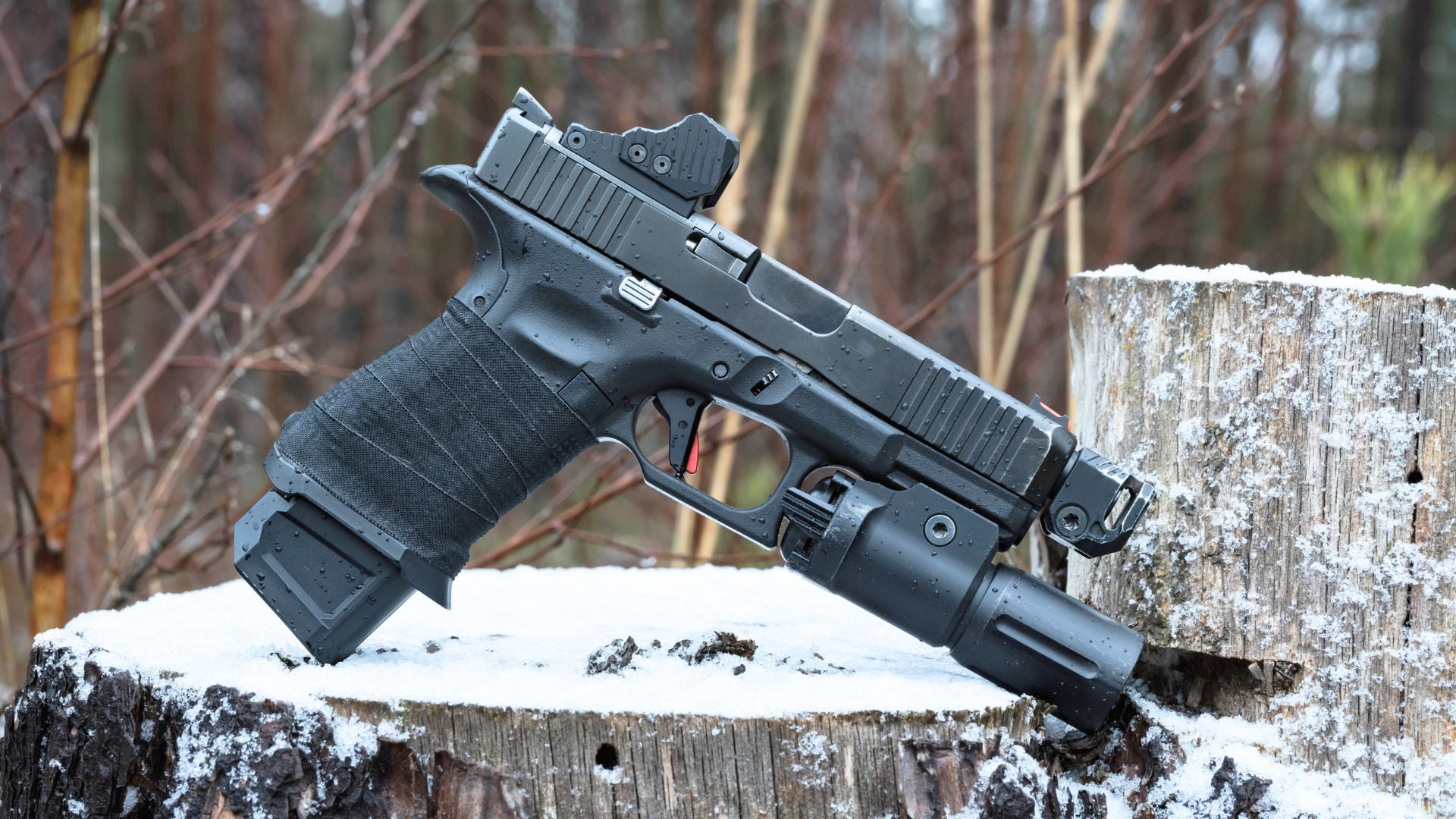
Photo credit: Dmitri T/Shutterstock.com
A lot of pistols get labeled as “tactical” these days, mostly because they come with an accessory rail, taller sights, or a threaded barrel. But when you strip away the marketing, many of these guns fall short once you start carrying them, training with them, or putting them through the same conditions regular shooters deal with. Some are too big for daily use. Others are too heavy, too finicky, or too feature-loaded to give you any advantage outside a controlled environment. Real-world shooting demands reliability, manageable recoil, intuitive controls, and ergonomics that work under stress—not features added to check a box on a spec sheet.
This list isn’t about bashing good guns. It’s about pointing out the ones that don’t line up with how most people actually carry or shoot. These pistols tend to impress on a static range or in flashy ads, but once you try running them through everyday scenarios, their shortcomings show up fast.
SIG Sauer P226 Legion

The P226 Legion is a beautifully built pistol, but it’s also a heavy, full-size handgun that doesn’t match up well with real-world carry. Once you add a weapon light, a loaded magazine, and a holster, the weight can wear on you by midday. Many shooters love how it handles during slow-fire drills, but the size makes it tough to conceal without printing.
The DA/SA system requires consistent practice to master, especially if you’re used to striker-fired guns. While the gun is easily accurate, the controls are placed in a way that doesn’t always favor fast, instinctive operation under pressure. It thrives as a duty or home-defense pistol but feels out of place as a “tactical” option for everyday use.
FN Five-seveN

The Five-seveN has a certain appeal, but the 5.7×28 round’s real-world performance doesn’t always match expectations. The pistol is large and lightly built, and the ergonomics feel unusual to many shooters. While the recoil is light, the trigger and long reach can make consistent accuracy harder than expected.
Another issue is ammunition cost and availability—two factors that limit practice time. A tactical pistol should be easy to run hard, but the Five-seveN feels more like a specialized tool than an everyday sidearm. It fits niche roles well, but in real-world defensive scenarios, the benefits don’t outweigh the bulk or the ammo limitations.
H&K Mark 23

The Mark 23 is legendary, but it’s enormous—far beyond what most shooters can reasonably carry or train with. The grip size alone eliminates a large percentage of shooters, and the length makes holster selection nearly impossible. It was built to survive extreme military testing, but those specs don’t translate well to normal defensive use.
Even though it’s accurate and reliable, the Mark 23 feels like you’re carrying a suppressed-duty pistol even when you’re not. Most shooters who try to run drills with it quickly realize how slow it is to draw and how unwieldy it feels. It’s a collector’s dream, but not a practical tactical handgun.
Glock 34

The Glock 34 is a solid competition pistol, but its extended slide and overall length become liabilities in tight environments. Many shooters find the front-heavy feel slower to transition between targets, and concealment is nearly impossible unless you’re wearing heavy layers.
In real-world training, the extra sight radius doesn’t provide a meaningful advantage for most defensive shooting distances. The long slide can also bind against certain holsters during seated positions. It’s a fantastic competition rig, but for a so-called tactical pistol, the size alone makes it tough to justify off the range.
SIG P320 X-Five Legion

The X-Five Legion is purpose-built for competition, and the tungsten-infused grip module adds noticeable weight. While that weight helps manage recoil on a flat range, it becomes a hassle in real-world carry. The longer slide and substantial build make the pistol far more than most people want hanging on their belt.
Even though it shoots beautifully, the trigger and ergonomics are tuned for controlled environments. When you’re moving hard, drawing from concealment, or wearing gloves, the oversized nature becomes obvious. For a tactical label, it feels more like a competition gun misplaced in a defensive role.
Walther Q5 Match Steel Frame

The Q5 Steel Frame delivers accuracy, but the weight is overbearing for anyone trying to run it as a defensive pistol. It’s smooth and stable on the line, yet impractical in nearly every real-world setting. The long slide and sharp edges make concealment and comfort a challenge.
While the trigger is excellent, the gun’s dimensions make rapid handling more demanding under stress. It performs better as a race gun, and that’s where it belongs. As a tactical pistol, it’s simply too large and too heavy for regular carry or fast deployment.
FN FNX-45 Tactical

The FNX-45 Tactical is a beast—big, tall, and wide. Even with its impressive capacity, the physical size makes it tough to grip comfortably for many shooters. The slide height changes the recoil impulse, and follow-up shots require more focus than people expect.
Once you add a suppressor or optic, the gun becomes even more cumbersome. It’s an excellent home-defense or duty pistol, but when you try running it in realistic conditions—moving, shooting from awkward positions, reloading under stress—it becomes clear how much it asks from the shooter.
CZ Shadow 2

The Shadow 2 is one of the best range pistols ever made, but it’s also nearly three pounds loaded. That alone puts it out of reach for realistic defensive use. It points naturally and shoots softly, yet the size and weight slow down draw times and reduce mobility.
Most shooters who attempt to carry it—even in training—realize the gun isn’t built for that role. It thrives on square ranges and structured competition stages. As a tactical tool, it’s simply too heavy and too tuned toward precision over practicality.
Springfield XD-M Elite Tactical OSP

This pistol offers capacity and features, but the tall slide and chunky frame don’t lend themselves to fast, natural handling. Many shooters find the grip angle awkward, and the trigger wall can feel unpredictable during rapid strings.
Add an optic, a light, and a loaded mag, and you end up with a noticeably overbuilt sidearm. The XD-M Elite runs fine on the range, but once you start incorporating movement, dark environments, or cold-weather gear, the ergonomics feel less forgiving than other platforms in the same category.
Beretta M9A3

The M9A3 is a durable pistol, but it’s still a large DA/SA handgun that demands practice to run efficiently. The slide-mounted safety can interfere with racking, and the grip size makes it tough for smaller-handed shooters to manage.
While the pistol performs well in controlled drills, the long trigger reach and the weight become disadvantages in real-world carry. It’s a proven system, but it doesn’t fit modern expectations for a tactical pistol meant for everyday defensive scenarios.
SIG Sauer P227

The P227 packs .45 ACP into a double-stack frame, but that design choice creates a wide grip that many shooters struggle to control. The weight and dimensions also make it difficult to carry discreetly. Under stress, the DA/SA system adds another layer of complexity.
While accurate, the pistol’s bulk and control layout feel dated when compared with modern striker-fired designs. It works well as a home-defense gun, but when people try to run it in tight spaces or from concealment, the shortcomings show quickly.
Glock 41

The Glock 41 brings a long-slide .45 ACP format to an already large platform. The extra barrel length doesn’t offer much benefit inside realistic defensive distances, and the slide length can snag on holsters during seated draws.
Many shooters find the front-heavy feel affects transitions, especially when moving laterally. The gun performs well on the line, but once you start training the way real encounters unfold, the size proves to be a hurdle rather than a help.
CZ P-09

The P-09 offers high capacity, but the massive grip and long slide make it difficult to handle for many shooters. The DA/SA trigger requires consistent training to master, and the gun’s length makes concealment nearly impossible.
Although it’s accurate, the large frame makes it feel unwieldy during dynamic drills. Shooters often find themselves working harder to control it compared to more compact options. As a tactical pistol, it brings more bulk than benefit.
Canik TP9 SFX

The TP9 SFX is another competition-oriented pistol that gets labeled as tactical, but the dimensions say otherwise. The oversized slide, extended barrel, and long sight radius are built for accuracy, not fast defensive handling.
The gun excels in flat-range practice but starts to feel sluggish during real movement or rapid transitions. Holster options for the SFX are also limited due to its size. It works well for what it was intended for, but that intention isn’t everyday defensive use.
SIG P320 M17

The M17 is a solid duty pistol, but its full-size grip and overall height make it tough to conceal comfortably. The long slide can feel slow during transitions, and the high bore axis creates more muzzle flip than some shooters prefer.
As a duty gun, it checks every box. But for real-world tactical scenarios involving concealment, movement, or cold-weather gear, the M17’s bulk becomes obvious. It’s reliable and capable, yet not the most practical “tactical” pistol for the average shooter.
Like The Avid Outdoorsman’s content? Be sure to follow us.
Here’s more from us:
The worst deer rifles money can buy
Sidearms That Belong in the Safe — Not Your Belt
*This article was developed with AI-powered tools and has been carefully reviewed by our editors.


