Photo credit: The Avid Outdoorsman
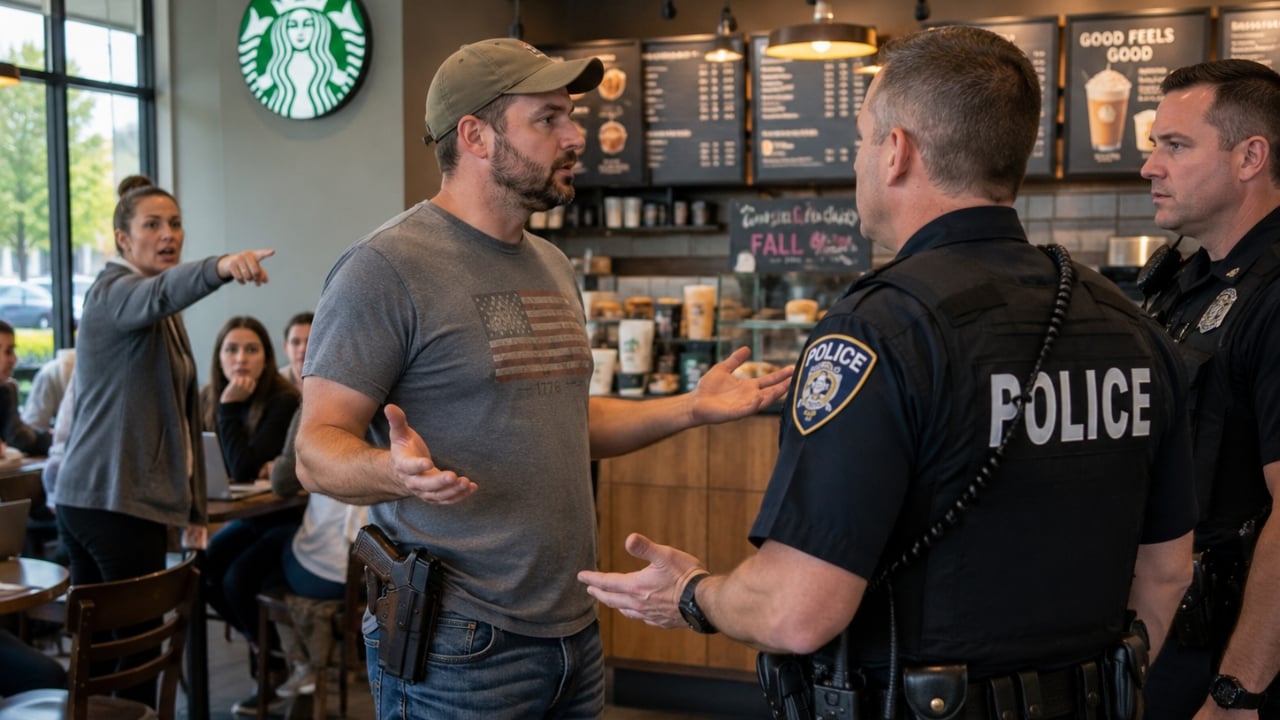
A gun owner in Reddit’s r/CCW described the kind of public carry moment that a lot of armed citizens think about long before it ever happens. In his post, he said he was open carrying at Starbucks when a woman noticed the gun, decided it was a problem, and called police. He wrote that this was his first real law-enforcement encounter as an armed civilian, and the whole thing played out in the middle of an ordinary coffee stop. The original Reddit thread is here: https://www.reddit.com/r/CCW/comments/978o4d/interesting_open_carry_leo_encounter_at_starbucks/. (reddit.com)
He gave a little background that mattered to the way he understood the situation. He said he open carried most of the time, liked the comfort, lived in a good neighborhood, worked in an even better one, and generally preferred the simplicity of seeing the gun on his belt instead of burying it under clothing. None of that sounded unusual to him. In his mind, he was in a state where open carry was legal, he was not acting strangely, and he was doing what he normally did. That is what made the call to police feel so jarring. He was sitting in a coffee shop going about a normal day while someone else in the room was apparently looking at him like a reason to bring in officers. (reddit.com)
The first twist in the story came when the responding officer walked in and immediately recognized him. According to the poster, the first officer to arrive was actually someone he knew from the range. The officer saw him, looked at the situation, and said something to the effect of, “Oh jeez, they didn’t call us for you, did they?” That line changed the tone of the encounter instantly. A woman in the store then stood up and said, “Yes, that’s him!” making it completely clear who she had called about. The officer got on the radio and canceled the two other units that had been headed that way, then told the woman that open carry was legal and that the police did not need to be called just because she saw a gun on someone’s hip. (reddit.com)
That is the part that probably stayed with the poster more than anything else. Up until the moment the officer recognized him, he had no idea how the contact was going to go. A police response in public, even when you know the law is on your side, still comes with a certain amount of tension. Somebody in the room has already decided you are a threat. The officers do not yet know who is right. There are other customers around, there is a woman apparently worked up enough to stand and identify him, and there is always that split second where you wonder whether the next few minutes are going to be routine or turn into something much more unpleasant. Then, suddenly, the first officer turns out to know him personally, and the entire encounter flips from uncertain to awkward in a completely different way.
The woman’s reaction is also what gives the story its shape. She was not someone grumbling quietly to herself or whispering to a cashier. She was engaged enough in the whole thing that when the officer questioned why he was there, she immediately answered that yes, the call was about the armed man in the store. That kind of moment matters because it shows the gap between legal carry and public comfort in the most direct possible way. The poster may have seen himself as one more ordinary citizen at Starbucks. The woman clearly did not. To her, the visible gun was enough to bring police into the room.
The poster made a point of saying that the officer handled it well. From his telling, the cop did not come in hot, did not escalate, and did not act like legal carry somehow stopped being legal because someone was nervous. He recognized the situation for what it was, canceled the extra units, and addressed the caller. That calm response probably kept the entire event from becoming a much bigger scene. Once the officer made it clear that the gun itself was not the issue, the energy shifted away from the carrier and back onto the misunderstanding around him. But that does not erase the social part of it. Even a calm police interaction in a coffee shop still puts the armed citizen under a spotlight most carriers work hard to avoid.
The comments under the thread reflected that split between law and public reaction. Some people focused on how fortunate the poster was that the first officer knew him and understood the law well enough to end things quickly. Others focused on the caller and the fact that a lot of people still react to a visible firearm like it is automatically a crime scene. Several commenters basically said this is one of the practical downsides of open carry: even when it is legal, it invites more public attention and more chances for someone to call police simply because they are uncomfortable. That did not mean everyone in the thread thought he was wrong to open carry. But a number of replies made it clear they saw the Starbucks incident as a preview of the kind of social friction that comes with it.
There was also the usual divide between people who prefer open carry and people who think concealed carry is almost always the smarter public option. The original poster openly admitted he liked open carry, partly for comfort and partly because he simply enjoyed it. Some commenters agreed with that and treated the woman’s reaction as the real problem. Others were less enthusiastic and pointed out that one reason many permit holders choose concealed carry is exactly to avoid turning an ordinary coffee stop into a police contact because someone across the room got spooked. The poster did not seem shaken out of his preference by the encounter, but the thread definitely turned into one more reminder that legality and public ease are not the same thing.
What makes the whole situation uncomfortable is how little control the carrier has once another person decides to escalate socially. He can follow the law. He can sit quietly. He can keep his hands to himself and do everything right. If someone else in the room sees the gun and decides it means danger, he is suddenly part of an incident anyway. That is what this Starbucks story really shows. Nothing in his account suggests he was drawing attention to himself or acting aggressively. The only thing that changed his afternoon was the fact that another customer could see the gun and did not like it.
The fact that the officer knew him added a strangely personal layer to the whole thing. On one hand, it probably made the contact go much more smoothly than it otherwise might have. On the other hand, it also turned his first law-enforcement encounter over open carry into the sort of story that is almost funny afterward only because it could have been much more serious. He went into Starbucks as an armed citizen getting coffee and wound up being identified to a responding officer by a stranger who wanted police to deal with “that guy.” Then the officer turned out to be someone who already knew exactly who he was.
That is where the story lands. A woman at Starbucks saw an openly carried gun and called police. Officers came in. The first one recognized the carrier from the range, canceled the backup, and told the caller that open carry was legal. The actual law side of the encounter may have ended quickly, but the social side did not disappear nearly as fast. Once a stranger stands up and says, “Yes, that’s him,” over a cup of coffee, the point has already been made: carrying legally in public does not always stop other people from treating you like the problem anyway.