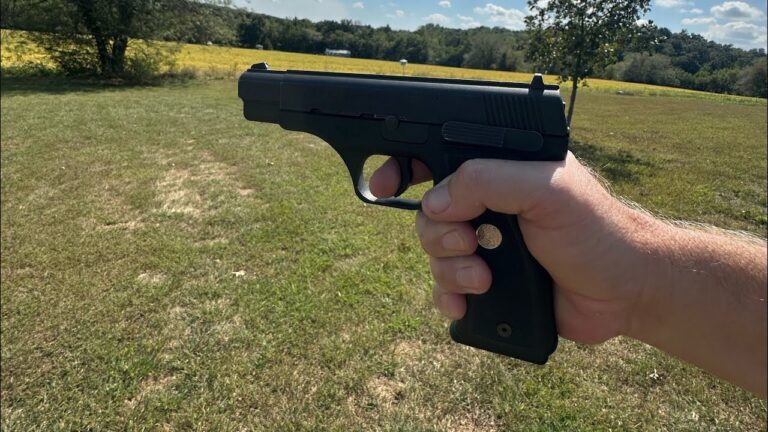
Photo credit: Ambrosia Studios/Shutterstock.com
Gun policy in the United States is being rewritten in real time, not by sweeping legislation but through a series of targeted courtroom fights. Those cases are already reshaping how governments can ban specific weapons, demand registration, and deploy enforcement tools that touch everything from immigration stops to ammunition possession. I want to trace how these disputes fit together, and what they signal about the next phase of battles over bans, registries, and the reach of federal and local power.
The D.C. lawsuit that puts bans and registration on a collision course
The Justice Department’s new lawsuit against Washington, D.C., is the clearest sign yet that the federal government is prepared to attack aggressive local gun restrictions from the inside. In Washington, a firearm cannot be legally owned unless it is registered, and it cannot be registered if it falls within the city’s broad definition of an “assault weapon,” a category that sweeps in AR-15 style rifles and other semiautomatic guns that are, by any measure, widely owned. By tying legal ownership to a registry that categorically excludes these rifles, the District has effectively combined a registration mandate with a functional ban, and the federal complaint argues that this structure collides with the Supreme Court’s insistence that arms “in common use” for lawful purposes sit at the core of the Second Amendment.
On its face, the case is about whether the District can outlaw a class of rifles that the Justice Department now describes as “unquestionably in common use today,” but the deeper fight is over whether a city can use its registration system as the choke point for that kind of prohibition. The federal filing in United States v. District of Columbia leans on statutory authority that lets the attorney general bring civil actions to address violations of constitutional rights, and it treats the registration-plus-ban scheme as exactly that kind of abuse. In parallel commentary, critics of the law have stressed that, in Washington, the registry is not a neutral recordkeeping tool but the gatekeeper that locks out a whole category of commonly owned firearms, a point underscored in detailed analysis of the District’s rules on what can and cannot be registered in Washington.
Why the Justice Department is attacking an “assault weapon” ban it once defended
For years, the federal government typically defended state and local gun restrictions when they were challenged in court, so it is striking to see the same Justice Department now arguing that D.C.’s “assault weapon” ban is historically ungrounded and arbitrary. The complaint frames the District’s list of prohibited features and models as a political judgment rather than a constitutional one, noting that the city has targeted rifles that function similarly to other semiautomatic firearms that remain legal. That argument tracks the Supreme Court’s recent insistence that modern gun regulations must be consistent with the nation’s historical tradition of firearm regulation, not simply justified by contemporary policy preferences.
In its briefing, the department leans on a federal statute that authorizes the attorney general to seek “appropriate equitable and declaratory relief” when jurisdictions infringe constitutional rights, and it applies that tool to a gun law for the first time in this way. The filing argues that the District’s ban sweeps in weapons that are “unquestionably in common use today,” language that mirrors the Court’s own description of protected arms and that appears in detailed critiques of the city’s approach to “assault weapons” as a category in recent analysis. For gun control advocates, that stance raises the unsettling prospect that a future administration could wield civil-rights enforcement powers not to expand regulation but to dismantle it.
How the NRA and political actors are framing the stakes
Outside the courtroom, the D.C. lawsuit has become a rallying point for national gun-rights groups and political figures who see it as a test of whether “assault weapon” bans can survive in the post-Bruen landscape. The NRA has highlighted the case as proof that the federal government now views AR-15 style rifles as protected arms, and it has cast the District’s law as a template that other cities might try to copy if it is not struck down. In that telling, the lawsuit is not just about one city’s rules but about whether local officials can use registration systems to quietly outlaw entire categories of firearms that remain legal elsewhere.
That framing has been amplified by commentary that folds the case into broader partisan narratives, including criticism of former vice presidential candidate Governor Tim Walz, whose record on gun regulation has been described as a “Bah Humbug” stance toward lawful ownership during the holiday season. One account of the Justice Department’s filing, introduced with the phrase “With the holiday season upon us,” uses Walz as a foil to argue that some Democrats still favor sweeping bans even as federal lawyers now challenge them in their coverage. As a result, the D.C. case is already doubling as a political litmus test, with advocacy groups on both sides treating its outcome as a signal of how far courts will let cities go in restricting specific weapons.
Trump’s Justice Department and the federalism twist
The lawsuit also reflects a striking federalism twist: President Donald Trump’s administration is suing a local government for being too restrictive on guns, rather than too lenient. According to reporting on the filing, the Trump administration has argued that D.C.’s ban on AR-15s and other semiautomatic rifles violates the Second Amendment and that the city’s registration rules compound that violation by making it impossible to legally possess those weapons at all. That posture puts the White House in the unusual position of using federal power to pare back local regulation in the name of individual rights, a move that could invite similar challenges to other city-level bans if it succeeds.
Coverage of the case notes that the Justice Department’s complaint was filed as part of a broader push by the Trump administration to reshape gun policy through litigation, not just legislation, and that it explicitly targets the District’s ban on AR-15s and other semiautomatic guns as an overreach in the nation’s capital. A separate account of the filing, attributed to the Associated Press, underscores that the administration is willing to take its own Justice Department into direct conflict with a Democratic city government, with the story noting that it was reported “By” the Associated Press and flagged as both “Updated Dec” and “Published Dec,” with the word “PUBLISHED” appearing prominently in the dateline. That level of national attention ensures that the case will be read as a broader referendum on how aggressively the federal government should police local gun bans.
Supreme Court signals: what gets reviewed and what gets left in place
While the D.C. case begins in a trial court, the Supreme Court is quietly shaping the boundaries of gun regulation by choosing which disputes to hear and which to leave on the cutting-room floor. Earlier this year, the Court declined to take up a challenge brought by the NRA and its lobbying arm, the ILA, to federal restrictions on short-barreled rifles under the National Firearms Act. That denial of review left in place lower court rulings that had upheld the NFA’s registration and tax requirements for those weapons, signaling that at least some longstanding federal regulations on specific firearm configurations remain safe for now.
The decision, described in coverage as “SCOTUS Denies Cert in NRA-ILA Challenge to NFA Short-Barreled Rifle Restrictions,” underscores that the justices are not eager to revisit every corner of federal gun law, even as they scrutinize newer state and local measures. The account notes that SCOTUS Denies Cert in NRA-ILA Challenge despite arguments that the NFA’s short-barreled rifle restrictions violate the Second Amendment, leaving those rules intact. At the same time, the Court has agreed to hear additional disputes over the scope of the right to bear arms, including a case added to the docket after The Supreme Court on Monday expanded its gun-rights calendar, taking up a challenge that grew out of a lower court decision in which the 5th Circuit upheld Judge Amos Mazzant’s ruling on a contested regulation over the summer. Together, those moves suggest a Court that is willing to refine the edges of gun rights but not yet ready to dismantle the entire architecture of federal firearms law.
Lower courts, unfinished receivers, and the future of enforcement
Below the Supreme Court, a dense thicket of federal cases is redefining what counts as a “firearm” and how far regulators can go in policing the gray market for parts and kits. One of the most closely watched disputes involves the Regulation of Unfinished Receivers, Frames and Firearms Parts Kits, litigated in a case captioned Bondi v. VanDerStok in the Supreme Court of the United States. That fight centers on whether the Bureau of Alcohol, Tobacco, Firearms and Explosives can treat partially completed frames and receivers as firearms for purposes of serialization and background checks, a question that goes directly to how effective any registration regime can be when hobbyists can build guns from components.
A comprehensive roundup of recent gun court rulings notes that the Bondi litigation is part of a broader wave of challenges to federal and state enforcement strategies, from magazine limits to sensitive-place restrictions, that are all being tested against the Supreme Court’s new historical-tradition standard in a detailed survey. As I read those cases together, I see a judiciary that is increasingly skeptical of novel enforcement tools that go beyond traditional prohibitions on possession by felons or in narrowly defined locations, but that remains open to regulations that can be analogized to longstanding practices. That tension will matter for any jurisdiction that tries to extend registration or tracking requirements to the component level, since courts are now asking whether there is any historical analogue for treating unfinished parts as regulated arms.
Who can be disarmed: from “habitual drunkards” to marijuana users
Another front in the current litigation wave focuses less on what weapons can be banned and more on which people can be barred from owning them. In Hemani, the U.S. Court of Appeals for the 5th Circuit relied on an earlier appellate decision to uphold a federal law that restricts gun ownership by “habitual drunkards,” reasoning that there is a historical tradition of disarming individuals deemed dangerous or irresponsible. That approach treats certain status-based prohibitions as consistent with the Second Amendment, so long as they can be tied to longstanding practices rather than modern policy judgments about risk.
The Supreme Court now faces a related question in a case challenging the federal ban on gun possession by people who use marijuana, and the ACLU has taken the unusual step of siding with the gun owner. In a filing described under the heading “ACLU Joins Supreme Court Challenge to Gun Ban for Marijuana Users,” the organization argues that the law unfairly targets individuals based on their past or current use of cannabis, even when they have no history of violence, and that it has led to their arrest for firearm possession in circumstances that raise civil-liberties concerns at the Supreme Cour. An analysis of the Court’s docket notes that, in Hemani, the 5th Circuit’s reliance on earlier precedent shows how lower courts are trying to navigate the new standard while still upholding some status-based bans, even as the justices are offered an “off-ramp” that would let them resolve the marijuana case on narrow grounds without rewriting the entire framework in Hemani and beyond. The outcome will shape how far Congress and the states can go in tying gun rights to lifestyle choices rather than criminal convictions.
Immigration, policing, and the outer edge of enforcement power
Gun policy does not exist in a vacuum, and some of the most consequential recent rulings involve enforcement tactics that spill over into other areas of law. In Los Angeles, a Supreme Court decision has allowed immigration agents to conduct more aggressive stops, prompting the ACLU to warn that the ruling will enable “indiscriminate ICE stops” that rely on racial profiling. The organization contrasted that outcome with a prior case, Noem, that bars immigration agents from stopping individuals without reasonable suspicion and from relying solely on four factors that had been used as proxies for immigration status, arguing that the new decision erodes those protections.
In a public statement, the ACLU emphasized that the Court’s ruling would make it harder to challenge stops that are based on appearance rather than behavior, and that it could embolden agents to expand their presence in neighborhoods already wary of law enforcement in Los Angeles. Although the case is not about firearms directly, it illustrates how the Court is willing to tolerate broad enforcement discretion in some contexts even as it scrutinizes gun regulations for historical grounding. That contrast matters because many gun laws are enforced through street-level encounters, and a judiciary that blesses expansive stop powers in immigration cases may be less inclined to rein in similar tactics when they are used to search for weapons.
State-level resistance and the limits on Trump’s deployment power
As federal courts reshape the rules for bans and enforcement, state and local officials are testing how far they can push back against President Trump’s use of federal power. In one high-profile dispute, Top attorneys for Illinois and Chicago said Trump has overstepped his authority in seeking to deploy federal resources in ways they view as intrusive, and They were joined by officials from Los Angeles and other jurisdictions who share those concerns. That coalition reflects a broader anxiety among blue-state leaders that federal law enforcement initiatives, including those framed as responses to crime or unrest, can be used to sidestep local preferences on policing and public safety.
Coverage of the clash notes that the U.S. Supreme Court has, in a separate context, refused to let President Trump deploy certain tools he sought, signaling that there are judicial limits on how far the executive can go in overriding state and local objections in that dispute. A related report, summarized under the heading “The Brief,” describes how a federal appeals court paused the release of more than 600 immigrants detained during a Chicago-area immigration operation, a move that affected up to more than 4,000 arrests and underscored the judiciary’s role in checking both federal enforcement zeal and local resistance in Chicago. For gun policy, those episodes are a reminder that the same courts now weighing the fate of “assault weapon” bans are also refereeing high-stakes fights over who controls on-the-ground enforcement.
What these fights mean for everyday gun owners and defendants
For people who live under these shifting rules, the practical stakes are immediate. In California, for example, Proposition 36 enhances penalties for repeat gun-related offenders, and state authorities have leaned on databases like the Armed Prohibited Persons System to identify individuals who are barred from possessing firearms. Trends show increased APPS enforcement, with more seizures from people flagged as prohibited, and those efforts intersect with federal laws such as 18 USC 922(g) that add layers of liability for non-citizens and others who fall into disfavored categories.
Defense lawyers in places like Los Angeles now routinely advise clients that ammunition possession alone can trigger serious charges if they are already on the wrong side of these overlapping bans and registries, and that even technical violations can carry steep consequences under enhanced sentencing schemes in cases shaped by Proposition 36 and APPS. When I put that reality alongside the D.C. lawsuit, the Supreme Court’s selective docket, and the ACLU’s warnings about enforcement overreach, I see a legal landscape in which bans, registration, and policing are converging into a single, contested question: not just who may own which weapons, but how far the state can go in finding, disarming, and punishing those it decides should not have them.
Like The Avid Outdoorsman’s content? Be sure to follow us.
Here’s more from us: