Photo credit: Militarist/Shutterstock.com
The AK-47 is one of those rifles that almost disappeared under its own reputation. Everybody knows it is famous. Everybody has heard some version of “rugged,” “simple,” and “everywhere.” But once you dig into the history, a lot of the details people repeat are either half-true, oversimplified, or missing the more interesting part of the story. The Kalashnikov rifle was officially adopted by the Soviet Army on June 18, 1949, and Kalashnikov Group now says more than 100 million AK-pattern rifles of all variants have been produced worldwide.
What makes the AK-47 worth revisiting is that the real story is bigger than the clichés. It was not just one man sketching a perfect rifle in a hospital bed and instantly changing the world. It came out of postwar Soviet thinking about intermediate cartridges, multiple design iterations, and later production changes that led directly into the AKM and beyond. Here are 15 surprising facts about the AK-47 that most people never really get told straight.
1. The AK-47 was officially adopted in 1949, not 1947

A lot of people assume the “47” in AK-47 means that is the year the rifle entered service. It does not. Kalashnikov Group says the rifle was adopted by the Soviet Army on June 18, 1949, officially as the “7.62-mm Kalashnikov rifle (AK).” The “47” points back to the 1947 design stage, not the adoption date.
That is one of the most basic AK facts, and it still gets blurred constantly. The name and the service date are connected, but they are not the same thing. The rifle’s development and its formal military acceptance were two different steps.
2. The hospital-bed origin story is heavily oversimplified

The romantic version says Mikhail Kalashnikov was wounded, lying in a hospital bed, had a flash of inspiration, and basically invented the AK-47 in one burst of genius. American Rifleman’s “Foreign Weapons 101” says that story is not how it really happened, noting that Kalashnikov did not get it right until his sixth prototype.
That does not make Kalashnikov less important. It makes the real story more believable. The AK-47 was not the result of one magical sketch. It was the result of repeated development, revision, and testing until the design matured into something the Soviets could actually use.
3. The AK-47 was built around the Soviet intermediate cartridge idea

The AK-47 did not appear in a vacuum. The NRA Museum’s firearms history says the Soviets had already embraced the lower-power intermediate-cartridge concept with the 7.62×39 mm round before following it with the Kalashnikov-designed AK-47.
That matters because the rifle was part of a bigger shift in military thinking. The Soviets were moving away from the old full-power rifle-cartridge model toward something that better fit controllable fire and practical infantry use. The AK-47 made the most of that cartridge idea instead of inventing it from scratch.
4. The rifle borrowed ideas from more than one earlier gun

People sometimes talk about the AK-47 as if it was either a total original or a straight copy of the German StG44. Neither version really gets it right. American Rifleman says Kalashnikov combined elements of the M1 Garand’s gas-operated, long-stroke piston design with the more compact StG44 assault-rifle concept.
That is a much better way to understand the rifle. The AK was not one clean-room invention or one direct clone. It was a practical synthesis of ideas that already existed, shaped into something that fit Soviet priorities very well.
5. Early AK-47s were not all stamped-sheet-metal guns

A lot of people think the AK-47 was always the classic stamped-steel rifle. The history is more complicated. American Rifleman’s AKM article says the original stamped-receiver approach appeared in 1947, but production realities pushed the Soviets toward milled receivers in the interim before they later returned to stamping with the AKM.
That surprises a lot of shooters because “cheap stamped AK” is such a strong part of the modern image. In reality, the Soviets had to work through manufacturing problems before they fully got where they wanted to go. The production story was not as simple as the legend makes it sound.
6. The AKM is not just an AK-47 with a different name

Many casual shooters use “AK-47” for basically every classic 7.62×39 Soviet-pattern rifle. That is sloppy. American Rifleman says the AKM brought major changes, including the return to a stamped-sheet-metal receiver and updated production methods, even though the rifle kept the same long-stroke gas-piston operating principle.
That means the AKM is part of the same family, but it is not just a trivial rename. It was a meaningful production and design evolution, and in practice many of the rifles people casually call “AK-47s” are actually AKM-pattern guns or later descendants.
7. The AK-47’s operating system is still pretty specific

People often describe the AK as “simple,” which is true, but that vagueness hides the actual mechanics. American Rifleman describes the AK pattern as gas-operated, using a long-stroke piston and a rotating bolt.
That matters because simplicity is not the same thing as crudeness. The rifle became famous for rugged operation, but it still relies on a very specific operating system that has proven durable across decades of military use and many national variants.
8. The AK-47 family is likely the most widely produced rifle pattern in history

Kalashnikov Group says more than 100 million units of AK rifles and variants have been produced, while American Rifleman called the AK family a design with more than 75 million examples in one 2024 historical piece. The exact total depends on how broadly you count family variants, but the overall point is the same: the scale is enormous.
That level of production is one of the most surprising AK facts if you stop and think about it. The rifle is not just “common.” It is one of the defining military long-arm patterns on the planet.
9. The rifle became globally important because it was easy to produce and distribute

The AK-47’s reputation is not only about field performance. The NRA Museum’s broad history says the rifle earned a reputation for relatively cheap production and for reliability even under adverse conditions or neglect.
That combination is a huge part of why the rifle spread so widely. A gun that is rugged but difficult to build stays limited. A gun that is rugged and can be produced in huge numbers by aligned states and factories becomes a global presence. The AK-47 did the second thing.
10. The “AK-47” people picture today is often actually a later pattern

This is one of the biggest AK misconceptions. American Rifleman’s review of a PSA AK-103 says the Russians effectively moved on from the AK-47 and AKM after the adoption of the AK-74, with later series evolving from that line.
So when people say “AK-47” today, they often mean the whole visual family of Kalashnikov rifles rather than the original 1949-adopted pattern specifically. That is understandable in casual conversation, but it blurs a lot of real history.
11. Mikhail Kalashnikov was working in Soviet arms testing circles before adoption

Kalashnikov did not create the rifle from nowhere while totally outside the system. Kalashnikov Group’s 2024 anniversary note says that by 1942 he had been assigned to the Central Research and Proving Ground for Small Arms of the Red Army’s Main Artillery Directorate.
That helps explain how the project matured. He was not simply a random soldier tinkering in total isolation forever. He was moving inside the Soviet small-arms development world, where prototypes could be developed, tested, and refined in an actual institutional setting.
12. The AK-47’s legend partly hides how much iteration mattered

One reason the AK myth got so big is that the rifle feels inevitable in hindsight. But American Rifleman’s 2010 piece is clear that the successful AK-47 was the result of multiple prototypes, not one perfect first attempt.
That is actually one of the most surprising AK facts because it makes the rifle’s success feel more human and less mystical. The design that conquered the world was refined into shape. It was not dropped into history fully finished.
13. The rifle’s family tree became much more complex than most people realize

The AK-47 name is famous, but the family after it became much broader. American Rifleman’s AK-103 review points to the later 100 series, while also noting that those guns are internally quite different from the older AK-47 and AKM lineage and were based more on the AK-74M.
That means “AK” is really a family story, not one static rifle story. Once you move past the original pattern, you are in a world of national variants, production differences, caliber changes, and internal evolutions that most casual observers never notice.
14. The AK-47’s simplicity is one reason people misuse its history

Because the rifle is simple and rugged, people often turn it into folklore. That is exactly why so many myths stick to it: one-prototype genius, direct StG44 copy, magical indestructibility, and so on. The combination of the NRA Museum’s broad history and American Rifleman’s myth-correcting coverage makes clear that the real story is more grounded—practical, iterative, and tied to specific Soviet military needs.
In other words, the AK is impressive enough without turning it into a fairy tale. The facts are already strong. The myth just tends to shout louder.
15. The most surprising fact may be that the AK-47 became bigger than the Soviet Union itself
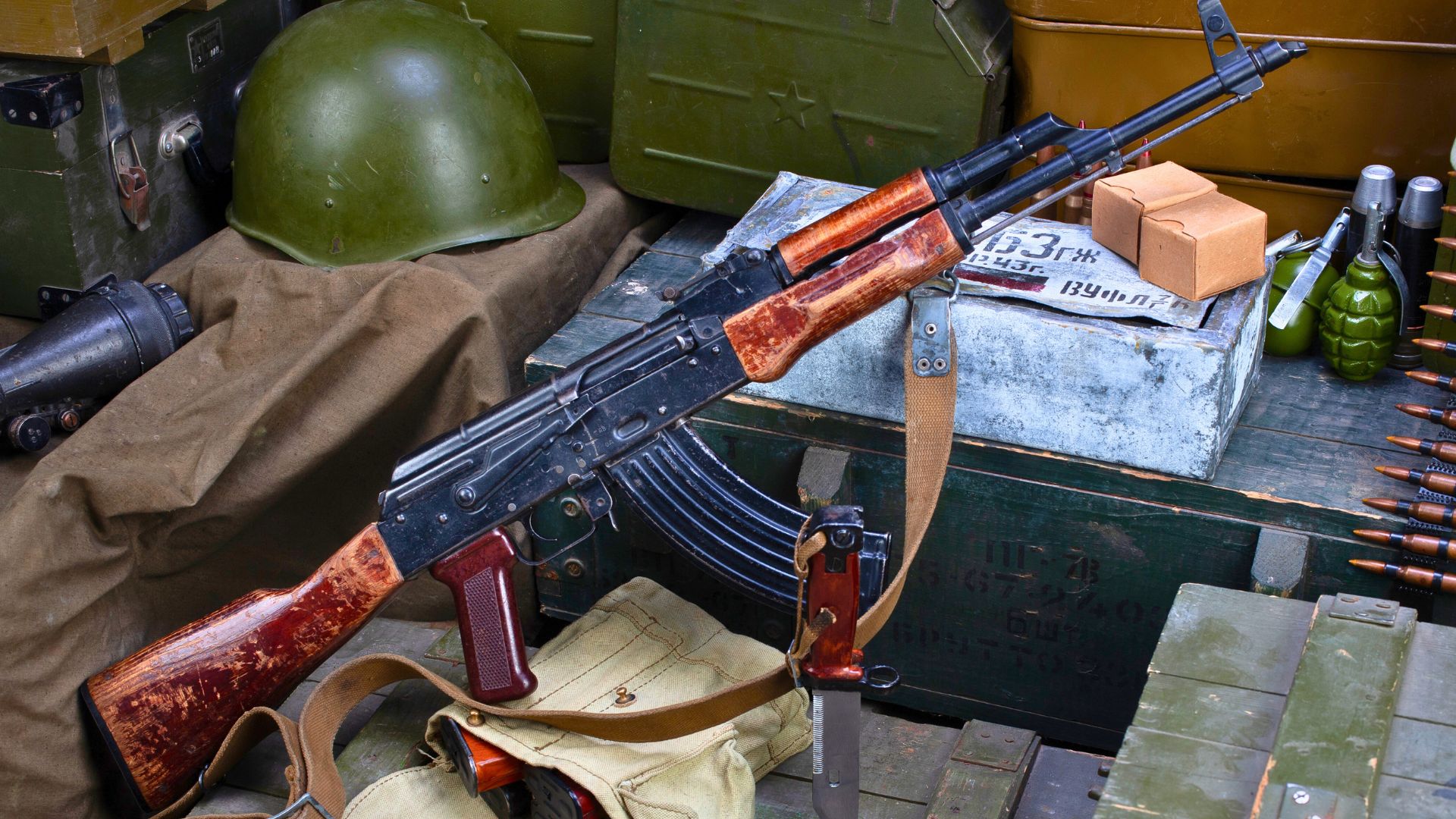
The Soviet Union adopted the rifle, shaped its early production, and made it globally influential. But the AK-47 long ago outgrew any one state or one era. Kalashnikov Group says AK variants are in service in 106 countries, and the family has remained one of the defining military-rifle patterns of the modern world.
That is probably the biggest surprise of all. Plenty of Cold War weapons stayed trapped in their own time. The AK-47 became a worldwide symbol, a military tool, a political image, and a design family all at once. Very few rifles ever reach that level of cultural and historical spread.
Like The Avid Outdoorsman’s content? Subscribe to our newsletter so you never miss an article.
Here’s more from us: