Photo credit: Creeping Things/Shutterstock.com
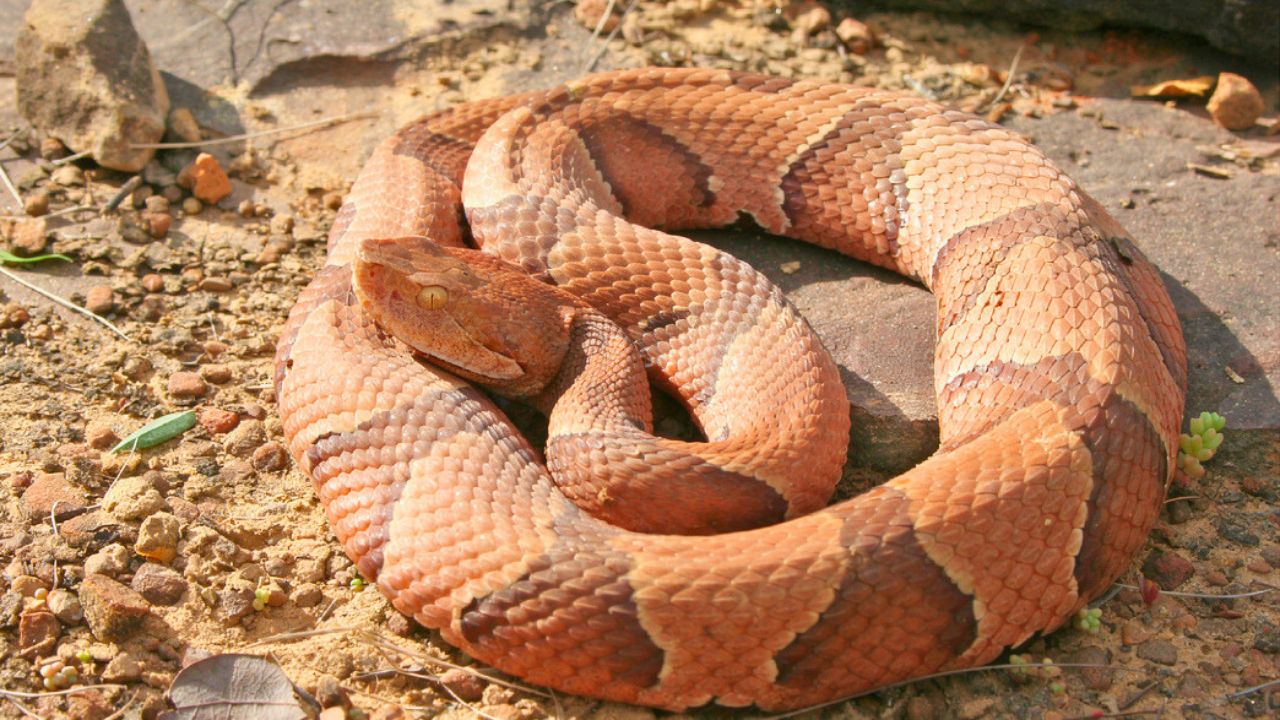
Copperheads get missed for one big reason: they are built to disappear. Texas Parks and Wildlife says their coloring blends so well with leaves on the ground that it is possible to be looking right at one and still not see it, which helps explain why so many bites happen when somebody sits down too fast, reaches under something without checking, or steps where they cannot clearly see. Officials also note that most bites happen when people take unnecessary risks around venomous snakes, not because the snake came looking for a fight. That is the part people get wrong. A copperhead usually is not announcing itself. More often, it is already there, tucked into cover, staying still, and letting camouflage do the work.
The ground suddenly starts looking perfect for a copperhead
If you are walking through leaf litter, brush piles, loose rock, hollow logs, creek edges, or weeded-over ground, you are already in the kind of place where you need to slow down. Texas Parks and Wildlife says snakes are attracted to loose rock piles, large brush piles, hollow dead logs, and areas where leaf litter has piled up, while its copperhead guidance specifically points to rocky areas, wooded bottomlands, stream edges, and weedy lots as places where copperheads turn up. That does not mean every brush pile has a venomous snake in it, but it does mean the setting itself is a warning sign. When the cover looks cool, shaded, messy, and undisturbed, that is exactly when people need to stop walking like they are crossing a clean driveway and start treating the ground like something could be using it for shelter.
You stop hearing or seeing what should be there
This is not a hard science rule, but it is a real woodsman clue. When a spot looks like it should be alive with small movement and instead feels strangely still, pay attention. Copperheads are ambush predators, and they do well in places where prey moves through thick cover, edges, and ground clutter. Official guidance leans more on habitat than on “reading the woods,” but the overlap matters: the same conditions that hide a copperhead also create those uneasy spots where you are stepping blind into perfect concealment. If the grass is high, the leaves are deep, the rocks hold shade, and you cannot clearly see where your next boot is landing, that is enough of a sign by itself. Shenandoah National Park warns visitors to be careful in dead leaves and around logs because snakes can be hidden underneath, and Texas Parks and Wildlife warns not to step or reach until you can see the bottom. That is practical advice, not overreaction.
You are about to step over a log, board, or rock ledge
This one gets people in trouble all the time. A lot of folks step over a log or reach to flip something without thinking about what is resting on the other side, underneath, or around it. Texas Parks and Wildlife is blunt about this: never step over a log without first seeing what is on the other side, and if you need to move a log, use a long stick or tool first. The same agency also warns not to reach into burrows or hidden spaces without checking. Copperheads love the kind of cover people casually mess with during yard work, fence work, clearing brush, and quick walks through timber. If you catch yourself about to put a hand where your eyes have not been yet, that is one of the clearest signs a copperhead could be closer than you think. Most close calls start exactly there.
It is dusk, dark, or one of those warm low-light hours
Copperheads do not need full darkness to become harder to spot. Once the light gets soft, their camouflage gets even better, and the chances of a careless step go up fast. Shenandoah National Park warns that snakes are active at night and says visitors should use a flashlight or headlamp after dusk. CDC guidance for outdoor workers also warns that snakes tend to be active at night and in warm weather. That matters for people on rural property because a lot of the risky moments happen during normal evening routines, not some dramatic backcountry hunt. Walking to the barn, checking a gate, carrying feed, taking out trash, or turning dogs loose after sunset is all it takes. If you are moving through grass, brush, or around structures in low light without a beam on the ground, you are gambling more than you think.
Your dog is locked onto one spot and acting wrong
A dog does not know the word “copperhead,” but a good dog often knows something living is tucked into cover before you do. If your dog suddenly freezes, stares hard at one patch of leaves, refuses to move past a certain spot, or starts giving an area way too much attention, do not brush it off. The safest move is to assume there is something there until proven otherwise. National Park Service guidance tells visitors to keep pets on a leash around snake habitat for a reason. Dogs investigate with their noses and feet, and that is a bad combination around a well-camouflaged snake. A dog acting strange by a woodpile, rock border, brush edge, or trail shoulder is not proof of a copperhead, but it is definitely a sign to stop, look carefully, and widen the gap.
You catch a shape that does not quite fit the leaves
A lot of copperhead sightings happen only because somebody notices one small visual detail that does not belong. Maybe it is the heavy body shape folded in a tight curve, maybe it is the banding pattern breaking up the leaves, or maybe it is just a section of ground that looks too symmetrical to be random. Texas Parks and Wildlife notes that copperheads blend in so well that people can stare right at one without seeing it. That means you usually are not looking for a dramatic coiled snake in the open. You are looking for a small inconsistency in the ground. The more leaf litter, patchy sunlight, and broken color you have, the easier it is to miss. That is why experienced people tend to slow down around edges, scan twice, and trust that weird little feeling when something on the ground does not look quite right.
You hear movement, but it is not the warning you expected
One mistake people make is assuming a venomous snake will always give some loud, unmistakable warning before things get serious. Texas Parks and Wildlife specifically warns against relying on that kind of thinking with snakes in general, noting that the danger comes when they are surprised or cornered. Copperheads are especially bad snakes to underestimate this way because their best defense is often to stay put and rely on camouflage. In other words, the “sign” may not be a sound at all. It may be the absence of one. If you hear a faint rustle in dry leaves and then cannot relocate the source, do not charge in closer to solve the mystery. Stop, scan, and back your eyes out across the ground. A copperhead does not need to make a scene to be dangerously close.
You are working with your hands near ground cover
Weeding, moving firewood, clearing brush, reaching into equipment, grabbing feed sacks off the floor, lifting old tin, and pulling boards off the ground are all the kind of chores that create bad copperhead moments. CDC guidance tells workers to wear boots and long pants, avoid tall grass and piles of leaves when possible, and wear leather gloves when handling brush and similar material. Texas Parks and Wildlife gives similar advice and says not to reach into holes, crevices, or hidden spots without checking first. That is worth taking seriously because copperhead bites often happen during quick work, not long hikes. People get casual around home because the setting feels familiar. But a familiar yard with stacked lumber, storm debris, old boards, and warm cover can be exactly the place where a copperhead goes unseen until a hand is already committed.
What to do the moment you think one is there
If you suspect a copperhead is nearby, the smartest move is not heroic at all. Texas Parks and Wildlife says to freeze when snakes are known to be nearby until you know where they are, then allow the snake to retreat, and if you must move, back away slowly and carefully. The agency also says snakes generally do not chase people and most bites happen when humans push the situation. That lines up with National Park Service advice to leave snakes alone and give them a wide berth. The goal is not to identify it from two feet away or prove you are calm under pressure. The goal is to avoid that last careless step. Most of the time, once you stop crowding the snake and start giving it room, the situation settles down fast.
If you do get bitten, move fast and keep it simple
If a copperhead bite does happen, do not waste time on cowboy nonsense. CDC guidance says to seek emergency medical attention as soon as possible, keep calm, and avoid driving yourself because venomous bites can make you dizzy or cause you to pass out. The CDC also advises keeping the bite below heart level if possible, removing rings or jewelry before swelling starts, washing the wound, covering it with a clean dry bandage, and getting to the hospital quickly. It also says not to use a tourniquet and not to try sucking venom out. If you can safely photograph the snake from a distance, that may help with treatment, but chasing it or trying to kill it is a bad idea. The simple version is this: create space, stay calm, call for help, and get real medical care.
The biggest trick copperheads have is not speed or aggression. It is the fact that they fit into the background so well that people do not treat the spot seriously until they are already too close. That is why the best warning signs are usually not dramatic. They are ordinary things: a shady brush pile, dead leaves around a log, a dog fixated on one patch of ground, low light at the edge of the yard, or your own hand reaching where your eyes have not checked yet. Once you start noticing those conditions for what they are, you are far less likely to blunder into the kind of close-range surprise that causes most problems in the first place.
Like The Avid Outdoorsman’s content? Subscribe to our newsletter so you never miss an article.
Here’s more from us: