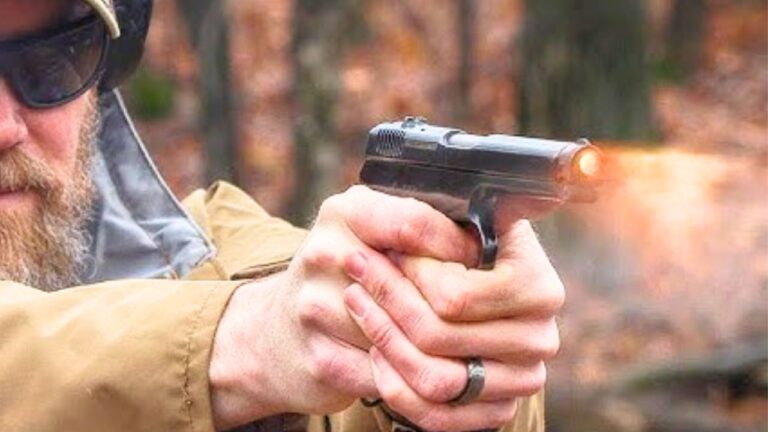
Some calibers feel like a good idea until you leave the bench and step into the field. They’re fun to shoot on steel, accurate on paper, and easy on the shoulder—but when it’s time to hunt, they don’t deliver. Either they lack the punch to penetrate, the accuracy to hold steady past 100 yards, or the reliability to perform when the weather turns ugly. These are the rounds that shine in casual range sessions but fall apart when the shot really counts.
.17 HMR

The .17 HMR is a tack driver at the range. Flat, fast, and satisfying to shoot—it’s easy to see why it’s a favorite for plinking and varmints. But when it comes to hunting, that tiny 17-grain bullet has limits. Wind eats it alive, and energy drops to small-game levels fast.
It’s a squirrel and prairie dog killer, not a deer or hog cartridge. Many hunters learn that the hard way when they try to stretch it into roles it was never meant for. Fun to shoot, but too light for anything with a real hide.
.22 LR

The .22 LR is the king of range day fun. Cheap, quiet, and accurate—it’s where most shooters start. But it’s also where too many stay when they shouldn’t. For hunting anything bigger than a rabbit, it lacks both energy and consistency.
At the blind, it’s the wrong tool for ethical kills. The tiny bullet can’t penetrate deeply or expand effectively on deer-sized targets. Great for training, plinking, or knocking cans off a stump, but when you need stopping power, the .22 LR’s backyard comfort zone is where it should stay.
.22 WMR

The .22 Magnum bridges the gap between rimfire and small centerfire rounds nicely, but it’s still limited. On the range, it’s accurate and fun. In the woods, it’s unpredictable on larger game. Expansion and penetration vary wildly depending on bullet type and distance.
It’ll drop a fox clean but might barely wound a small deer. That inconsistency is why many hunters leave it at home once they’ve spent time in the field. It’s great for the bench—but not for the blind when real performance matters.
.204 Ruger

The .204 Ruger is fast, accurate, and laser-flat on paper. But it’s designed for varmints, not game with thick hides or tough bones. Those light bullets fragment quickly and lose energy almost instantly past 300 yards.
It’s exciting to shoot on the range, where targets don’t run off. But when used for coyotes or anything larger, too many shots fail to exit or penetrate properly. It’s a great cartridge for clean range work, not for hunting trips where the wind and distance aren’t so forgiving.
.17 WSM

The .17 Winchester Super Magnum sounds impressive—a rimfire pushing 3,000 fps. But when you take it to the field, its limits show fast. The tiny bullet disintegrates on impact, offering explosive hits on varmints but no deep penetration for serious hunting.
At the range, it’s accurate and fast, no question. But on anything beyond small game, it’s more flash than function. It’s one of those rounds you’ll love behind the bench but quickly leave behind once you start tracking wounded animals in tall grass.
.300 Blackout (Supersonic Loads)

The .300 Blackout became a range favorite thanks to its low recoil and AR compatibility. But when used for hunting with supersonic loads, it’s mediocre. Energy levels drop sharply past 200 yards, and bullet performance varies dramatically.
At the range, it’s smooth, accurate, and reliable. In the blind, though, you’ll find it lacking for anything bigger than a coyote. It’s a capable cartridge—but only within a very narrow range. Too many hunters treat it like a .308 substitute, and it isn’t.
7.62x39mm

The 7.62x39mm is one of the most popular cartridges in the world, and for good reason—it’s cheap and reliable. But its accuracy and range leave much to be desired in hunting situations. Past 150 yards, it drops like a rock, and bullet expansion can be hit or miss.
It’s perfect for fun days with an SKS or AK at the range, but when you’re sitting in a blind hoping for a clean kill, its limits show. The round is great for reliability, but its ballistics were never designed for ethical hunting distances.
.300 AAC Blackout (Subsonic)

Subsonic .300 Blackout rounds are great for suppressed shooting. Quiet, soft-recoiling, and movie-cool—but for hunting, they fall flat. Heavy bullets moving under the speed of sound don’t expand well, and energy levels are low.
It’s fun to run steel all day with that whisper-quiet thump, but when it’s time to anchor an animal, the subsonic load disappoints. Unless you’re hunting very close and very small, it’s better left for tactical range play than the deer woods.
.25 ACP

The .25 ACP looks good on paper for a small pocket pistol, but in practice, it’s one of the weakest rounds you can shoot. At the range, it’s reliable enough for paper, but penetration on real targets is laughable.
In a hunting context—or even self-defense—it’s ineffective. The tiny bullet and low velocity make it more of a novelty than a tool. It survives backyard range sessions because it’s cheap to shoot, but no serious hunter or shooter relies on it for anything more.
.32 ACP

The .32 ACP offers mild recoil and manageable accuracy, making it a fun plinker for older pocket pistols. But for hunting or serious use, it’s sorely underpowered. Even small game often requires multiple hits for clean kills.
At the range, it’s a joy to shoot—no recoil, easy control, and decent accuracy. But the second you take it into the field, it feels like you’re bringing a toy to a grown-up fight. It’s survived for a century mostly out of nostalgia, not performance.
.30 Carbine

The .30 Carbine earned its fame in World War II, but its real-world performance is underwhelming today. Out of the M1 Carbine, it delivers soft recoil and fun shooting, but energy drops quickly, and bullet design hasn’t evolved much.
For hunting, it’s barely adequate for small deer or varmints. It’s the definition of a range darling that doesn’t carry its weight in the blind. You’ll have fun with it on steel, but don’t expect it to impress when fur and bone enter the equation.
.350 Legend

The .350 Legend was marketed as a straight-wall game changer for deer hunters. While it’s mild and accurate on paper, real-world results vary. At the range, it’s pleasant to shoot and easy to zero. In the woods, though, expansion and energy drop faster than advertised.
It works fine for smaller deer at moderate distances, but it’s not the powerhouse many were promised. It’s reliable, but not remarkable. When you expect a “modern .30-30” and get ballistics closer to a hot 9mm carbine, disappointment follows.
.450 Bushmaster

The .450 Bushmaster looks intimidating and shoots great groups at the range. But in the blind, its limited range and heavy recoil make it a one-dimensional round. Energy drops hard past 200 yards, and trajectory suffers even sooner.
It’s fun to shoot big holes in paper, but you quickly realize it’s better suited for short-range ambushes than versatile hunting. It hits hard up close, but once the range stretches, it’s as limited as it is loud.
6.8 SPC

The 6.8 SPC was hyped as the AR cartridge that would finally dethrone the 5.56, but it never fully delivered. It performs fine on the range—accurate and consistent—but in hunting conditions, its terminal energy doesn’t live up to expectations.
It’s fine for small to medium game, but not the powerhouse many were led to believe. Between expensive ammo and limited availability, it’s become more of a handloader’s hobby round than a dependable hunting cartridge.
.410 Bore Slugs

The .410 slug looks impressive, but performance is underwhelming in practice. On paper, it’s small but mighty. In the field, it’s weak, slow, and lacks the penetration for clean kills on anything larger than a rabbit.
At the range, it’s fun and easy to shoot—low recoil, simple handling, and satisfying impacts on targets. But when you’re in the blind, that mild recoil comes at a cost: poor terminal performance. The .410 slug is a range toy masquerading as a hunting tool, and most hunters find out the hard way.
Like The Avid Outdoorsman’s content? Be sure to follow us.
Here’s more from us:
The worst deer rifles money can buy
Sidearms That Belong in the Safe — Not Your Belt
*This article was developed with AI-powered tools and has been carefully reviewed by our editors.