Photo credit: The Avid Outdoorsman
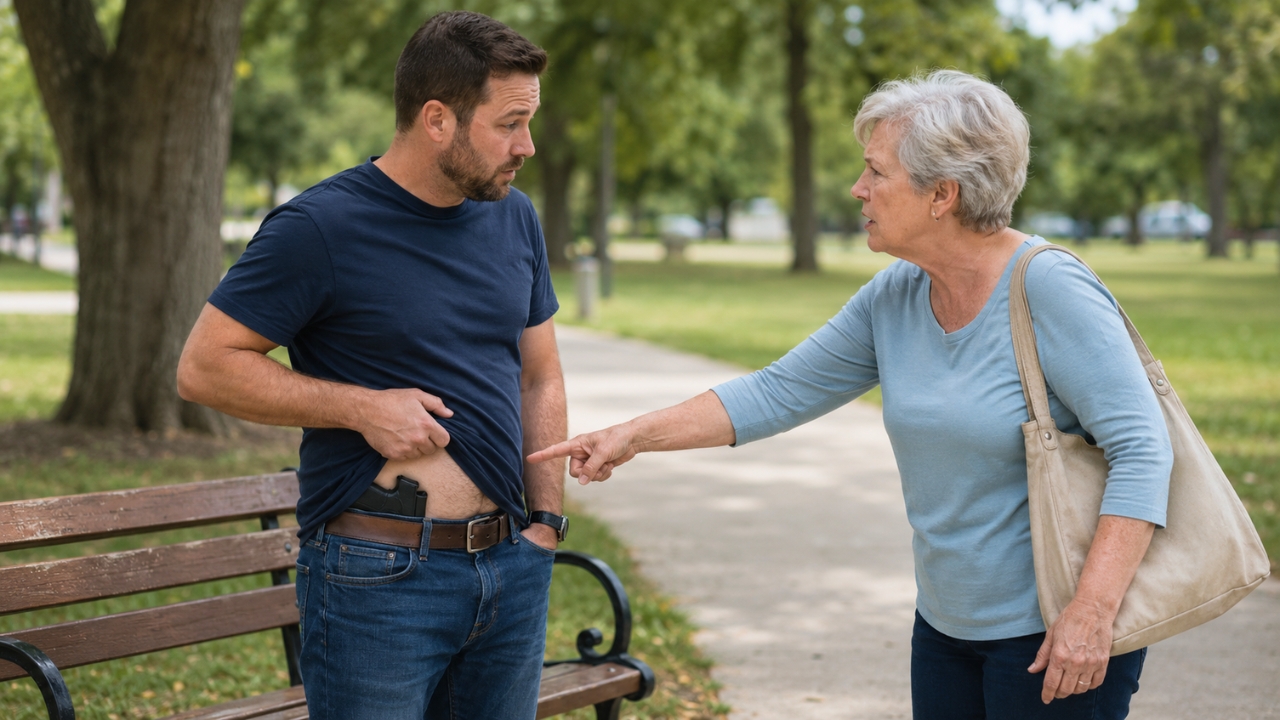
A concealed carrier in Reddit’s r/CCW described a lunchtime encounter that started with nothing more dramatic than a yawn and turned into one of those strange public carry moments where a stranger suddenly decides she has authority she absolutely does not have. He said he had finished eating lunch at his local park and stretched his arms out while yawning, only to realize an older woman walking by with what he described as her “ankle biter chihuahua” had seen his IWB holster. The original Reddit thread is here: https://www.reddit.com/r/CCW/comments/gzvorw/had_a_small_encounter_with_a_karen_who_saw_my_ccw/. (reddit.com)
From the way he wrote it, the whole thing was quiet until she clocked the holster. She waved, saw it, and immediately asked, “is that a gun?!” He answered directly: yes. Then she moved almost instantly from curiosity to challenge, asking whether it was legal to carry a gun “like that.” He answered that he had the license to prove it. At that point, instead of leaving it alone, she asked if he would mind showing her the license “just so I know you’re right.” That line really set the tone for the rest of the encounter. This was no longer one nervous passerby asking a question and moving on. This was a stranger trying to turn herself into the kind of authority figure she was not.
He refused, and he did it calmly. He told her he did mind, and that he was not obligated to show his license to anyone who was not law enforcement. That is the moment the interaction shifted from awkward to confrontational. Instead of accepting the answer, the woman told him that if he would not show her the permit, then she would assume he had something to hide. The carrier responded that he did not, and that it was nothing personal, but he still was not obligated to show her his permit. It is a very familiar kind of public argument once you strip it down. One person believes legality is their business the second they feel uncomfortable. The other knows it is not.
The woman then raised the stakes a little more and said maybe she should call police and have them request the permit from him. His answer was one of the lines that made the thread memorable: “I bet the dispatcher would tell you to pack sand.” That reply was sharper than diplomatic, but it fit the tone of the situation he was describing. At that point, he was not dealing with a confused bystander asking sincere questions. He was dealing with someone who had decided that if she could not get what she wanted directly from him, she would try to use the police as leverage instead.
She did not back off after that. According to the post, she pulled out her phone and told him to stay there while she sorted it out. He told her no, he had to go back to work. She mocked him, asking whether he was afraid he would lose his bet. He answered that it was not a literal bet, repeated that he was going back to work, and left. The final little jab she threw after him — “oh poor baby!” — tells you pretty much everything about where the interaction had gone. This was no longer about safety, legality, or genuine public concern. It had turned into the sort of small, pointless dominance game people play when they are angry they cannot make a stranger do what they want.
The most interesting part of the thread may actually be how the carrier described his own exit. He said he tried to use the advice of his firearms-safety and hunter-safety instructor, which was to make footsteps toward the exit whenever possible if talks are going nowhere. He called walking away an underrated de-escalation tactic and made clear that, while he could have been nicer, he ultimately preferred leaving over feeding the argument. That gave the whole post a different weight. He was not only telling a story about a rude woman in the park. He was also trying to explain what it looks like when an armed citizen decides not to “win” a pointless public argument and just leaves instead.
The comments immediately piled onto the woman rather than the carrier. One of the first popular replies pointed out the basic absurdity of her behavior: if she truly believed she had just spotted an armed criminal, why in the world would she confront him with nothing but a chihuahua? Another commenter said people like that are looking for a reaction more than a resolution, and that by walking away he took away what she really wanted. That idea ran through a lot of the replies. To many people in the thread, the encounter was less about fear and more about control. The woman saw something she did not like and wanted the carrier to prove himself to her personally, on demand, as if she had a right to command that exchange.
Other commenters focused on his response. Some thought he handled it exactly right by refusing to show anything and then leaving. A few said he might have been a little sharper than necessary with the “pack sand” line, but even those replies usually came back to the same bottom line: she had no right to see his permit, and he had no duty to stand there while she tried to boss him around. There was also a thread of replies pointing out how often people who act like this never really think through the logic of their own behavior. If they honestly believed the person was dangerous, confronting him is reckless. If they did not believe he was dangerous, then they were just trying to force a stranger to comply with them for no real reason. Either way, the result is the same. They are not actually improving anyone’s safety.
The park setting matters too. Parks feel public in a different way than stores or restaurants. They invite casual conversation, small social gestures, and the kind of passing interactions where strangers sometimes feel weirdly entitled to each other’s attention. A gun or holster spotted in that setting can trigger a different kind of response than it would in a more transactional space. In a restaurant, people may just whisper or leave. In a park, someone like the woman in the story may feel freer to walk right up and start asking questions because the whole environment feels less formal and more like shared space. That may be part of why the carrier chose to leave so quickly once it became clear the conversation was going nowhere. A park does not give you walls, counters, staff, or any other structure to absorb a weird social confrontation. It is just you, the stranger, and whatever distance one of you decides to create.
What lingers in the story is how little really happened before the conflict started. He yawned. He stretched. The holster showed. That was enough. The woman did not witness threatening behavior, a brandished weapon, or some loud disturbance. She saw the equipment, decided that made the carrier answerable to her, and pressed the issue when he refused. That is part of what makes the story useful in the carry context. It shows how some of the most annoying public encounters are not born from actual danger at all. They come from the simple fact that someone else feels entitled to inspect, verify, or control the legality of something they were never empowered to control in the first place.
And that is where the story sits. A man on his lunch break stretched at the park, exposed part of his IWB holster, and got pulled into a weird little power struggle with an older woman who wanted to see his carry license right then and there. He refused, she threatened police, and he walked away. No officers showed up. No dramatic ending followed. But the point had already been made. Once a stranger decides your lawful carry is her personal business, sometimes the smartest move is not to out-argue her. It is to let her keep talking to the chihuahua while you go back to work.
Like The Avid Outdoorsman’s content? Subscribe to our newsletter so you never miss an article.
Here’s more from us: