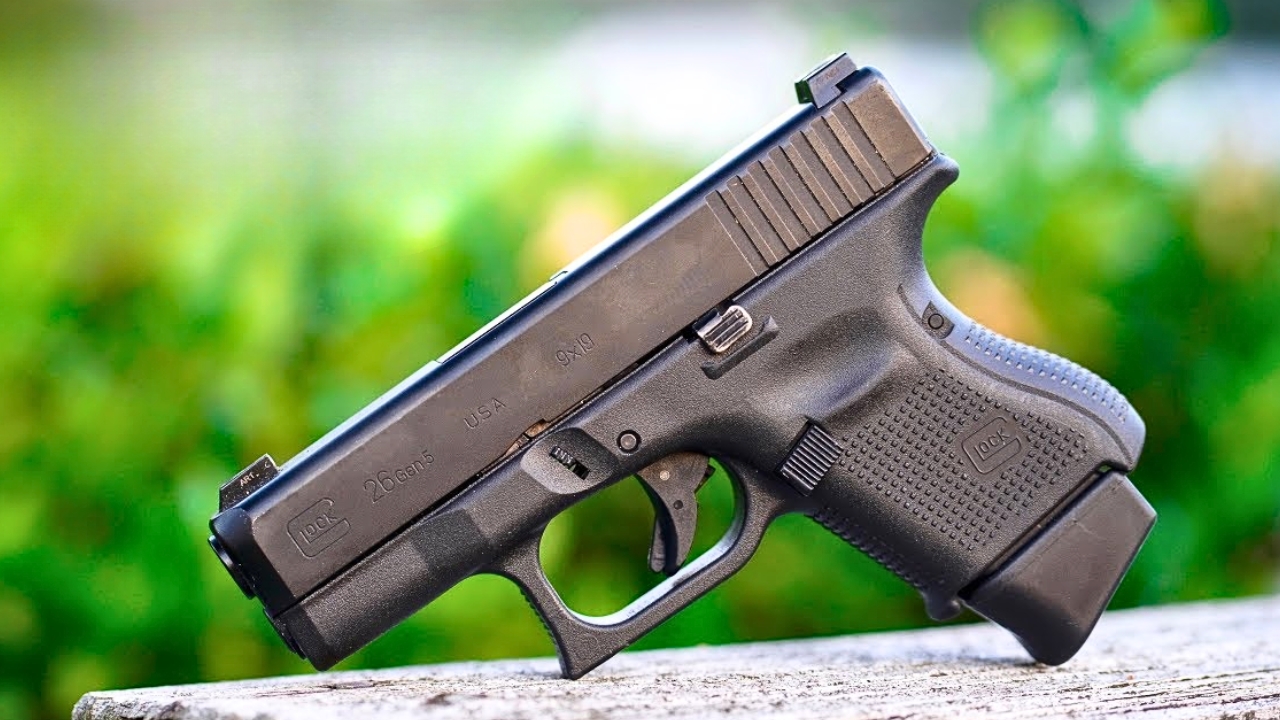
Photo credit: Mrgunsngear Channel/YouTube
A Reddit concealed-carry owner said he bought a new Gen 5 Glock 26, put roughly 550 rounds through it without trouble, then hit a failure to feed at the range that immediately got in his head. He wrote that the malfunction happened while shooting Blazer Brass 124-grain ammo, that the round’s nose looked slightly flattened, and that the cartridge chambered and fired on the second try. After cleaning the gun, he said he went back and fired another 700 rounds without a single issue, but still wanted advice because one hiccup in a carry gun can make a person start second-guessing a lot more than one bad range session.
That is what gave the post its edge. It was not some junk pistol choking every other magazine. It was a gun with one failure in more than a thousand rounds, and that may be exactly why it bothered him so much. A pistol that fails constantly is easy to diagnose: something is wrong. A pistol that runs almost perfectly except for one ugly moment is harder on the nerves, because now you are stuck asking whether you saw a harmless ammo issue or the first crack in something you planned to trust with your life.
The replies came back with a message he probably did not fully want, but probably needed. Multiple commenters told him not to overthink it. One pointed out that one failure in roughly 1,200 rounds is not much to worry about. Others said low-quality range ammo, dirt, over-oiling, or plain manufacturing variation can all line up and create a single stoppage without meaning the gun itself is bad. The general tone was blunt: every semiauto can choke once, and carrying one does not mean you are walking around with some magic object that guarantees perfection.
That last part is what made the thread feel more honest than the usual brand-loyalty chest thumping. One commenter flatly told him that a carry gun is “a tool to give you a chance to survive,” not a talisman. Another urged him to practice tap-rack drills with dummy rounds so that if a stoppage ever happens again, his hands know what to do before his brain has time to panic. The point was not that malfunctions are no big deal. The point was that betting your life on a semiauto means accepting that mechanical systems, ammo, dirt, and human error all still exist.
The original poster seemed to know that was true, but he still sounded rattled. He thanked commenters for helping him get out of his own head and admitted he had started worrying that something might be “jacked” with the gun. That reaction is probably familiar to a lot of people who carry. The first time a trusted pistol coughs during live fire, it does more than interrupt a drill. It plants a question. Maybe it is the ammo. Maybe it is the magazine. Maybe it is nothing. But once that question gets planted, it can be hard to look at the gun the same way for a while.
Other commenters tried to shrink the problem back down to size. They pointed out that he was putting huge round counts through the Glock in single sessions, far more than he would ever fire in a likely defensive use. One person noted that when he actually carries, the pistol will presumably be clean and loaded with quality defensive ammo, not bulk range ammunition after hundreds of rounds of fouling. Others said to clean the mags, keep the pistol maintained, and move on unless the problem starts repeating.
There was also the usual gun-world undercurrent of brand bias running through the thread. One commenter joked that people are quick to excuse a Glock malfunction when they might trash another brand for the same thing, and the poster laughed that brand loyalty can get as tribal as Chevy versus Ford. That part mattered because it kept the conversation from turning into a pure Glock fan club. Even people defending the pistol were not claiming perfection. They were mostly saying something simpler: one failure, by itself, is not enough evidence to convict the gun.
That is probably why the thread landed with so many carriers. The real story was not one Glock 26 choking once. It was that sick feeling a carry owner gets when a stoppage turns a trusted tool into a question mark, even for a moment. And the hard truth in the replies was one a lot of people do not love hearing: if you carry a semiauto, you are trusting a machine. Machines can fail. The real test is whether one bad round shakes your confidence forever, or pushes you to train, verify the gun, and keep your head where it belongs.