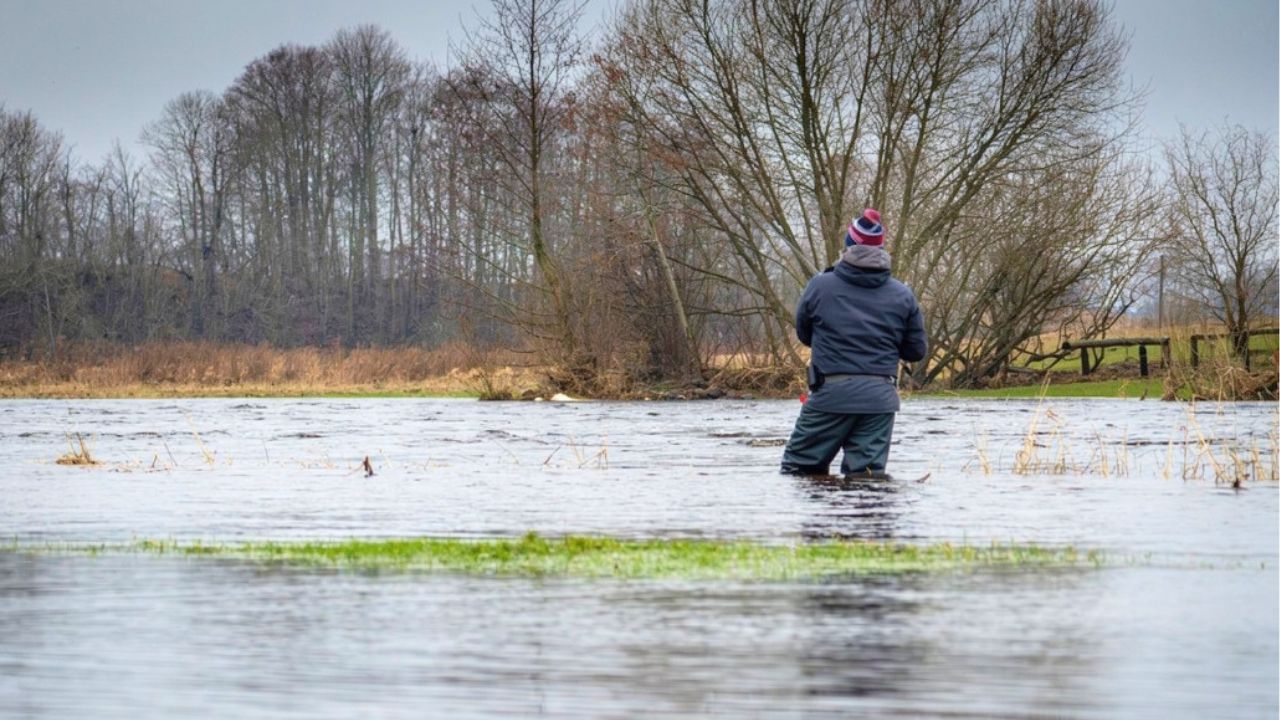
Photo credit: Edijs K/shutterstock.com
A fisherman on Reddit said he had one of those close calls that starts with one bad step and turns serious before a person has time to fully understand what is happening. He was wearing waders, working around mud and water, when his feet got suctioned down hard enough that he could not easily pull free. Anyone who has walked soft river mud, tidal flats, lake edges, or marshy banks knows that feeling. One step feels firm enough, the next sinks deeper than expected, and suddenly the ground is holding onto your boot like it has teeth.
At first, getting stuck in mud can feel more annoying than dangerous. You rock one foot, then the other. You try to lift straight up. You lean on a rod, a stick, a bank edge, whatever is nearby. But when waders are involved, the situation changes fast. Waders add bulk, trap air, restrict movement, and can become a problem if water starts coming over the top. If they fill, you are not only wet. You are dragging extra weight while trying to stay upright in a place that already has your feet pinned.
The fisherman said his waders almost filled while he was stuck, and he was close to being swept away. That is the part that takes it from a muddy inconvenience to a real survival problem. If moving water gets enough grip on a person who cannot free his legs, the current starts doing the work. It pushes at the knees, hips, and chest. It shifts balance. It makes every movement clumsy. A person can go from standing upright and irritated to face-first in the water with heavy gear fighting against him.
He managed to pull himself out, but it was not clean. He sliced his hand badly on sharp rocks while getting free. That detail makes the whole thing easier to picture. He was not casually stepping out of a muddy patch and laughing it off. He was clawing and pulling hard enough to cut himself up, using whatever grip he could find because the alternative was staying stuck while the water kept working on him. Sometimes the only way out is ugly, and he took the cut hand over staying planted in that mud.
A lot of anglers underestimate mud because it does not look dramatic. Waves look dangerous. Deep water looks dangerous. A storm rolling over the lake looks dangerous. Mud looks like something you can muscle through. But suction mud can lock down boots so tightly that normal strength does not matter much. The harder you yank straight up, the more it can hold. If you are alone, tired, cold, carrying gear, or standing near moving water, that becomes a bad place to learn how strong mud can be.
Waders make fishermen bolder too. That is part of the problem. A guy wearing them may take two more steps than he would in regular boots. He may move farther from the bank, cross softer bottom, or keep edging toward better water because he feels protected. The gear keeps him dry, but it does not make the bottom stable. If anything, it can encourage him to go places where footing is already questionable.
The danger gets worse around rivers, tidal areas, spillways, and lakes with soft silt. Water levels can rise. Current can change. A mud flat that seemed manageable on the way in may not feel the same on the way back. If a fisherman is focused on a bite, a drift, or a promising seam, he may not notice how far he has moved into a bad area until one leg sinks and the other one follows.
There are ways to lower the risk. Use a wading belt. That matters because it helps slow water from rushing into waders if you fall or step too deep. It does not make you invincible, but it buys time and keeps the gear from becoming a giant water bag all at once. A wading staff helps too, especially in rivers or soft-bottom areas where every step needs testing before you trust it. If the bottom feels like it is pulling at your boots, back out before both feet are buried.
Fishing alone around mud and current is where the margin gets thin. If another person is there, they may be able to throw a rope, grab a branch, call for help, or talk you through staying calm. Alone, every bad decision has to be fixed by the same person who made it, and panic can burn energy fast. A phone in a waterproof pouch, a whistle, and telling someone exactly where you are fishing may sound excessive until you are stuck and the water is not slowing down.
The fisherman got out with a cut hand and enough fear to remember it. That is a good outcome compared with what could have happened. Mud does not have to be deep to be dangerous. Water does not have to be raging to take advantage of a trapped person. One stuck boot, one rising current, and one pair of waders starting to fill can turn a normal fishing trip into a fight to get back to solid ground.