Photo credit: The Avid Outdoorsman
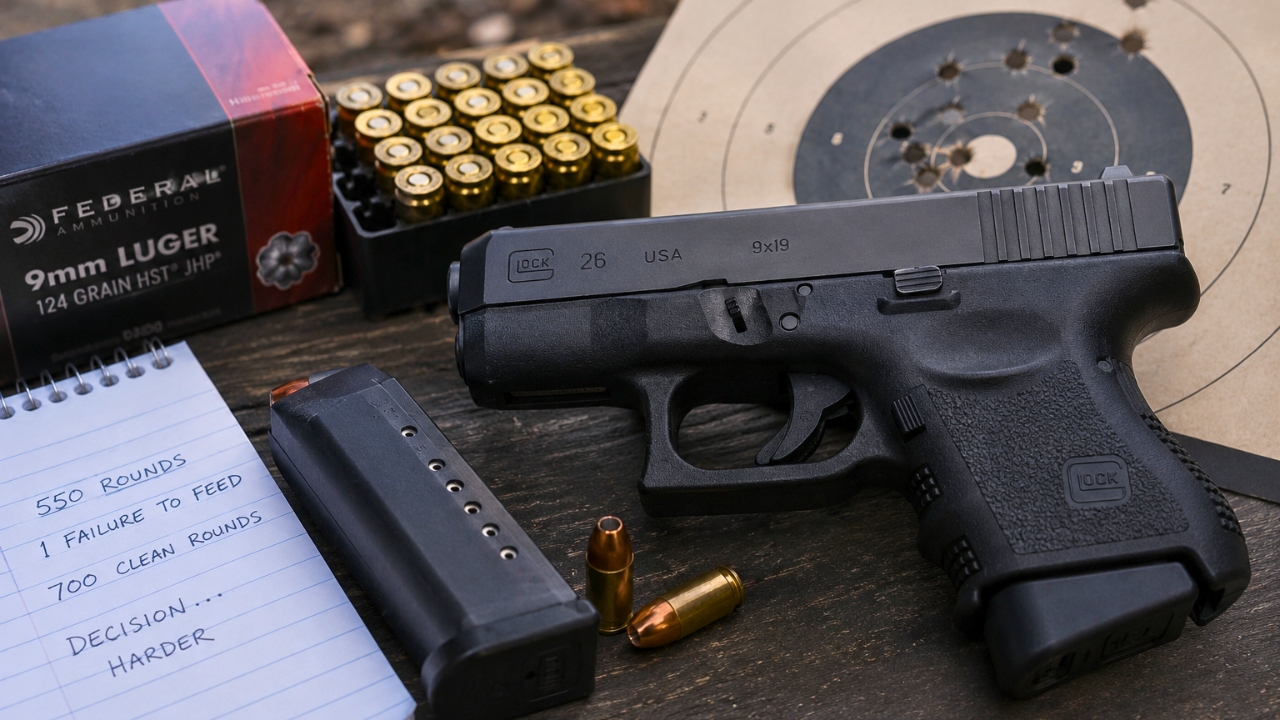
The Glock 26 owner had the kind of problem that sounds simple until it is your carry gun.
One failure to feed.
That’s it. Not a gun that jammed every magazine. Not a pistol that choked on every hollow point. Not a disaster at the range. One malfunction after hundreds of rounds.
But when the gun is supposed to be carried for defense, one malfunction can stick in your head harder than 700 good rounds.
In a Reddit post, the gun owner said his Glock 26 had a failure to feed after about 550 rounds. After that, he put another 700 rounds through the pistol with no issues. That should sound reassuring, and in a lot of ways, it is. A gun that runs clean for 700 rounds after one stoppage is not exactly screaming “broken.”
But it still left him wondering whether he could trust it.
That’s the rough part with carry guns. If this were a casual range pistol, most people would clear the malfunction, keep shooting, and maybe make a mental note. Guns are machines. Ammo varies. Magazines can be weird. Grip can change. Dirt, lubrication, fatigue, and one slightly off round can all cause a hiccup.
But a carry gun lives in a different category.
You do not carry it because you expect a calm, convenient situation. You carry it because if something ugly happens, you may need the pistol to work right then, without negotiation. So when it fails once, even after hundreds of rounds, the owner starts asking a bigger question: was that just a fluke, or did the gun show me something I need to respect?
That is why the decision got harder after the 700 clean rounds.
If the gun had kept malfunctioning, the answer would be easy. Stop carrying it. Fix it. Replace a part. Try different magazines. Send it in. If it never had any malfunction at all, confidence would be easy too. But one failure followed by a long stretch of reliability puts the owner in the gray area.
The Glock 26 has a strong reputation, which probably made the malfunction more annoying. People expect small Glocks to run. That does not mean they are magic. Any semi-auto can fail. But when a gun with a reliable name has a stoppage, the owner may second-guess himself before he blames the pistol.
Was it limp-wristing? Was it the ammo? Was it the magazine? Was the gun dirty? Was it during break-in? Did he ride the slide? Was the round seated weird? Was it a bad grip during a long range day?
Those questions matter because the cause changes the next step.
If it was a magazine issue, the fix may be as simple as marking that mag and testing it hard or removing it from carry use. If it was cheap range ammo, then maybe the gun still runs perfectly with defensive loads. If it was shooter-induced, he may need more practice, especially with a smaller pistol. If it was a mechanical issue, then the gun needs inspection.
The problem is that one malfunction does not always leave enough evidence.
That is why tracking matters. Good shooters mark magazines. They pay attention to the ammo. They remember where in the session it happened. They note whether the gun was clean, dry, hot, dirty, or being shot weak-handed. They do not just say, “It jammed once.” They try to figure out the pattern.
Here, the follow-up mattered. Seven hundred rounds after the malfunction without another issue is a strong sign that the gun may be fine. But carry confidence is personal. Some people would say that is more than enough. Others would want to run their actual carry ammo again, through every carry magazine, before putting it back on the belt.
Neither instinct is crazy.
A defensive pistol does not need to meet some impossible standard where it never has a single mechanical hiccup in its lifetime. But it does need to prove that the hiccup is not repeatable. If a gun fails once and then runs hundreds of rounds across multiple magazines and ammo types, that’s useful information. If it fails again in the same way, that’s also useful information.
The owner was doing the right thing by asking instead of pretending the issue did not happen.
That is the difference between confidence and denial. Confidence says, “I tested it again and it ran.” Denial says, “I don’t want to think about that malfunction because I like this gun.” A carry gun needs the first one.
The practical path is pretty clear. Clean and inspect the gun. Mark the magazines. Shoot the actual defensive ammo you plan to carry. Test the carry magazines, not just random range mags. Pay attention to your grip, especially with a smaller pistol like the Glock 26. If the gun keeps running, trust can come back. If the same malfunction repeats, stop carrying it until the cause is fixed.
The malfunction was not automatically a dealbreaker.
But it was a reminder that trust is not permanent. Even a respected carry gun has to keep earning it.
Commenters mostly treated the single failure as something to investigate, not something to panic over.
Several people said one malfunction after hundreds of rounds, followed by 700 clean rounds, would not automatically make them retire the gun. Semi-autos can have occasional stoppages, and the clean follow-up testing mattered.
Others focused on magazines. If the owner knew which magazine was involved, that magazine needed to be marked and tested. If the same mag caused another problem, it should not be used for carry.
A lot of commenters brought up ammo and grip. Smaller pistols can be more sensitive to weak grip, and range ammo can sometimes be inconsistent. The advice was to test the actual carry ammo and make sure the gun runs with the exact setup he plans to carry.
Some commenters were stricter and said any carry gun malfunction deserves more testing before it goes back into rotation. Not because the gun is automatically bad, but because the owner needs confidence based on evidence.
The main point was simple: one failure is a warning, not a verdict. The gun earns trust again by running clean with the right ammo and magazines.