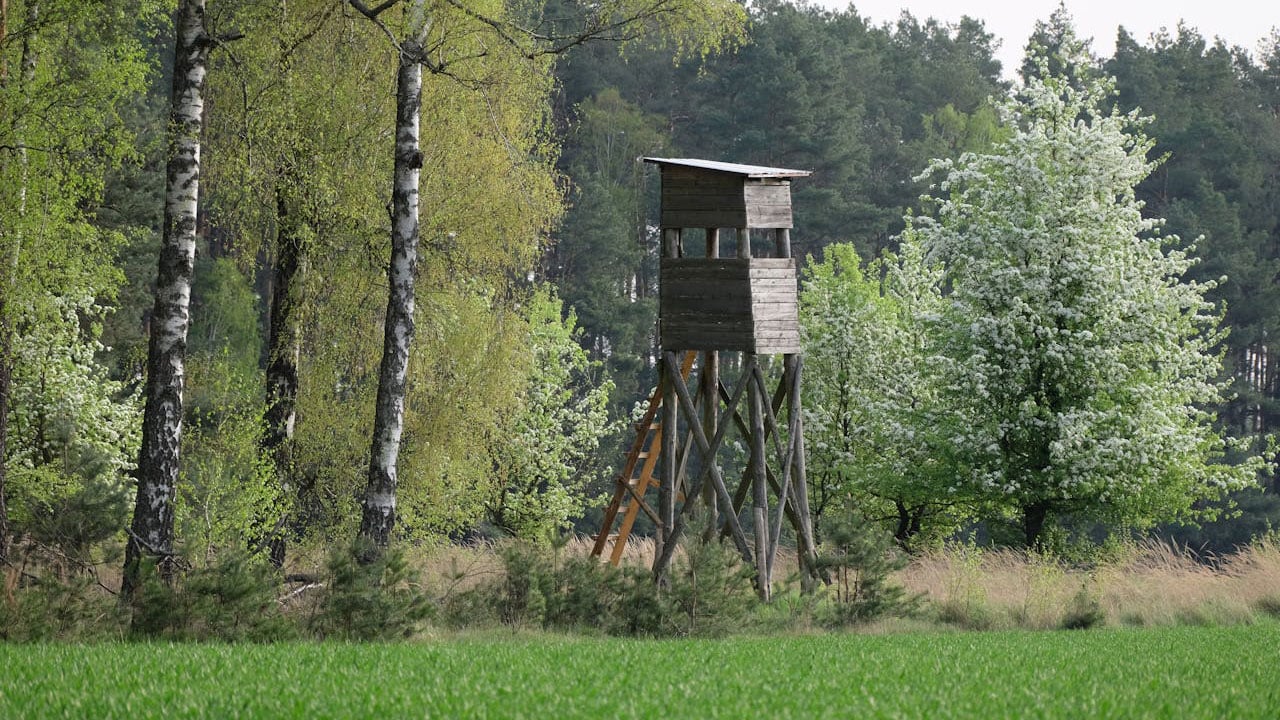
Photo credit: Roman Biernacki/Pexels.com
A hunter said his neighbor had put a tree stand right on the property line, and from the sound of it, he was already bracing for trouble before the season even got rolling.
In a Reddit post, the poster described one of those hunting situations that can go from annoying to ugly pretty fast. The neighbor had decided to put a stand right along the boundary, close enough that it immediately raised questions about what direction he planned to shoot and how much of the poster’s land he expected to use without actually asking.
A stand near a line is not always illegal. That is what makes these disputes so frustrating. A person can set up on his own property and technically be within his rights, even if every bit of common sense says he is asking for conflict. But when a stand is placed right against the boundary, the message it sends is hard to ignore.
Most landowners know exactly what that setup usually means. The hunter may be hoping to catch deer moving along the edge. He may be watching trails that cross between properties. Or he may be trying to take advantage of habitat, food, bedding cover, or pressure patterns on land he does not own. The stand itself may sit on his side, but the whole situation can still feel like he is trying to hunt both sides of the fence.
That is what makes property-line stands such a sore spot. The law may allow the stand. The neighbor may claim he is only hunting his side. But the other landowner is left wondering what happens once a deer steps across the line, or worse, what happens if a shot is angled toward people, livestock, buildings, roads, or another hunter.
The poster wanted to know what to do about it. He was not the only one who had dealt with it, either. The comments filled up with hunters and landowners who had seen the same kind of boundary pressure before.
One response stood out because it showed just how far some landowners will go when a neighbor keeps pressing the line.
A commenter said he had dealt with a similar situation by creating a physical screen between the properties. He described building what was basically a brush wall, using natural cover to block visibility from the neighbor’s stand into his land. It was not about threatening anyone or marching over the line. It was about changing what the neighbor could see.
That approach may sound petty at first, but for a lot of rural property owners, it is also practical. If the neighbor’s stand is legal and on his own side, there may not be much you can force him to move. But you can manage your own side. You can hinge-cut trees, let brush grow, stack limbs, plant screening cover, or create a visual barrier that makes the setup less useful.
It is the land-management version of saying, “Fine, sit there if you want, but you are not going to watch my whole property from that tree.”
That kind of response made sense to people who have been stuck in the same position. Nobody wants to spend hunting season watching a neighbor watch them. Nobody wants to wonder if shots are crossing a line. And nobody wants deer movement on their land treated like a shared resource by someone who never asked.
Still, the poster had to be careful. A brush wall might solve the visibility problem, but property disputes can turn personal when one side realizes the other is intentionally blocking them. That is especially true if the neighbor already believes he is doing nothing wrong.
The smarter move, commenters suggested, was to start with the basics: know the exact line, document everything, and do not assume more than you can prove. If the neighbor’s stand is even a few feet over the line, that changes the entire discussion. If it is on his property, then the poster has to work within his own rights instead.
That means cameras, clear signs, a survey if needed, and a calm conversation if the relationship allows it. It also means not letting anger turn into trespassing or harassment from the other direction. Once both sides start trying to “teach lessons,” these things can spiral fast.
The stand itself may have been legal. The message behind it was the problem.
For the poster, the situation was a warning sign. A neighbor who sets up right on the line may stay perfectly legal all season, or he may push farther once deer start moving. The only way to know is to watch, document, and make sure the boundary is impossible to misunderstand.
Commenters had plenty of ideas, but the advice mostly came down to one thing: do not let the neighbor’s setup control your season.
Some hunters said the poster should start with a direct conversation. Not an angry one. Not a threat. Just a simple, clear talk about the property line, where everyone plans to hunt, and how both sides can avoid unsafe shots or recovery disputes. A few said they had solved similar problems that way, especially when the other person had not realized how bad the stand placement looked from the opposite side.
Others thought that was too generous. They said anybody putting a stand right on a line knows exactly what he is doing. To them, the poster should assume the neighbor is testing boundaries and prepare accordingly.
That is where the survey advice came in. Several commenters said the first step is confirming the line beyond argument. Not with a phone app. Not with a fence that may or may not be accurate. A real survey, marked clearly. Once that line is confirmed, the poster can post signs, hang cameras, and document any crossing or shooting violations with a lot more confidence.
The brush-wall idea got a strong reaction because it gave the poster something he could actually do without relying on the neighbor to be decent. Commenters talked about planting screens, dropping brush, using natural barriers, and improving habitat deeper inside the property so deer were less likely to travel the edge in front of the neighbor’s stand.
Some suggested making that side of the property less attractive during season. Not by breaking laws or harassing the neighbor, but by managing pressure and travel patterns. If the deer have better cover, food, and security deeper on the poster’s side, the property-line stand becomes less valuable.
Other commenters warned against escalating too hard. They said property-line fights can get nasty, and a person still has to live next to that neighbor after deer season ends. A stand on the line may be irritating, but the poster needed proof before involving the game warden or accusing the neighbor of shooting across.
The game warden came up as the right call if the neighbor crossed the line, shot onto the property, baited illegally, tracked without permission, or threatened anyone. Until then, commenters said the poster was mostly dealing with bad manners, not necessarily a violation.
That was probably the most frustrating part. A stand can be rude, aggressive, and obviously aimed at taking advantage of the neighbor’s land, while still not being illegal by itself.
For the poster, the answer was not as satisfying as “make him move it.” It was more like: confirm the line, make the boundary clear, block what you can from your side, and be ready if the neighbor crosses from annoying into illegal. Property-line hunting drama rarely gets fixed by wishful thinking. It gets fixed by proof, patience, and making your own land harder to exploit.