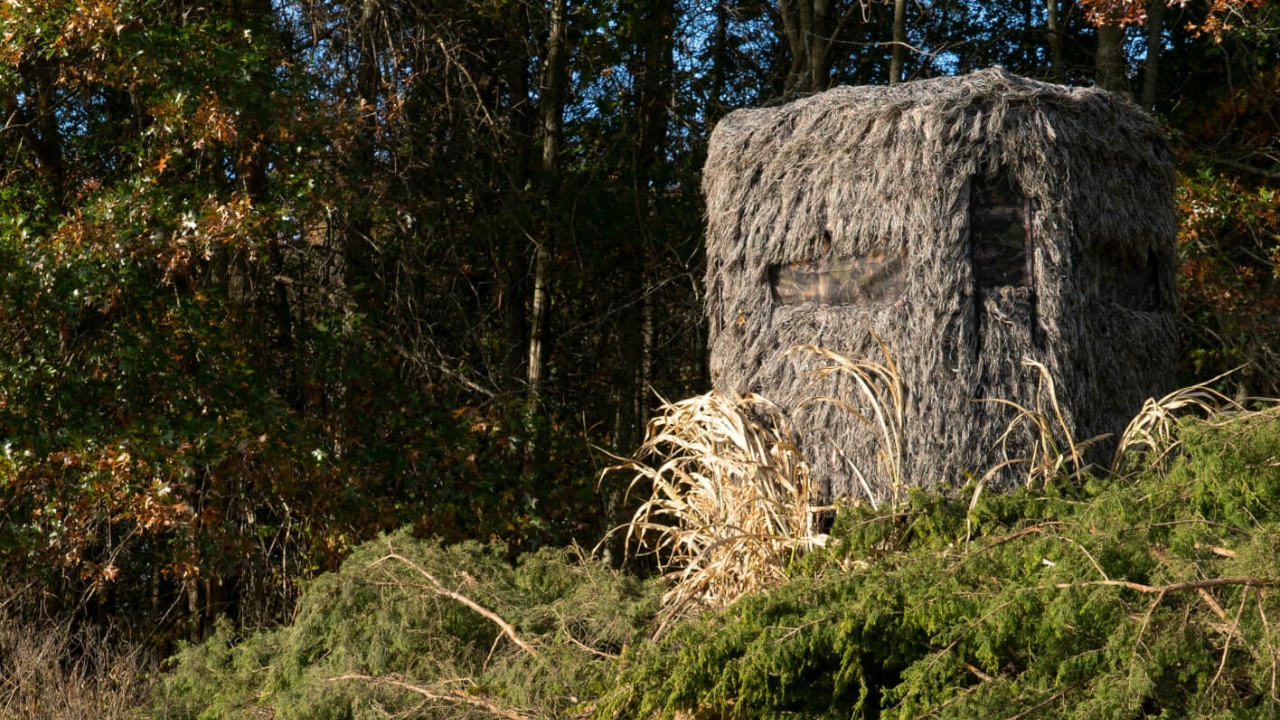
Image Credit: Redneck Blinds.
A hunter in Reddit’s r/Hunting described the kind of discovery that keeps getting worse the longer you stand there looking at it. He said his dad found a hunting setup on their property while walking a thicket along the east side of the line, and at first the obvious problem was the stand itself. But once they started taking in the whole scene, it became clear the stand was only part of it. According to the post, there was an ATV trail running right up to the area, along with a salt lick and a scent drip nearby. In his state, he said, those extras were illegal. In the original Reddit thread, he laid out the situation and asked what people thought he should do next: https://www.reddit.com/r/Hunting/comments/yth9n7/what_does_reddit_think_i_should_do_my_land_not_my/.
What made the whole thing feel more serious than a simple property-line mistake was how built-out the setup looked. A stand a little too close to the line can still leave room for people to argue over maps, corners, old markers, and whether somebody got sloppy. A salt lick, a scent setup, and a trail in to service it all make that harder to believe. From the hunter’s point of view, this was not somebody wandering over by accident. It looked like somebody had quietly built a working hunting spot on land that was not theirs and had been comfortable enough doing it to keep adding pieces to it.
He also made it clear this was not some totally remote puzzle where nobody had any clue who might be responsible. He thought he knew which neighboring side it likely tied back to, partly because that same property already had several enclosed stands on it. That detail mattered because it raised the question that kept hanging over the post: if the neighbor already had multiple legal setups on his own side, why was there any need to cross over and build more on someone else’s ground? The existence of those other stands made the trespass look less like necessity and more like entitlement.
Then the story got murkier in a way that probably felt familiar to anybody who has ever tried to sort out a rural property problem. After checking county GIS records, the hunter realized the house he initially thought matched the parcel might not actually be tied to the piece of land with the stand. That meant the obvious visual clues on the ground did not line up as neatly with ownership as he had first assumed. So now he was not just dealing with an illegal setup on his property. He was also dealing with the fact that the exact person behind it might not be as obvious as it first looked.
Instead of rushing straight into a fight, he started checking things more carefully. In later comments, he said he used county GIS tools, Garmin coordinates, and a closer look at the lines to figure out where the stand really sat. By the time he had worked through those details, he said he believed the stand was roughly 28 to 29 feet off both the north and east property lines, which put it around 10 yards inside his side. That update changed the feel of the thread. At that point, he did not sound like somebody guessing anymore. He sounded like somebody making sure he had the facts before he confronted anyone.
That measured approach carried through the rest of what he said. He was clearly irritated, but he was also thinking several steps ahead. In one part of the discussion, he mentioned the possibility of putting up a camera to see exactly who was using the setup. That tells you a lot about where his head was. He was not only trying to catch somebody in the abstract. He was trying to keep from making the wrong accusation, starting the wrong fight, or walking into a property war with less proof than he needed. When the trail, salt, scent, and stand all point to repeated use, getting the identity right matters.
The commenters pushed him in a few different directions. Some said the salt lick and scent drip changed everything and should be reported immediately, especially because those were illegal in his area and could put the landowner himself in a bad position if left there. Others urged him to keep things civil at first, at least until he knew exactly who had put the setup there. A few people suggested a calm approach that almost read like a trap: mention to the neighbor that someone had built an illegal setup right along the line and see how he reacted. That way, the confrontation would start with facts instead of accusations.
There was also a practical streak in the replies that made a lot of sense. Several commenters said that even when you are angry, you have to think long-term with adjoining landowners. A stand can be taken down in an afternoon. A neighbor feud can last for years. One person pointed out that if land gets passed down in a family, bad blood at the line does not always die with one season. Another said the smart move was to post the area more clearly, set a hidden trail camera, and let the person behind the stand walk himself into a clearer problem instead of charging straight into a yelling match.
What probably bothered the hunter most was not only that someone had crossed the line. It was the amount of confidence the setup suggested. Somebody had cut or used access in, placed bait and scent, and chosen a stand tree on his side. That takes more than a careless step or two. It takes time. It takes return trips. It takes the assumption that nobody is going to stop you. Once a landowner sees that kind of confidence on his own ground, it changes the way he looks at the whole property. He is no longer only thinking about deer movement. He is thinking about how long somebody else has been acting at home there.
And that is really where the whole situation lands. A stand on the wrong side of the line is bad enough by itself. But once the trail, the salt, and the scent come into view, the whole thing starts to look less like a bad decision and more like a system somebody had already settled into. By the time the hunter was done checking maps and coordinates, the question was no longer whether something was off. The question was how much of another person’s hunting plan had already been built on land that was never his to use in the first place.