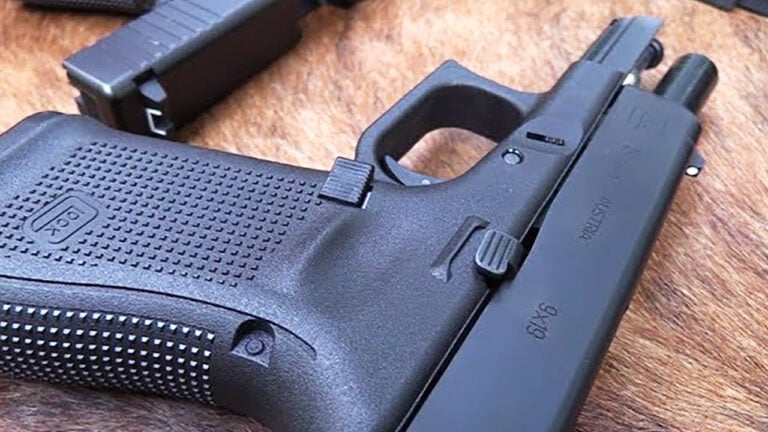
Photo credit: Vitaly V. Kuzmin – CC BY-SA 4.0/Wiki Commons
The Glock 17 has one of the strongest reliability reputations in the handgun world. It is the original full-size Glock, and it has been used by military units, police departments, competitors, instructors, and regular shooters for decades. A plain Glock 17 with factory magazines and decent ammo is usually about as low-drama as a pistol gets.
That does not mean it never malfunctions. The Glock 17 can still have failures to feed, failures to eject, stovepipes, extraction trouble, slide-lock problems, and ignition issues. Most of the time, those problems are tied to magazines, ammo, shooter grip, worn springs, poor maintenance, or aftermarket parts. The gun itself is simple and proven, but it still depends on every part of the cycle working the way it should.
Failure to Feed
Failure to feed is one of the more common Glock 17 malfunctions, especially when bad magazines or weak ammo are involved. The slide moves forward, but the next round does not chamber correctly. The bullet may nose-dive into the feed ramp, stop halfway into the chamber, or leave the slide slightly out of battery.
A lot of feeding problems start with the magazine. Weak springs, damaged feed lips, dirty magazine bodies, worn followers, or cheap aftermarket mags can all change how the round presents to the chamber. The Glock 17 is usually forgiving, but it is not magic. If one magazine causes problems and the rest run fine, the magazine is almost always the first suspect. Good factory mags solve more Glock “problems” than people want to admit.
Failure to Eject
Failure to eject happens when the pistol fires but the empty case does not clear the ejection port. It may stovepipe, get trapped by the slide, or bounce around inside the action and stop the next round from feeding. With a Glock 17, this can come from weak ammo, a loose grip, extractor issues, ejector problems, or a recoil spring that is not matched well to the load.
The Glock 17 is a recoil-operated pistol, so the slide needs enough energy to move rearward, extract the case, hit the ejector, and return forward. If the ammo is underpowered or the shooter gives the gun a weak platform, the slide may not cycle with enough speed. That is why some ejection issues show up more with cheap range ammo than with full-power defensive loads. The gun may not be broken. It may simply be telling you the ammo, grip, or spring setup is not giving it what it needs.
Stovepipes
A stovepipe is a specific kind of ejection failure where the empty case gets caught upright in the ejection port. It is easy to see and usually easy to clear, but it still means the pistol did not complete the cycle. On a Glock 17, stovepipes are usually tied to weak ammo, limp-wristing, dirty internals, or extractor and ejector issues.
Even though the Glock 17 is a full-size pistol and tends to be easier to control than smaller handguns, grip still matters. A shooter who lets the pistol move too much under recoil can rob the slide of the resistance it needs to cycle cleanly. That does not mean every stovepipe is the shooter’s fault, but it should be ruled out early. If the same pistol runs fine for one shooter and stovepipes for another, the grip is probably part of the story.
Failure to Extract
Failure to extract is less common than a basic ejection problem, but it is more serious when it happens. The case stays in the chamber after firing, and the slide either stops or tries to feed the next round into a chamber that already has brass in it. That usually creates a stoppage that takes more than a quick tap to clear.
Extraction problems can come from a dirty chamber, rough ammo, weak slide movement, or an extractor that is worn, chipped, dirty, or not moving freely. This is one of those issues where you need to look at the pattern. If it only happens with one brand of ammo, the ammo may be the problem. If it happens with multiple loads and magazines, the extractor and chamber deserve attention. A Glock 17 should not be leaving spent cases behind on any regular basis.
Failure to Return Fully to Battery
A Glock 17 can also stop just short of going fully into battery. The round is almost chambered, and the slide is almost forward, but the barrel and slide are not fully locked up. Sometimes the shooter can tap the back of the slide and finish chambering the round. Other times the round needs to be cleared.
This can happen when the gun is dirty, the chamber is fouled, the recoil spring is weak, the ammo is out of spec, or an aftermarket part is dragging. Tight aftermarket barrels can make this worse, especially with certain reloads or lower-quality ammo. A Glock that stops slightly out of battery is not ready to fire, and it should not be ignored if it keeps happening. Clean the chamber, check the ammo, inspect the recoil spring, and pay close attention to any parts that have been changed from factory.
Light Primer Strikes
Light primer strikes are not one of the most common Glock 17 problems, but they do show up. The trigger breaks, the striker moves forward, and the round fails to fire. When the round is cleared, the primer may show a shallow dent. That can be an ammo issue, but it can also be caused by the pistol.
Hard primers, cheap ammunition, a dirty striker channel, weak striker spring, or aftermarket trigger parts can all reduce ignition reliability. This is especially common on pistols that have been modified to get a lighter trigger pull. A Glock 17 with stock internals is usually very dependable, but once spring weights and trigger parts get changed, the margin can shrink. If the pistol is used for defense, repeated light strikes are a serious red flag.
Slide Failing to Lock Back
The slide failing to lock back after the last round is a common complaint with Glock pistols, including the Glock 17. Sometimes the magazine follower is worn, the magazine spring is weak, or the slide stop lever is damaged. But plenty of the time, the shooter’s grip is the issue.
A high thumbs-forward grip can ride the slide stop lever and prevent it from lifting after the last round. The shooter may not feel it happening, but the slide will close on an empty chamber instead of locking open. If the slide locks back for one shooter but not another, grip is the likely cause. If it fails across multiple shooters and only with one magazine, the magazine is probably the problem. If it fails with every magazine and every shooter, then the slide stop deserves a closer look.
Magazine-Related Problems
The Glock 17 is only as reliable as the magazine feeding it. Factory Glock magazines are generally excellent, but they still wear out. Springs get weak, feed lips get damaged, followers wear, and dirt builds up inside the mag body. Once that happens, the pistol can start having failures to feed, slide-lock issues, and weird stoppages that seem random until the bad magazine is identified.
Aftermarket magazines are another common source of trouble. Some are fine for range practice, but not all are worth trusting for serious use. If a Glock 17 runs perfectly with factory mags and starts choking with off-brand mags, the answer is pretty obvious. Mark your magazines, track which ones cause problems, and do not keep giving a bad mag another chance just because it was cheap.
Aftermarket Parts Causing Reliability Problems
The Glock 17 has endless aftermarket support, and that is both a blessing and a problem. Triggers, connectors, barrels, slides, compensators, recoil springs, magwells, extended controls, and optic-cut slides can all change how the pistol behaves. Some upgrades are well-made and reliable. Others create problems the factory gun never had.
A modified Glock 17 needs to be tested like a new pistol. A compensator may need a different recoil spring. A light trigger setup may cause ignition trouble. A tight barrel may dislike certain ammo. An aftermarket slide may change cycling speed. None of that means the parts are automatically bad, but it does mean reliability has to be proven after the changes. A Glock 17 is known for working, but that reputation belongs mostly to guns that are set up correctly and tested hard.
Like The Avid Outdoorsman’s content? Subscribe to our newsletter so you never miss an article.
Here’s more from us: