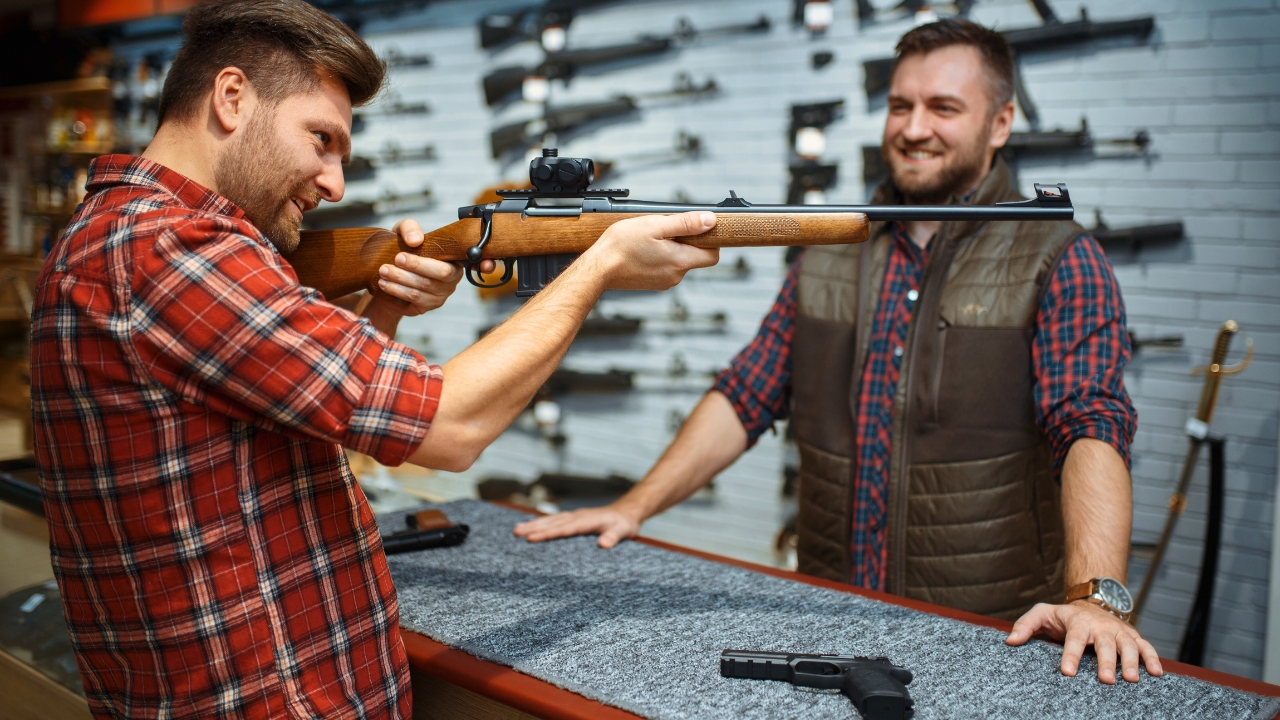
Photo credit: Nomad_Soul/Shutterstock.com
Gun counters are one of the few retail spaces where a single careless sentence can shut down a sale, alarm everyone within earshot, or even trigger a police report. The stakes are higher than in a typical shop, and regulars know there is a short list of things you simply do not say if you want to be taken seriously and stay on the right side of the law. I want to walk through those verbal land mines so a first visit feels professional instead of like an interrogation that went sideways.
From safety faux pas to jokes that sound like confessions, the wrong comment can make staff instantly wary or legally obligated to refuse a transaction. Knowing what to avoid at the counter is as important as knowing how to handle a firearm, because in a regulated environment, your words are part of your safety record.
1. “Relax, it’s not loaded” and other safety-denying lines
The fastest way to lose credibility at a gun counter is to dismiss basic safety rules with a shrug and a line like “Relax, it’s not loaded.” In every serious training environment, the first rule is to TREAT EVERY WEAPON AS IF IT WERE LOADED, and staff expect customers to respect that mindset. When someone waves a pistol around and insists it is safe because “I checked it earlier,” they are not just breaking etiquette, they are signaling that they do not understand why redundant checks exist in the first place.
Experienced shooters know that you Always verify the condition of a firearm handed to you and Never point a gun at anyone, even in a store where everything on the rack should be unloaded. Clerks hear “It’s fine, I know what I’m doing” as a red flag, not reassurance, because they have watched too many customers sweep the room with a muzzle while insisting they are safe. At the counter, the only acceptable script is to keep the firearm pointed in a safe direction, open the action, visually and physically check the chamber, and let your behavior, not your bravado, do the talking.
2. “Can you show me something super deadly?” and other macho posturing
Another category of phrases that lands badly is the cartoonish request for “something super deadly” or “the most powerful thing you’ve got.” Every modern firearm is capable of lethal force, and staff are trained to think in terms of fit, purpose, and local law, not body counts. When a customer frames the conversation around how intimidating a gun will look or how much damage it could do, it suggests they are chasing an image rather than taking on the responsibility that comes with ownership.
Good counter staff try to steer the discussion toward practical questions like intended use, recoil tolerance, and storage plans, which is why many etiquette guides urge customers to Do Your Research and arrive with a realistic idea of what they need. Walking in cold and announcing that you want “the biggest thing in the case” wastes time and makes it harder for staff to take you seriously. A better approach is to describe your experience level and goals, then let the clerk recommend options instead of trying to impress them with over-the-top language.
3. “I just got out after a Felony” and other background-check killers
Some of the most uncomfortable moments at a gun counter start with a customer casually admitting, “I just got out after a felony, can I still buy?” or hinting that they are under a restraining order. In a regulated sale, those are not small talk topics, they are disqualifying facts. Under both state and federal law, Felony convictions are a primary reason background checks are delayed or denied, and staff cannot simply ignore what a customer volunteers at the counter.
Workers who have shared their experiences online describe situations Where strict local laws meant that When a buyer hinted at disqualifying history, the sale “will definitely not be approved.” Once you tell a clerk you are prohibited, they cannot ethically or legally proceed, and some may be obligated to document the interaction. If you are unsure about your status, the right move is to consult an attorney or official resources before you ever step up to the counter, not to test the limits with a half-joking confession in front of a display case.
4. “I’ll buy it for my buddy” and other straw-purchase confessions
Few phrases shut down a conversation faster than “I’m actually buying this for my buddy, he can’t pass the check.” That is a textbook description of a straw purchase, and it is not something staff can laugh off as a misunderstanding. In plain terms, Straw Purchases, Buying a firearm on behalf of someone who is prohibited from owning one, are treated as serious gun violations, not favors for a friend.
Legal guides are blunt that it is a crime to transfer or purchase a firearm on behalf of anyone who may not lawfully possess one, and they note that Truth in the form of Buying for a prohibited person is called a “straw purchase.” When you say out loud that you are acting as a stand-in for someone who cannot pass a background check, you are effectively asking the clerk to participate in a crime. At that point, the only responsible response from staff is to refuse the sale and, in some jurisdictions, consider notifying law enforcement. If you are trying to help a lawful new shooter, the correct path is to have them fill out their own paperwork and pass their own check, not to volunteer incriminating details at the register.
5. “What if I make it full auto?” and other illegal-modification talk
Modern gun culture is full of customization, but there is a hard legal line between personalizing a firearm and turning it into something that violates federal or state law. At the counter, asking “How do I make this full auto?” or “Can I file this down so it bypasses the safety?” is not a clever technical question, it is a request for help committing a crime. Staff know that certain modifications, especially those that convert a semi automatic into a fully automatic weapon, are illegal in many places and can carry severe penalties.
Legal educators warn that Sharing information or images related to firearm modifications that push a gun toward fully automatic operation can raise red flags even online, where there is no sale taking place. In a brick and mortar shop, the stakes are higher, because the person you are talking to is part of a regulated industry. If you genuinely need to understand what is legal, the right way to ask is to frame it as a compliance question, not a how-to request, and to accept it when the answer is that certain changes are simply off the table.
6. “Watch this” while you sweep the room
Even when a customer keeps their mouth shut, their body language can say all the wrong things, and pairing that with a line like “Watch this” only makes it worse. Clerks routinely describe people picking up a pistol, snapping it toward other customers, and then trying to excuse it with “It’s not loaded” or “I’m just seeing how it points.” In a confined retail space, that kind of behavior is not just rude, it is frightening for everyone in the line of the muzzle.
Seasoned shooters emphasize that you should Never point a gun at anyone and that you should Always check and clear a firearm when it is handed to you, even if you watched the clerk clear it seconds earlier. Many stores spell out similar expectations, reminding customers that firearms live in the holster or in a safe direction and that Firearms Live in the Holster when not being deliberately examined. If you need to check the sights or feel the trigger, keep the muzzle pointed at a designated backstop or the floor, ask permission before any dry fire, and let your safe handling speak louder than any attempt to show off.
7. “Mind if I just dry fire a bunch?” and other handling missteps
Dry firing, or pulling the trigger on an unloaded gun, is a normal part of evaluating a firearm, but it is not something you assume is allowed. Walking up to the counter and saying “Mind if I just dry fire a bunch?” while you start snapping the trigger is a quick way to make staff nervous. Many shops are comfortable with limited dry fire if the muzzle is in a safe direction and the customer has asked first, but they expect you to treat their inventory with the same care you would give your own property.
Instructors who talk about store etiquette stress that you should never start manipulating a trigger until you have confirmed with the clerk that it is acceptable, a point that is echoed in short educational clips on Nov about dry fire in a gun store. Some retailers also remind customers not to walk in with their own gun drawn from a holster or bag, and to use a chamber flag if they are bringing in a firearm for service, advice that aligns with guidance not to walk into a shop with assumptions or a bad attitude from Don. At the counter, the polite script is simple: ask before you manipulate anything, move slowly, and treat every gun as if it were your own.
8. “I’m just browsing, leave me alone” and other customer-service killers
Gun stores are retail businesses, but they are also gatekeepers for a heavily regulated product, which means staff have to ask more questions than a clerk at a shoe store. Snapping “I’m just browsing, leave me alone” when someone approaches is not only rude, it makes it harder for them to do their job. Instructors who coach new buyers point out that the reflexive “Hey, no I’m fine just browsing” response can shut down useful guidance that would actually make the visit more productive.
Etiquette guides urge customers not to Be Rude or Impatient and to Avoid treating staff like pushy salespeople when, in reality, Everyone is there to help navigate complex laws and safety considerations. At the same time, they caution against monopolizing a clerk’s attention for an hour of free education if you have no intention of buying, or turning the counter into a social club while others wait. A simple “I’m just getting a feel for what is out there, but I will let you know if I have questions” keeps the interaction courteous without cutting off help you might actually need.
9. “Just kidding, that’d be illegal” and other bad jokes
Finally, there is the category of comments that are meant as jokes but land like confessions. Cracking, “What if I robbed a bank with this, ha ha, just kidding” or “How many people could I take out with this thing?” is not edgy humor in a place where staff are trained to listen for threats. Training outfits explicitly warn customers not to Make a joke about anything that sounds even REMOTELY ILLEGAL, because clerks cannot read your mind, only your words.
Workers have heard every variation, from people joking about failing background checks to customers asking if they can Jiggle the safe and see what falls out, behavior that other professionals echo when they list Jiggle gun safe handles and attempt to buy a firearm after admitting disqualifying conduct as things that will get you shown the door. Even seemingly harmless banter about “gaming the system” can sound like intent to commit fraud. In a setting where every sale is documented and potentially scrutinized, the safest choice is to leave illegal scenarios out of your small talk entirely.
10. “I don’t care about the rules” and other attitude problems
Beyond specific phrases, the overall attitude you bring to the counter shapes how every word is received. Walking in and announcing “I don’t care about the rules, I just want a gun” or rolling your eyes at paperwork tells staff that you may not respect the responsibilities that come with ownership. Etiquette advice aimed at new buyers stresses that you should not go into a shop with assumptions or a bad attitude, and that you should be ready to listen when staff explain store policies or legal requirements.
Some guides even suggest doing basic homework on Other Firearms Terminology You Should Know Straw Purchase The and related concepts so you are not learning the vocabulary of gun law for the first time at the counter. That preparation makes it easier to ask precise questions and avoid sounding cavalier about serious topics. Communication experts also note that certain sales buzzwords and aggressive phrases tend to shut down conversations, which is why they recommend avoiding language that triggers eye rolls from your prospects, advice that applies just as well when you are the customer, as outlined in a guide to sales words to avoid. At a gun counter, respect for the process, clear questions, and a willingness to hear “no” are the difference between a smooth transaction and a conversation that ends before it begins.
Like The Avid Outdoorsman’s content? Be sure to follow us.
Here’s more from us: