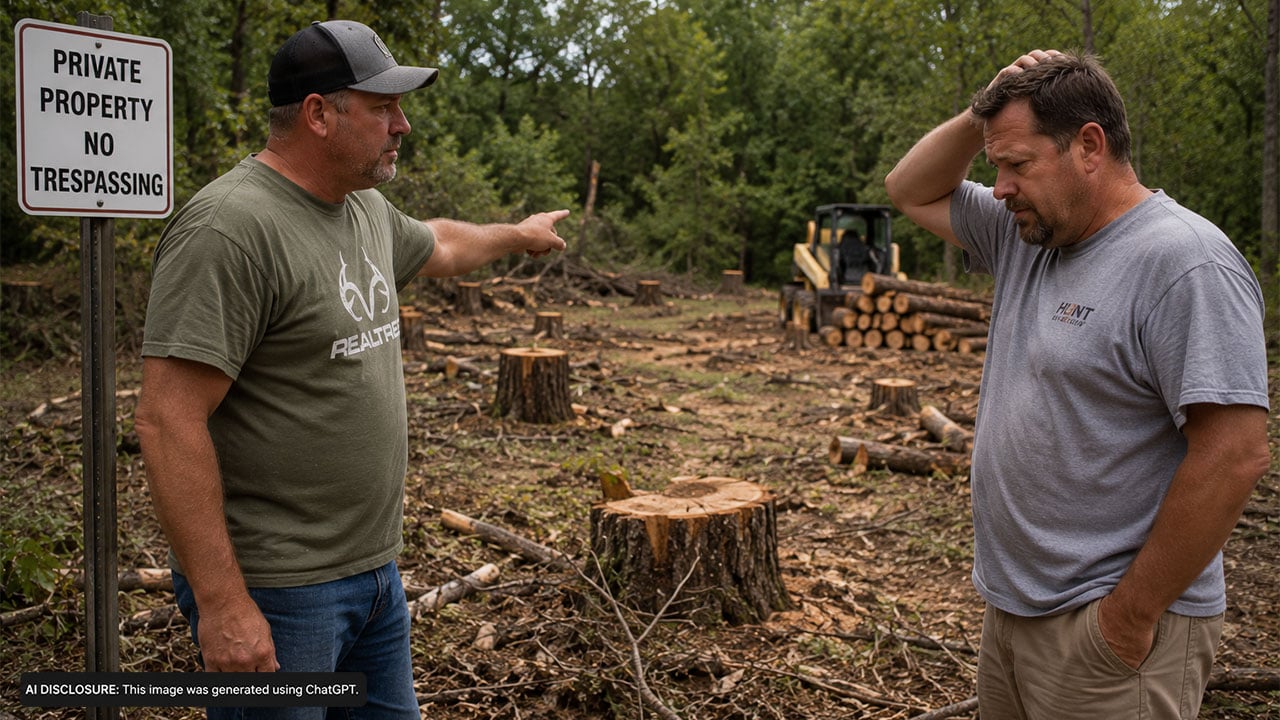
Photo credit: AI-generated image created using ChatGPT. Illustrative only
You can walk a property line a hundred times and never notice the weak spots—until somebody runs equipment through the back corner and leaves you staring at fresh stumps. That’s exactly what one landowner found out after a hunting buddy spotted a cleared strip at the far end of the property.
In the original post, the landowner said a neighbor behind him cleared a path roughly 600 feet long and about 50 feet wide, using machinery. In the process, somewhere around 17 to 19 good-sized oak trees were cut down, and the area was left bare aside from debris.
A hunting buddy found the damage first
This wasn’t a case of the owner noticing a small change while mowing or checking fence. It was a hunter on the property who found it—exactly how a lot of rural problems get discovered. Hunters tend to cover the ugly, out-of-the-way corners: the back end of the place, the thick pockets, the edges nobody drives by every day.
According to the landowner, the cleared area looked like a deliberate corridor cut with equipment. When you’re talking 600 feet of disturbance and dozens of feet wide, that’s not a guy with a chainsaw getting confused for 10 minutes. That’s a project.
Seventeen to nineteen oaks is more than “just some trees”
Oak isn’t brush. Oak is mast, shade, stand sites, funneling cover, and years of slow growth that can’t be replaced on your timeline. On many hunting properties, big oaks aren’t just scenery—they’re part of how you hold deer and how you predict movement when acorns are falling.
Even if you never planned to log, mature oaks carry real value. There’s timber value, sure, but there’s also the replacement value side—what it costs to restore the property to something close to what it was. And depending on the state, timber trespass can come with penalties that go beyond simply paying for the wood.
The neighbor admitted fault, but the landowner still went into “prove it” mode
When the landowner contacted the neighbor behind him, the neighbor reportedly admitted fault. That’s rare, and it matters, because so many of these disputes turn into finger-pointing fast. But an admission doesn’t fix the damage, and it doesn’t automatically settle what’s owed.
The landowner’s response was about as practical as it gets. He scheduled a surveyor to verify property lines, lined up two logging estimates to nail down timber value, and also arranged for a certified arborist to calculate replacement value for the trees. He also took photos of the area and stumps he believed were on his side, and documented conversations with the neighbor.
If you’ve spent time in the country, you know why that matters: memories get foggy, stories change, and “I thought it was mine” suddenly becomes the default line. The paperwork is what holds.
Why this hits hunters and rural landowners right in the gut
A lot of folks who don’t own land hear “trees got cut” and picture a few random trunks. But hunters read this differently. A newly cut lane can change how deer travel, open up sightlines you didn’t want, and shift pressure onto neighboring cover. It can also create access for trespassers—two-track lanes and cleared corridors have a way of becoming invitations.
There’s also the simple fact that a back boundary is where people push their luck. It’s far from the house, far from the road, and the odds of being caught in the act feel low. When heavy equipment shows up, it’s not just property damage—it’s a safety concern. An unannounced dozer or skid steer working a line can put hunters, family members, or guests in a bad spot.
The landowner didn’t describe a confrontation in the field, and that’s a good thing. When you find damage like this, the smart play is to step back, document, and handle it through the right channels—not get into a shouting match in the timber where nobody has witnesses and everybody’s adrenaline is high.
The most useful “next steps” were already underway
The landowner asked what else he should do besides contacting a lawyer, and the reality is he was already doing the big three things that matter in a timber-cut scenario: confirm the boundary, document the damage, and establish value with professionals.
Those steps matter because each one answers a different question. The survey answers “whose land is it?” The logging estimates address “what was the timber worth?” The arborist speaks to “what’s the cost to replace or restore?” And photos plus written notes help preserve the timeline—what it looked like, where the stumps sit, and what was said.
In a rural setting, it’s also common sense to keep an eye on the site after the fact. Not to play security guard, but because debris piles, ruts, and disturbed soil can lead to erosion and washouts that get worse with each rain. If the corridor becomes a new “route,” it can create ongoing problems long after the chainsaws leave.
A hard lesson: property lines are only real when they’re verified
Plenty of neighbors get along fine for years based on a handshake understanding of where the line “has always been.” Then somebody decides to clear a path, run a fence, cut firewood, or open up a view—and suddenly that old assumption becomes expensive.
What makes this situation stand out is the scale: a long cut lane, heavy machinery, and nearly 20 mature oaks. Even with an admission of fault, it’s the kind of damage that can’t be shrugged off as a simple mistake, especially if the survey shows the cut was clearly over the line.
The best time to nail down your boundaries is before you need them. But if you’re reading this and thinking about your own place—especially land you hunt—take the hint. Know your corners, mark them clearly where legal, keep maps and survey records handy, and don’t assume the other side of the line is paying as much attention as you are.
For this landowner, the response was calm, methodical, and grounded in documentation—exactly how you protect your property, your hunting ground, and your wallet when someone else makes a mess of all three.
Like The Avid Outdoorsman’s content? Be sure to follow us.
Here’s more from us: