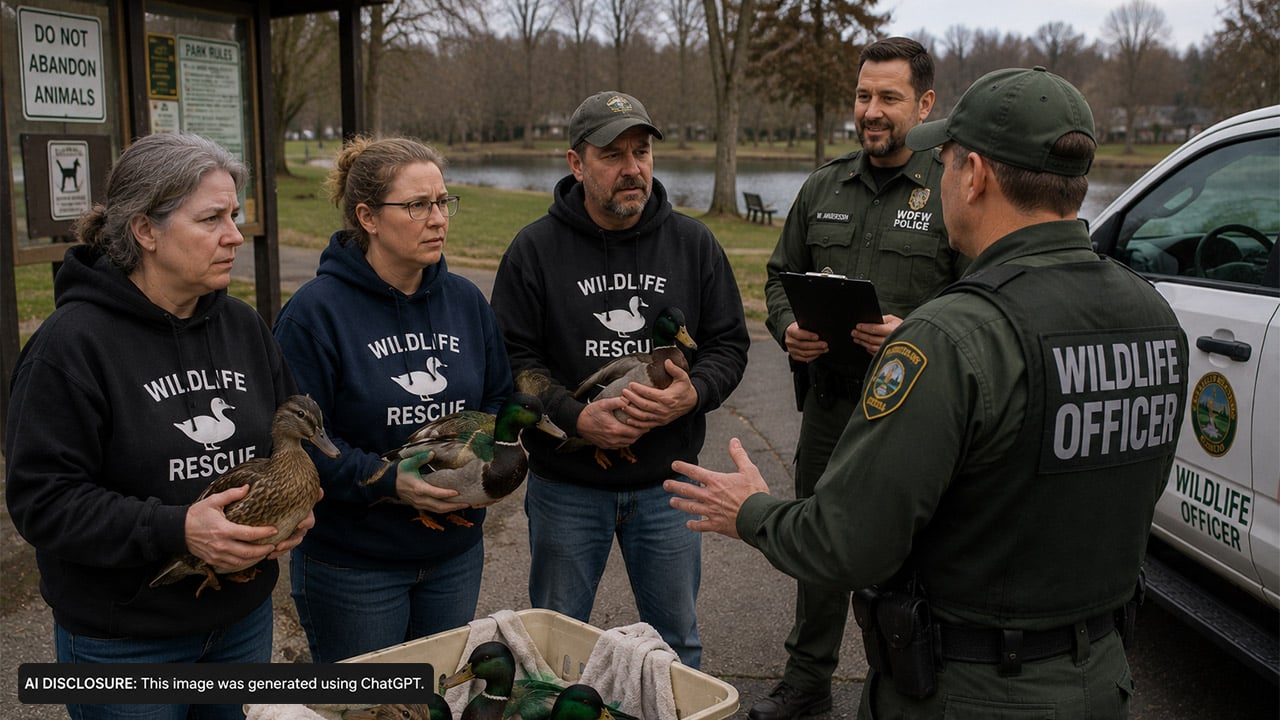
Photo credit: AI-generated image created using ChatGPT. Illustrative only
A couple domestic ducks in a park shouldn’t be a felony-level problem. But in Washington state, one group of volunteers says a simple animal-rescue effort turned into an hour-long detention, threats of “felony theft of wildlife” charges, and a confusing order to put the birds right back where they’d been dumped.
The account comes from the original post, where the writer describes trying to safely remove several domestic ducks from a local park after they were allegedly abandoned by a previous owner. According to the post, once an officer contacted fish and game, the tone changed fast—and the volunteers were cleared. But the way it ended left them with more questions than relief.
Domestic ducks in a public park set the stage
The volunteers say they were attempting to “safely remove a batch of domestic ducks” that had been dumped at a park. Not wild birds—domestic waterfowl—exactly the kind of animal that tends to do poorly when it’s suddenly expected to fend for itself around ponds, people, dogs, and coyotes.
The writer also noted they weren’t amateurs. They said they run a waterfowl and poultry farm with quarantine and foster capability and “over 50 years experience keeping and raising birds.” In other words, this wasn’t somebody grabbing ducks for fun. It was an attempt to get abandoned domestic animals out of a public place and into a controlled setup where they could be cared for and rehomed.
A bystander call turned it into a law-enforcement stop
In the post, a concerned (or angry) bystander decided the ducks should be left alone and called police. That’s the moment this went from a nuisance wildlife issue to an enforcement situation—one that played out in front of a park full of eyes.
According to the volunteers, police arrived and detained them. The writer describes the first officer as “extremely aggressive” and unwilling to listen, and said two more officers showed up shortly after. The claim is that the group was made to sit and wait while being “belittled and harassed.”
If you spend time outdoors long enough—hunting access issues, fishing spots, even trapping on the edges of town—you learn fast that the call-taker and the responding officer may not have the right category in mind at first. A domestic duck in a park can look like “wildlife” to someone who’s not used to sorting out what’s legal to possess, what’s protected, and what falls under livestock or domestic animal rules.
Felony talk, then a sudden reversal after fish and game was contacted
The big claim in the post is the threat: officers allegedly warned of “felony theft of wildlife charges” and jail time. For anyone who hunts or fishes, the phrase “theft of wildlife” hits like a hammer. That’s the kind of thing you associate with poaching cases, illegal take, spotlighting, or stealing game from a property—not picking up dumped domestic ducks.
Then things shifted. The writer says officer #1 made calls and eventually “supposedly contacted the fish and game department.” After that, the other two officers reportedly left quickly, the detention ended, and the volunteers were told no charges were being pressed.
That part matters. It suggests someone with actual fish-and-wildlife knowledge got looped in and immediately recognized the situation didn’t fit the initial threat narrative—at least not the way it was being framed on scene.
The order to release the ducks raised another legal concern
Here’s where the story gets especially frustrating for anyone who’s dealt with wildlife rules: the volunteers say they were ordered to release the four ducks they’d already captured back into the park.
The writer believed that re-releasing the birds was “technically illegal,” and pointed out why: domestic ducks “will not survive long in the wild,” could interbreed with wild mallards, and “should not legally be re released.” Even if you set aside genetics and long-term impacts, dumping domestic animals is a real problem in rural and suburban areas because it turns human irresponsibility into everyone else’s headache.
Outdoorsmen understand the basic principle: you don’t move animals around casually. Whether it’s baitfish, invasive species, or transplanting critters, “just let them go” can be exactly the wrong call. If these were truly domestic ducks, releasing them back into a public park doesn’t solve the abandonment—it just resets the clock until the next confrontation, the next dog chase, or the next cold snap.
They questioned officer conduct and want confirmation from fish and game
The volunteers didn’t just walk away irritated. They said they suspect they were lied to “multiple times” and plan to file formal complaints and request review of bodycam footage for misconduct.
They also described officers attempting to omit their information, including one who allegedly handed the writer’s wife a business card “that wasn’t his.” That’s the kind of detail that makes people lose trust quickly, especially in a situation that already felt heavy-handed.
On the practical side, the writer wanted to contact fish and game directly to verify the actual regulations. That’s a smart instinct. In the outdoor world, the most reliable way to keep yourself out of trouble is to get the rule straight from the agency that enforces it—especially when the incident involves categories like “wildlife” versus domestic animals and when local city bylaws might use broad terms that don’t fit real life neatly.
The writer’s view was simple: abandoned domestic waterfowl that were observed being dumped “cannot and do not fit under any category of wildlife,” and the city rules they’d seen referenced “wildlife.” If that’s true, it explains why the fish-and-game contact seemed to de-escalate things. It may also explain why the volunteers felt the initial felony talk was way out of lane.
What outdoorsmen can take from this kind of mess
This is the part a lot of hunters, anglers, and landowners will recognize: good intentions don’t protect you when you’re standing in public with animals in your hands and a patrol car pulls up. Even if you’re doing the right thing, you can still get treated like you’re doing the wrong thing—at least until the right person is consulted.
A few practical lessons show up in the details the writer shared. First, it helps to document what you can safely document: photos of dumped animals, the conditions, and the fact they’re domestic breeds if that’s obvious. Second, the moment law enforcement shows up, staying calm and clearly stating your purpose matters, even if the other side isn’t listening at first. Third, when an officer says they spoke to fish and game and you’re cleared, it’s reasonable to want to verify that—because “supposedly contacted” is not the same as getting a case number, a contact name, or clear direction.
And finally, if you’re ordered to do something you genuinely believe is illegal—like re-releasing domestic animals into a park—the best move is to ask, politely and plainly, for clarification and documentation. You don’t argue. You don’t get loud. You try to get the instruction and the reasoning pinned down, because later on that detail is what separates a misunderstanding from a mess that keeps growing.
In the end, the volunteers say they were cleared once fish and game got involved. But the bigger problem—people dumping domestic ducks and expecting the public to deal with it—was still sitting right there at the park. That’s the part worth remembering: when agencies and bystanders collide over “wildlife,” it’s often the animals that pay the price first, and the good Samaritans who learn how quickly a normal evening can turn into a legal scare.
Like The Avid Outdoorsman’s content? Be sure to follow us.
Here’s more from us: