Photo credit: The Avid Outdoorsman
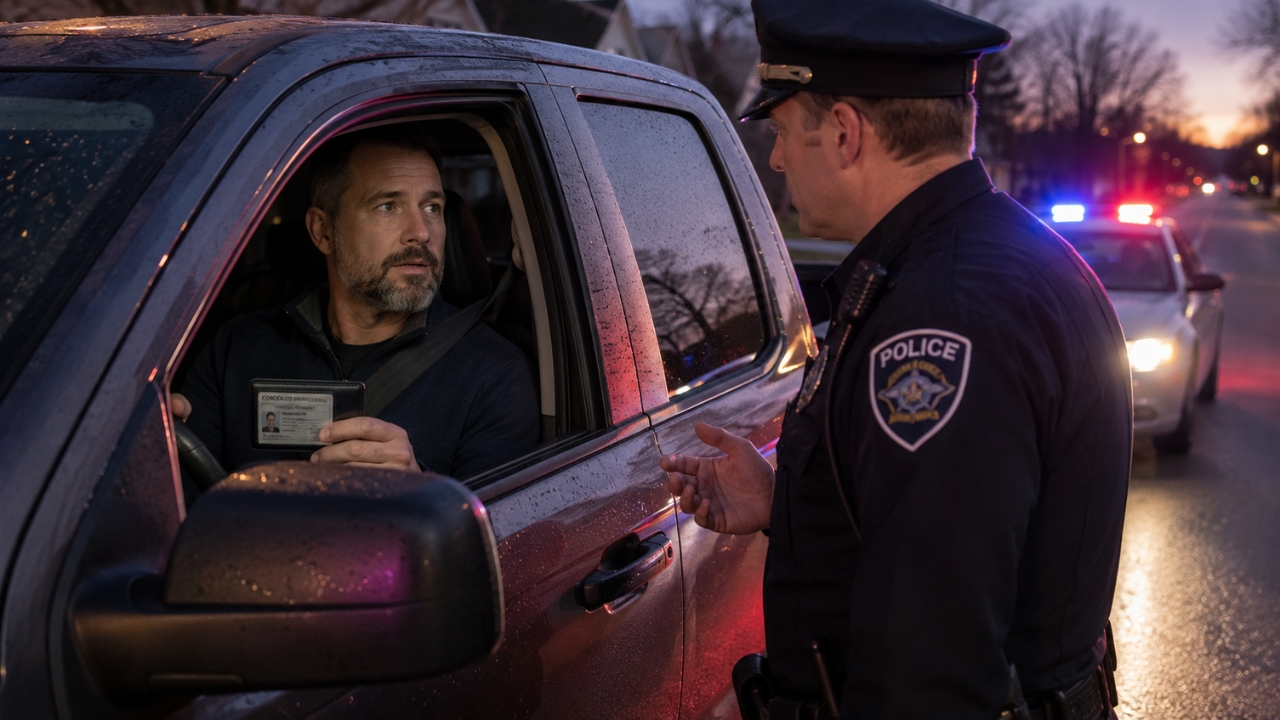
A concealed carrier in Reddit’s r/CCW described the kind of law-enforcement encounter that a lot of permit holders think through in advance but still do not fully understand until it happens for real. He said he got pulled over after making what he called a dumb U-turn, and it turned into his first traffic stop while armed. Nothing dramatic set it off. There was no argument, no drawn gun, and no suspicious behavior beyond the turn that got the officer’s attention. That was part of what made the stop feel so instructive to him. It was not some nightmare scenario. It was ordinary, which meant every small decision about how to act suddenly mattered more. The original Reddit thread is here: https://www.reddit.com/r/CCW/comments/1lamoiv/first_traffic_stop_while_carrying/.
From the way he wrote it, the moment the lights came on, his attention shifted fast from the traffic mistake itself to the fact that he was armed. That mental switch is familiar to almost anyone who carries regularly. A normal stop is one thing. A normal stop while carrying adds another layer immediately. Now the driver is no longer only thinking about license, registration, and whether he deserves a warning or a ticket. He is also thinking about visibility, hand placement, timing, whether to notify right away, what state law requires, and how to avoid creating tension in a situation where the officer has not yet decided what kind of person he is walking up on.
That is what gives a story like this its shape. Traffic stops are quiet until they are not. The armed driver has a few seconds to choose his tone, his posture, and how much he wants the officer to learn all at once. If he moves wrong, reaches too early, talks too much, or tries to be clever, he can make a basic roadside interaction feel far more dangerous than it needs to. That underlying pressure was all over the post. Even if the stop itself stayed calm, the carrier was clearly aware that his own behavior would do a lot to determine whether it stayed that way.
The discussion around first traffic stops while armed usually turns quickly toward one practical issue: notification. Some states require it. Some do not. Even where it is not required, a lot of carriers still prefer to notify immediately because they would rather be the one to say it before the officer sees a permit during the document check or catches sight of the gun itself. Other carriers think volunteering too much too quickly can raise the temperature for no reason if the officer would never have noticed. That tension tends to sit underneath almost every thread like this, and it is part of why first-stop stories matter so much to people. They are not just reading about a ticket. They are reading about how somebody chose to handle the most awkward part of the encounter.
The calmer replies in threads like this usually repeat the same advice because it works. Keep your hands visible. Tell the officer where your hands are going before you move them. Do not start digging around in the console while the officer is still walking up. Do not turn your body in a way that makes the gun or waistband area the center of the interaction. And above all, do not let your nerves push you into trying to over-explain everything. A traffic stop while carrying is one of those moments where boring behavior is your best friend. The more normal and predictable you look, the more likely the officer is to treat the stop like the normal stop it began as.
That is one of the most useful parts of these stories: they strip away a lot of the performative nonsense people imagine before it happens. The internet is full of fantasy traffic-stop debates where people argue about rights, rehearsed lines, when to inform, and how much anyone “owes” an officer in conversation. Then a real person gets pulled over for a dumb U-turn while armed, and what matters most is not who has the most theoretical talking points. It is whether the driver stays still, communicates clearly, and avoids making a routine roadside contact feel uncertain for the officer approaching the car.
A first stop also tends to change the way people think afterward. Before it happens, a lot of permit holders imagine only two versions: either everything goes perfectly and calmly, or everything spirals. In reality, most stops land somewhere in the middle. They are awkward, deliberate, and full of little moments where everyone is quietly trying to avoid misunderstanding the other person. That awkwardness is useful. It reminds carriers that a gun in the car may be legally ordinary to them, but it still changes the emotional geometry of the stop. Once the weapon enters the conversation, even briefly, the driver is no longer only “the guy who made a bad U-turn.” He is also “the guy with the gun,” and how he handles that identity matters.
Commenters on posts like this often respond with their own stop stories, and that tends to push the conversation toward pattern recognition. Some officers are totally matter-of-fact. Some barely react after notification. Some get a little stiffer. Some will direct the driver more closely. But the replies usually come back to the same broader point: the carrier has the most control at the beginning. If he sets the tone with calm hands, calm voice, and simple communication, the interaction usually stays much closer to ordinary. If he makes the officer work harder to figure out what is going on, the stop gets more tense for everyone in the first few seconds that matter most.
The “dumb U-turn” detail also helps because it keeps the story rooted in something unglamorous and real. This was not a tactical situation. It was a small driving mistake that became a first real test of how the carrier would behave with a loaded gun on him and police at the window. That is a much more useful kind of story than one built around internet swagger. It reminds people that their most important carry decisions will often happen in boring places: at a red light, in a parking lot, on a shoulder, with registration in the glove box and an officer approaching from behind.
What lingers in a post like this is not usually the traffic violation. It is the realization afterward that staying calm is not just good manners. It is part of safe gun handling in public life. A firearm does not only matter during crimes or emergencies. It also matters during misunderstandings, roadside stops, paperwork moments, and every situation where another person has to decide quickly whether you are safe to deal with. A first traffic stop while carrying makes that painfully clear because the carrier gets to feel every second of that judgment happening in real time.
And that is where this story lands. A man made a dumb U-turn, got pulled over, and had his first real traffic stop while carrying. The stop itself was not the point so much as the lesson built into it. When a gun is on your body and police are at your window, the smartest thing you can do is make yourself look exactly like what you want the encounter to be: calm, ordinary, and easy to understand. That sounds simple after the fact. It feels a lot bigger the first time the lights come on behind you.