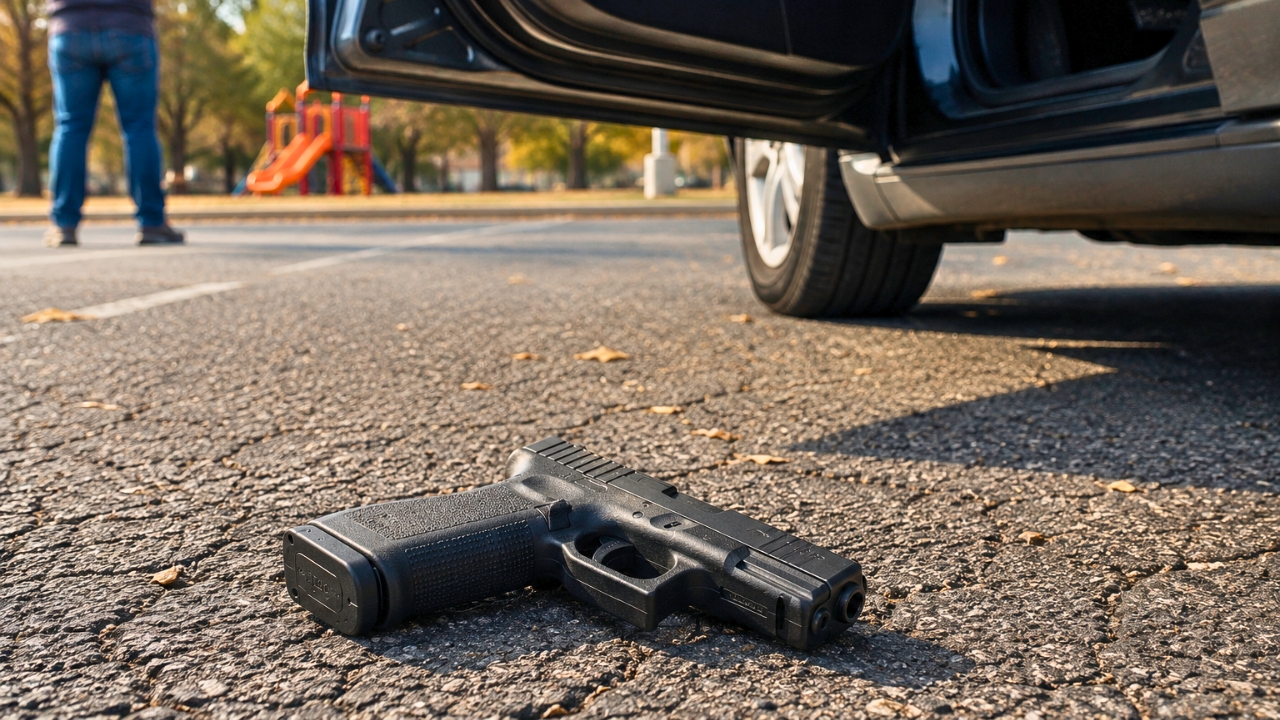
Photo credit: The Avid Outdoorsman
The gun owner was not in the middle of some high-stress moment.
He was getting out of his car.
That is the kind of boring, everyday movement concealed carriers do a hundred times without thinking much about it. Open the door, shift your weight, stand up, grab your stuff, close the door, and go about your day.
Except this time, the car door caught his gun.
In a Reddit post, the gun owner said his concealed carry pistol accidentally came out of its holster when he was getting out of the vehicle. From the way he described it, the door caught the gun or holster just right and yanked it loose, sending the pistol down onto the pavement.
That is one of those carry mistakes that makes your stomach fall before the gun even hits the ground.
A lot of people think about concealment while standing in front of a mirror. Does the shirt cover it? Does the grip print? Can anyone see the clip? But real life is not standing still in a bedroom. Real life is getting in and out of vehicles, buckling seatbelts, twisting around, reaching for dropped keys, leaning over consoles, picking up kids, and squeezing through tight spaces.
Cars are especially good at exposing weaknesses in a carry setup.
A seatbelt can push against a holster. A center console can rub the grip. A jacket can ride up. A door frame can catch fabric. A holster clip can shift. And if someone is pocket carrying, the pocket itself can get pulled, folded, snagged, or pressed in ways the carrier never tested.
That seems to be what happened here. One normal movement turned into a public gun drop.
The pistol landing on pavement is bad enough. Even if a modern handgun is drop-safe, nobody wants to test that theory beside a car in broad daylight. The sound, the sight of it, the sudden rush to secure it — all of that can make a person feel exposed instantly.
And if anyone is nearby, the embarrassment gets ten times worse.
People seeing a gun fall out of a vehicle do not know the backstory. They do not know if the owner has a permit, if the gun is loaded, if the holster failed, or if the whole thing was an accident. They just see a firearm hit the ground. Some people may freeze. Some may panic. Some may call police. Some may start recording. That is the nightmare side of concealed carry: a private equipment problem can become a public scene immediately.
The poster’s situation is exactly why retention matters, even with pocket carry.
Pocket carry can be convenient, especially with smaller pistols. It can be comfortable, discreet, and easy to work into normal clothing. But it also has its own risks. The gun needs to stay inside a proper pocket holster. The holster needs to cover the trigger guard. It needs to stay in the pocket when the gun is drawn. And most importantly for normal life, it needs to keep the gun secured when the carrier is sitting, standing, driving, bending, and getting out of tight spaces.
A pistol that can be yanked loose by a car door is not secure enough.
That does not mean the gun owner was reckless on purpose. Gear and carry methods sometimes fail in ways people do not expect until something embarrassing happens. But once it happens, the warning is loud and clear. Something about the setup needs to change.
Maybe the holster was too loose. Maybe the pocket was too shallow. Maybe the gun was too exposed when seated. Maybe the holster did not have enough structure. Maybe the carry position worked while walking but not while exiting a vehicle. Whatever the cause, it had to be fixed before the next carry day.
Because the next time, the gun might not fall onto empty pavement. It could fall in a parking lot full of people, at a gas pump, near a school pickup line, outside work, or in front of someone who reacts loudly.
That is the part that sticks. A carry system has to survive boring moments. In fact, it especially has to survive boring moments because those are the ones that happen every day. The parking lot, the grocery store, the park, the truck seat, the office chair — that is where most gear failures show up.
The gun owner’s post was embarrassing, but it was also useful because it caught a problem before anything worse happened. Nobody was hurt. The gun did not go off. He got a hard lesson and a chance to rethink the setup.
That is still a bad day, but it is a better outcome than it could have been.
Commenters mostly focused on the carry setup, because the car door did not create the problem by itself. It exposed it.
Several people said the gun should not be able to come out of the holster that easily. A proper holster needs enough retention to keep the pistol secure during normal movement, including getting in and out of a vehicle. If the gun can be pulled free accidentally, the setup is not dependable.
Others talked about pocket carry specifically. They said pocket carry can work, but only with the right holster and the right pants. Deep enough pocket, secure holster, covered trigger, and no loose items sharing that pocket. A pocket pistol floating around or sitting in a poor holster is asking for trouble.
A few commenters pointed out that vehicles are a major test for any carry method. Sitting changes angles. Clothing shifts. Holsters get pressed or bumped. The advice was to test the setup unloaded at home and around the vehicle: sit down, buckle up, get out, bend, twist, and see what catches.
Some people were sympathetic because almost every carrier has had a near-miss, printing issue, clothing snag, or gear scare at some point. But the sympathy came with the same message: fix it now.
The strongest advice was simple. Do not trust a carry setup just because it works while standing still. If it fails getting out of a car, it has already failed real life.