Photo credit: black bear
The hunter said he had thought about bear defense before.
He had watched the videos. He had read the arguments. He had worked through the usual questions that come up when people start talking about sidearms, bullet construction, and what actually matters if a bear decides to close the distance. Hard cast or expanding bullets. Heavy and slow or lighter and tougher. Bear spray or handgun. The kind of debate that sounds very organized when everyone is sitting safely at home.
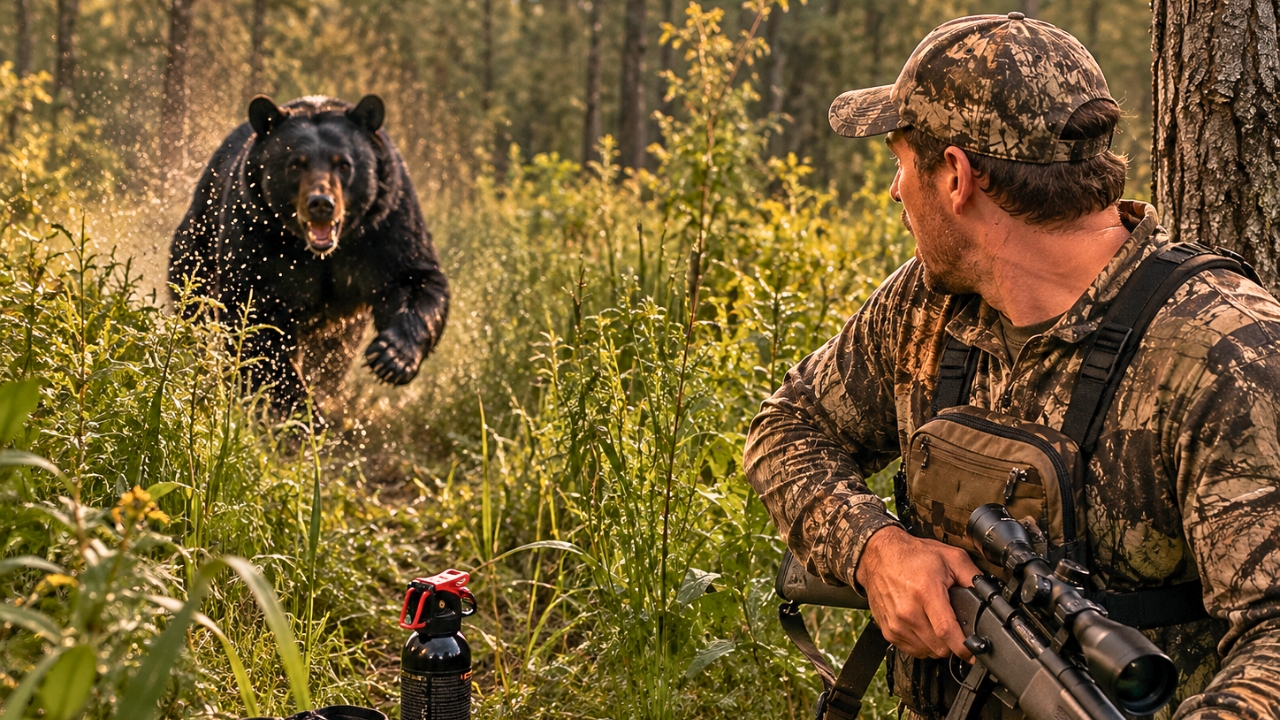
Then he had a bear come out of the trees and run straight at him through chest-high weeds.
In a Reddit post, the hunter was asking about bullet choices for bear defense, specifically for a .44 Magnum revolver. But buried in the replies, he shared a real encounter from a few years earlier in Santa Barbara County that made the whole discussion feel a lot less theoretical.
He said he and a friend were hunting in a little valley in the mountains. The weeds in the field were chest high, and there was forest on both sides of them, maybe 30 yards away. That is already not a place where you have much room to react. Tall weeds cut down visibility. Timber on both sides gives anything nearby a way to stay hidden until it is already moving.
Then they heard something crashing through the brush.
That sound alone will get your attention. Not a soft rustle. Not a squirrel making leaves sound louder than they are. Crashing. Something big moving with purpose through the cover.
Then they saw the black shape come out of the tree line.
It was an adolescent black bear, and it was barreling toward them.
That is the part that seems to have stuck with him more than anything else: the speed. He said that in just a fraction of a second, the bear was out of the trees and already halfway to them. That is the kind of distance your brain wants to measure calmly later, but in the moment, it is almost useless. You are not thinking in yards. You are thinking, “That thing is here now.”
He had a shotgun in his hands, but it was set up for birds. That meant the gun he was holding was not really the gun he would have chosen for a bear charge. He said all he had loaded was No. 6 birdshot.
That is a rough feeling. Technically, he had a firearm. Practically, it was not much comfort for a bear coming fast through the weeds.
He tried to get the bear into his sight picture, but even with the shotgun already in his hands, he could not do it until the bear was about 15 yards away. That detail says more than any gear debate could. People love to argue about perfect defensive calibers, but if the animal is covering ground that fast, even a gun in hand can feel slow.
Right as he was about to shoot, their yelling turned the bear.
That was the break. Not a perfect shot. Not a magic bullet. Noise. The bear turned away before he had to fire, which was lucky in more ways than one. If he had pulled the trigger, he was about to send birdshot at a bear at close range, not because it was ideal, but because that was what he had.
The hunter did not describe the bear as a monster or turn the story into some trophy-style brag. His reaction was more like shock. He was stunned by how much ground the animal covered before he even fully understood what was happening.
And that is the part that makes the story useful.
A lot of bear-defense talk gets stuck in numbers. Bullet weight. Penetration. Barrel length. Caliber. Hardness. Expansion. All of that matters in some situations, but this encounter put another question right at the center: can you even get the tool on target fast enough?
That is where commenters started talking about bear spray too. One commenter said spray is often easier to aim, can create a barrier between you and the bear, and may stop a charge without requiring perfect shot placement under panic. Others said they would never trust spray alone, especially around bigger bears. The original poster was mainly talking about California black bears, not coastal brown bears, so his risk calculation was different from someone hunting in Alaska.
Still, his own story made one thing clear. The bear did not give him much time to calculate anything.
From the tree line to 15 yards happened almost before he could process it. That means any defensive plan that requires calm, perfect aim, or multiple deliberate decisions may not survive first contact with a real animal moving fast.
It also shows why yelling, awareness, and not surprising animals matter. The bear turned when they made noise, which may have prevented the encounter from getting much worse. Maybe it was startled. Maybe it was not fully committed. Maybe it wanted out once it realized two people were standing there. Whatever the reason, the noise worked in that moment.
But the hunter came away with a sharper respect for how quickly a bear can close distance.
That is not the same as saying everyone needs to be terrified of every black bear in the woods. Most black bears want nothing to do with people. Plenty of encounters end with the bear leaving as soon as it realizes a human is nearby. But “most of the time” does not mean much when one is already coming through the weeds toward you.
For this hunter, the question of bear defense stopped being a tidy internet debate. He had already lived through the part that makes all those arguments matter: the sudden crash, the black shape, the shotgun coming up too late, and the realization that 30 yards can disappear in seconds.
Commenters had strong opinions, as they always do when bear defense comes up.
Some people told him he was overthinking the bullet question if he was mainly worried about California black bears. Their argument was that shot placement and the ability to control the gun mattered more than chasing the perfect load. A big revolver does not help if a person cannot draw it, aim it, and make hits under stress.
Others focused on penetration. Several said that for a charging bear, the goal is not only a clean heart-lung shot like a normal hunt. The goal may be breaking shoulders, driving deep enough to reach vitals, and slowing the animal down. That is why hard cast and other deep-penetrating bullets get recommended so often in bear-defense conversations.
Bear spray got a lot of support too. Some commenters said spray can stop a charge more reliably than people give it credit for, especially because it does not require the same pinpoint accuracy as a handgun. Others said spray and a gun together make more sense than treating it like one-or-the-other. Spray may buy space. A gun may be the last option if that fails.
There were also plenty of jokes, because it is Reddit. Someone suggested the best bear defense was a .22 so you could shoot your buddy in the knee and run. Another joked about grenade launchers. But under the jokes, most of the practical comments came back to the same point: practice matters.
A handgun on your belt is not a force field. A powerful cartridge does not matter if you cannot hit with it. And a bear moving fast through cover is not going to wait while you work through the perfect answer.
The hunter’s own story backed that up. He had a gun already in his hands, and the bear still covered most of the distance before he could get a sight picture. That is the part a lot of people should sit with before they assume the right caliber solves everything.