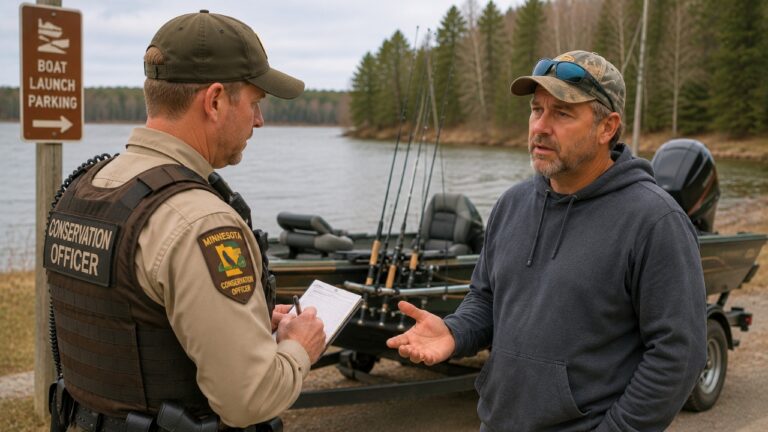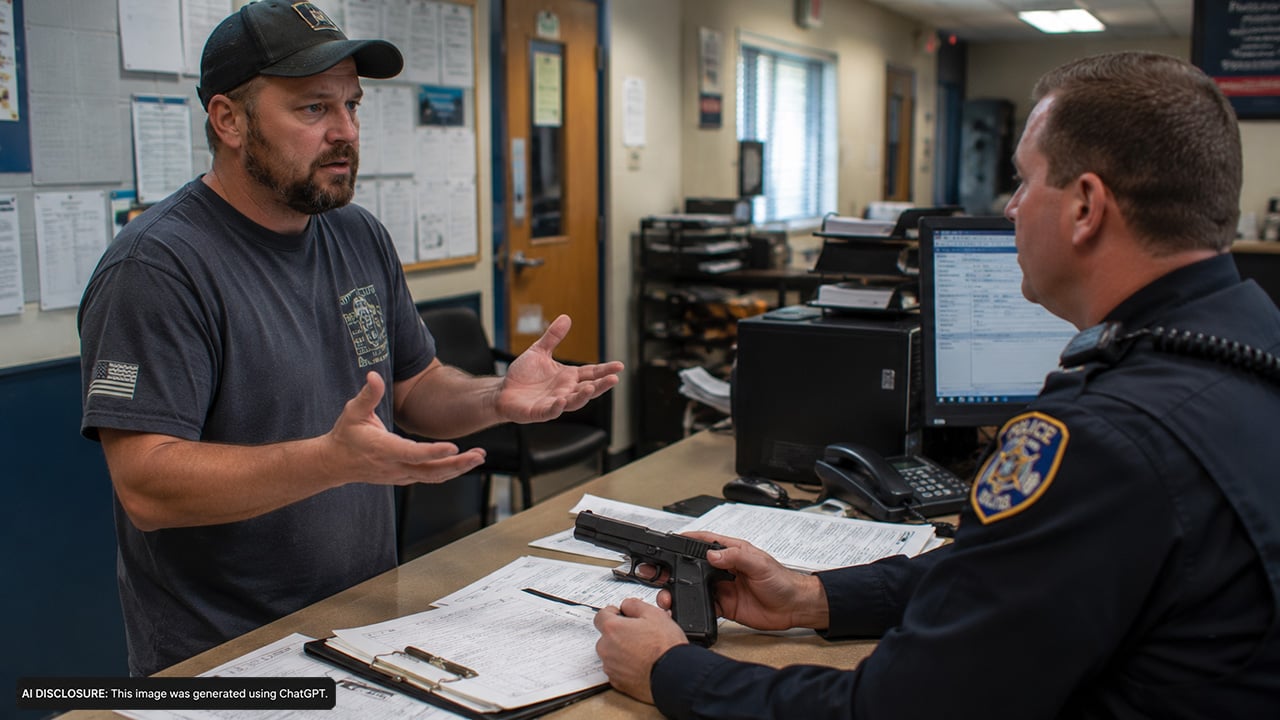
Photo credit: AI-generated image created using ChatGPT. Illustrative only
Most gun owners assume that if the police take a firearm during a call—especially when nobody’s charged—getting it back is just a matter of showing up and signing a form. In real life, it can turn into a slow-motion headache that drags on for years.
That’s the situation described in the original post, where a family’s .22 rifle was taken during a welfare check tied to a suicide threat. No criminal case. No evidence tag. Just a mental health hold—and then the gun effectively vanished into the system while life kept moving.
A welfare check turned into a firearm seizure
The incident goes back to 2018 or 2019. The writer says his mother—described as mentally ill—was threatening suicide, and her own mother called law enforcement to respond to the house. The writer had previously left a .22 caliber rifle there “for protection” since she lived alone.
When officers arrived, they seized the rifle because of the situation. That’s a pretty common outcome on calls involving suicide threats or mental health crises: if a firearm is present, it often gets removed from the scene to reduce the risk of immediate harm, even if nobody is being arrested.
Ownership paperwork made the next step harder
One detail matters a lot here: the rifle was in the father’s name. The writer says he was young at the time, so the gun was not legally in his name, and that meant he couldn’t just walk in and demand it back.
In the gun world, this kind of “family gun” arrangement is normal—dad buys the rifle, kids use it, it ends up at a relative’s place for critter control or peace of mind. But when law enforcement takes possession, the person on the paperwork (or the person who can prove lawful ownership under that state’s rules) is usually the person who has to deal with property release.
Delays piled up, and the rifle stayed in limbo
The father never went to retrieve the rifle. The writer explains part of the reason was practical: the police station was being redone due to mold. Then time did what time does. The father forgot, got busy, or just kept saying he’d “get around to it,” and the writer would eventually let it drop—until it came up again.
Years passed with no pickup, no closure, and no clear answers. That’s the part that should make any outdoorsman perk up, because most agencies don’t keep unclaimed property forever. They have evidence rooms, property rooms, policies, audits—and limited space.
No charges were filed, but that didn’t automatically trigger a return
The writer says the rifle was not seized as evidence and wasn’t part of any criminal case. The mother was placed on a 72-hour psychiatric hold, and “she wasn’t ever charged with anything.” In plain terms: there was no prosecution to wrap up, no court date to wait on, and no case number that would naturally prompt someone to call and say, “Come get your gun.”
That’s where a lot of regular folks get blindsided. “Not evidence” doesn’t always mean “automatic return.” Many departments still require a formal property release process, and in some places there can be extra steps when a firearm was taken during a mental health-related call—even if the person connected to the call wasn’t charged.
The big question: is it destroyed, sold, or still sitting on a shelf?
After so much time, the writer’s main question is the one plenty of gun owners would ask: do you think the police destroyed it, or sold it? He also notes something else that raises eyebrows—neither he nor his father recalls receiving letters or phone calls about it.
Different places handle this differently, but there are a few realities that tend to be consistent. If a firearm is considered abandoned property because nobody claims it within a required time window, it may be eligible for disposal under local policy and state law. “Disposal” can mean different things depending on jurisdiction: destruction, auction through an approved process, transfer, or other methods allowed by policy.
And even if it’s still there, the longer it sits, the more likely it is that the firearm is buried under paperwork, moved between facilities, or logged in a way that’s hard to track unless you have the right name, date range, and identifiers ready.
What gun owners can take from this before it happens to them
This isn’t just a one-off family mix-up. It’s a reminder that when law enforcement takes a firearm—especially during emotionally charged situations—your next steps matter, and timing matters.
First, keep records like your life depends on them. If you loan a rifle to a relative or stash a “farm gun” somewhere, at least keep the make/model/serial number in your files, plus a note of where it’s stored and who has it. If it ever gets taken, those details can be the difference between “we can’t find it” and “here’s the property receipt, sign here.”
Second, understand how ownership can complicate retrieval. In the writer’s case, the father is the one who likely has to initiate the return since it’s in his name. That’s not about being difficult; it’s how agencies protect themselves from handing a firearm to someone who can’t prove they’re the lawful owner.
Third, don’t assume you’ll get a courtesy call. Many departments do send notices for unclaimed property, but people move, paperwork gets missed, and not every situation triggers the same notification process. If your gun is in a property room, the safest assumption is that nobody is going to chase you down to return it.
Finally, if you ever have a gun removed from a home during a crisis, treat retrieval like a clock is ticking. Start the process early, ask what documentation is required, and follow up. Letting it sit for years—like what happened here—can turn a simple property release into a dead end.
In the end, the rifle itself is almost beside the point. A .22 can be a first trainer, a squirrel gun, a garden-varmint fixer, or just a piece of family history. When it gets sucked into the system and forgotten, you don’t just risk losing hardware—you risk losing something you can’t replace. The lesson is simple: if a firearm gets taken for “safe keeping,” make sure you’re the one who actually keeps track of it.
Like The Avid Outdoorsman’s content? Subscribe to our newsletter so you never miss an article.
Here’s more from us: