
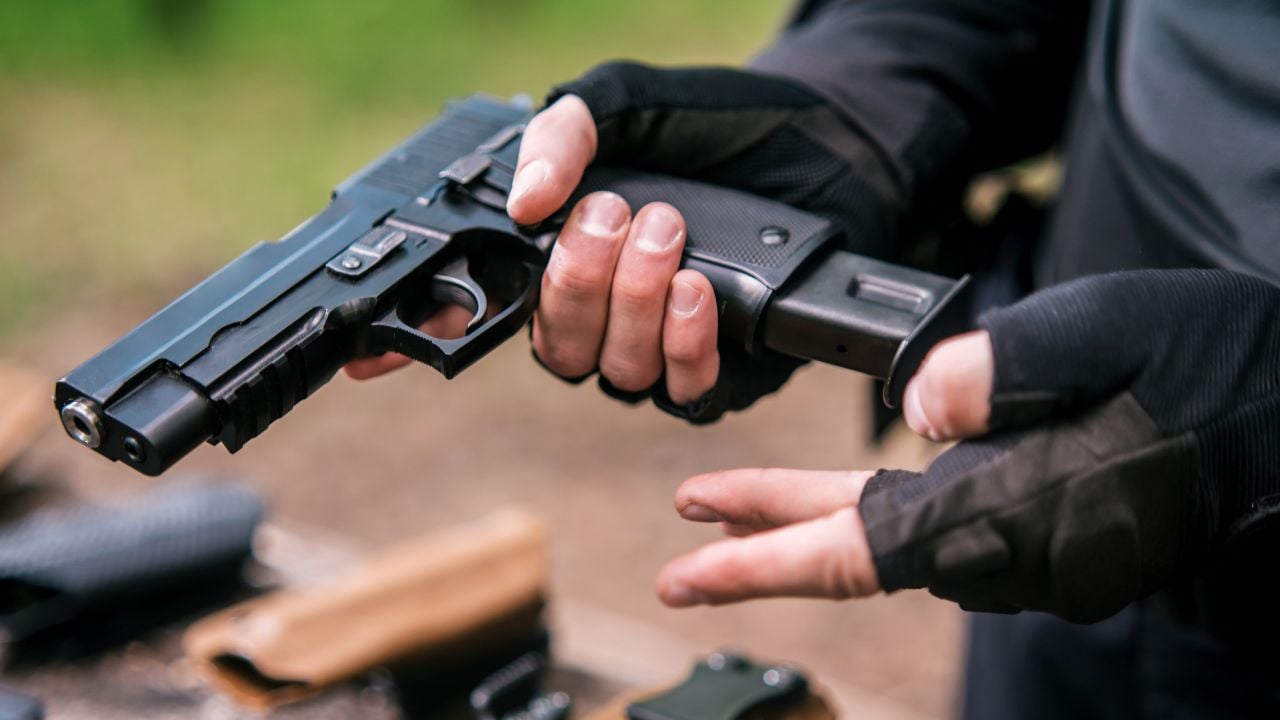
Photo credit: Maples Images/ShutterStock.com
Some handgun cartridges have built reputations on bark and recoil alone. They’re the rounds that feel powerful, kick hard, and sound impressive at the range—but out in the woods, where bullet performance and real stopping power matter, some of these “tough” calibers start to fall apart. Whether it’s lack of penetration, poor accuracy under recoil, or underwhelming energy where it counts, these cartridges prove that flash doesn’t equal field performance. When you’re hunting, hiking, or relying on a sidearm in the backcountry, the last thing you want is a caliber that talks tough but delivers soft.
.40 S&W
The .40 S&W earned its “tough guy” status through law enforcement use, but in the field, it falls short. It has more recoil than 9mm but rarely shows better penetration or terminal performance on medium game or predators. The round tends to overexpand and underpenetrate when it hits tougher targets like hogs or coyotes.
It’s not bad for defense, but for hunting or woods carry, it’s inconsistent. Modern 9mm loads match or exceed its real-world effectiveness, and the .40’s snappy recoil makes follow-up shots slower and less accurate. It might feel powerful, but once you start comparing energy and bullet behavior in tissue, the .40 is more bark than bite.
10mm Auto (light loads)

The 10mm Auto is often hyped as the perfect backcountry caliber, but that’s only true when it’s loaded hot. Many factory loads today are watered down to near .40 S&W levels to make them easier to shoot. Those lighter loads lose the deep penetration and energy the 10mm was designed for.
Hunters who rely on these weaker factory rounds often find them lacking on tough animals. The full potential of 10mm shines with 200-grain hardcast or high-velocity hunting ammo, but most off-the-shelf boxes don’t deliver that. Unless you handload or buy premium heavy loads, the 10mm’s “powerhouse” reputation is mostly for show.
.357 SIG
The .357 SIG was marketed as the semi-auto version of the classic .357 Magnum, but it doesn’t live up to that comparison in the field. While it achieves impressive velocity, it does so with lightweight bullets that expand too quickly and lack the penetration needed for anything beyond small game or varmints.
On paper, the energy looks strong. In practice, the limited bullet weight and case capacity keep it from performing like the magnum it imitates. It’s fast, loud, and flashy, but if you’re hunting or carrying in bear country, the .357 SIG offers little that a good 9mm +P can’t match—and it’s much harder to find suitable field ammo for it.
.45 ACP

The .45 ACP feels powerful because of its big, heavy bullets and deep “thump” on firing, but its slow velocity limits what it can really do outdoors. While it performs well in defensive use, its expansion and penetration on game are limited, especially through thick hide or bone.
At typical handgun velocities, it just doesn’t carry enough energy for larger animals. When you need penetration over expansion, the .45 ACP runs out of steam quickly. It might feel good in the hand and sound authoritative, but in the field, it struggles to match the versatility or range of higher-pressure calibers.
.41 Magnum (standard loads)
The .41 Magnum is a classic that never caught on, mostly because it sits awkwardly between the .357 and .44 Magnum. With standard factory loads, it’s closer to the lower end of magnum performance while still producing heavy recoil. Many loads are built for self-defense, not hunting, which makes them underwhelming in the field.
To get the full benefit, you need handloads or premium ammo, and those can be expensive or hard to find. Most off-the-shelf .41 rounds don’t hit with the authority their name suggests. It’s powerful enough to feel impressive but often too light to deliver consistent penetration on larger game.
.380 ACP

The .380 ACP feels snappy in compact pistols, but that recoil doesn’t translate into power. It’s too slow and too light to be effective on anything larger than small varmints, and even then, shot placement has to be perfect.
In the field, it lacks penetration and expansion, and it struggles against even light barriers like bone or thick fur. It might feel like a capable caliber because of its recoil and noise in small guns, but it’s not suited for serious outdoor use. The .380 is a backup cartridge, not a hunting or backcountry option.
.45 GAP
The .45 GAP was meant to match .45 ACP performance in a smaller case, but it never delivered. It operates at higher pressure, but it still lacks the velocity and bullet weight needed for reliable field performance. On game or in defensive roles outdoors, it falls flat compared to both .45 ACP and 10mm.
The limited ammo selection and lack of hunting-specific loads make it nearly useless beyond range work. While it feels snappy and loud, it simply doesn’t bring the energy or bullet integrity that hunters or outdoorsmen need. It’s one of those calibers that sounds good in theory but doesn’t hold up in practice.
5.7x28mm

The 5.7x28mm has an impressive reputation for speed, but it’s more show than substance when it comes to real-world field work. Its lightweight bullets often fragment or fail to penetrate deeply, even at high velocity.
It shines in specific defensive applications, but for hunting or wilderness carry, it’s a poor choice. The energy on impact is minimal, and its effectiveness relies heavily on specialized ammunition that’s hard to find and often restricted. Despite its “tactical” reputation, it’s a small-caliber round better suited to varmints than anything with real muscle.
9x18mm Makarov
The 9x18mm Makarov feels like an upgrade from .380 ACP, but it’s still underpowered for field use. It lacks the penetration and expansion needed for reliable performance on medium-sized animals.
While it’s fine for self-defense at close range, its lower velocity and energy make it a poor choice for hunting or backcountry protection. It feels punchy in the hand, but once you see how it performs through tough hide or bone, it becomes clear it’s not up to the job. It’s a relic of another era, not a cartridge built for today’s field conditions.
.32 H&R Magnum

The .32 H&R Magnum sounds tough on paper and feels zippy on the range, but it underdelivers on game. It’s too light and too small in diameter to produce consistent stopping power beyond varmints or small predators.
In revolvers, it has mild recoil, which makes it fun to shoot, but that also means it lacks the energy needed for field reliability. Hunters often find themselves wishing for a bit more punch and penetration—both of which the .327 Federal Magnum provides in spades. The .32 H&R was a step up from .22 LR, but it stops short of being truly capable outdoors.
Like The Avid Outdoorsman’s content? Be sure to follow us.
Here’s more from us:
The worst deer rifles money can buy
Sidearms That Belong in the Safe — Not Your Belt
*This article was developed with AI-powered tools and has been carefully reviewed by our editors.


