Photo credit: The Avid Outdoorsman
The restaurant worker said it happened in the most ordinary setting possible.
Not during a fight. Not during some heated customer situation. Not because he pulled the gun, touched it, talked about it, or tried to make a point.
He was at work, sitting in a staff meeting.
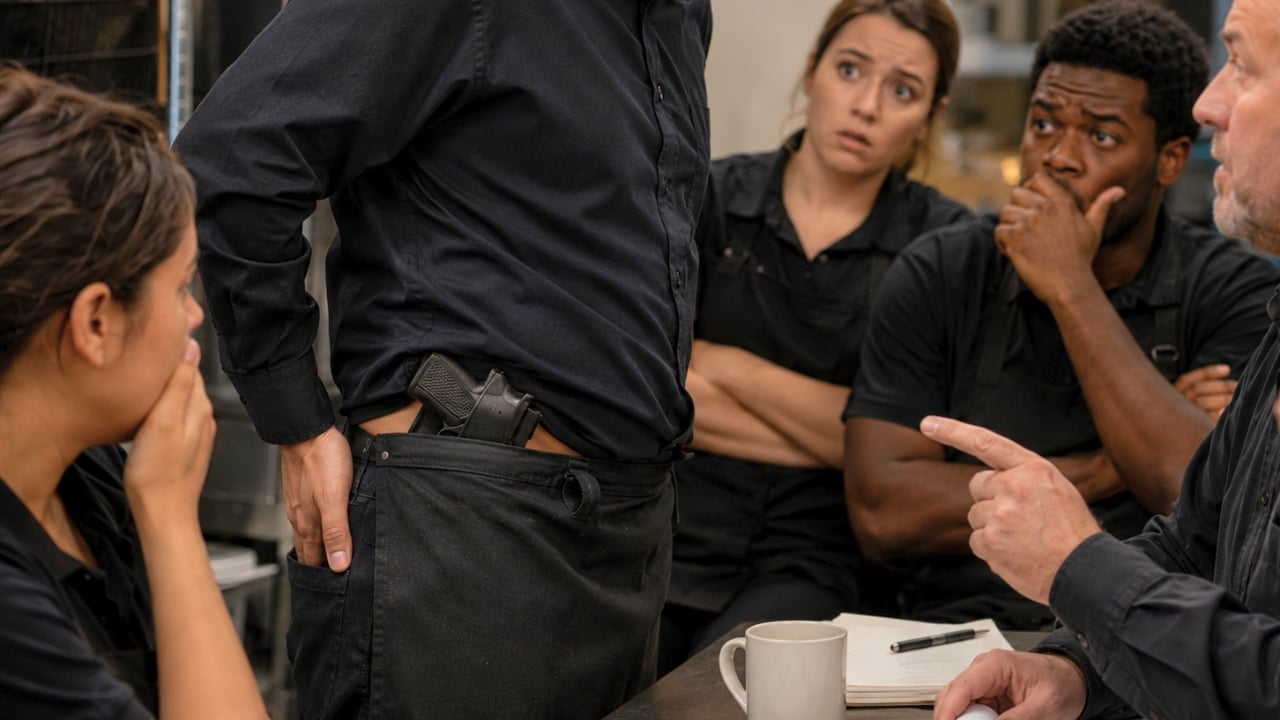
In a Reddit post, the gun owner said he was terminated after his concealed handgun became visible unintentionally during a meeting at the restaurant where he worked. From his side of the story, the gun was never handled, never drawn, and never used to threaten anybody.
It simply showed.
That is the kind of mistake concealed carriers dread, because it can go from nothing to job-ending in about three seconds.
The poster explained that he carried at work and thought the firearm was covered. But during the meeting, his shirt or clothing shifted enough that another employee saw it. Once that happened, the whole thing was out of his control. Someone noticed. Someone reacted. Management got involved. And before long, he was out of a job.
That is the brutal part about carrying at work. You can go months doing everything quietly, and one bad wardrobe moment can undo all of it.
A restaurant is already a tough environment for concealment. People bend, reach, twist, lift boxes, carry trays, lean over counters, clean, stock, and move in tight spaces around coworkers and customers. A shirt that covers fine while standing in front of a mirror may not cover the same way when you sit, stretch, crouch, or turn sideways in a booth or office chair.
And in a workplace, a visible gun does not stay a private mistake for long.
Once someone sees it, the situation becomes a management issue. Even if the carrier has a permit, even if state law allows it, even if the gun never leaves the holster, the employer may see it differently. The company may have a policy. The restaurant may serve alcohol. The workplace may have insurance concerns. Coworkers may feel uncomfortable. A manager may decide the simplest answer is termination.
That appears to be what happened here.
The worker’s frustration made sense because the display was unintentional. He was not trying to scare anyone or make himself look tough. But accidental exposure is still exposure, and once it happens at work, intent may not matter much.
That is a hard lesson.
A lot of concealed carriers think about legality first. Can I carry here under state law? Do I have the right license? Is there a posted sign? Is the restaurant off-limits? But employment is its own separate issue. A place can be legal to carry under state law and still be a place where your employer can fire you for bringing a firearm. That is the part that catches people off guard.
The worker was not asking whether he had scared anybody on purpose. He was dealing with the consequence of the gun being seen at all.
And that consequence was immediate.
There is also a social piece to it. A gun appearing in a staff meeting changes the mood instantly. Coworkers who never thought about firearms in the workplace now have opinions. Some may be angry. Some may be nervous. Some may not care. But management has to respond to the fact that a concealed firearm became visible in a room full of employees.
That is why workplace carry is so unforgiving. You do not always get credit for years of responsible behavior if the one thing everyone remembers is the moment the gun showed.
The poster’s story is not about a dramatic defensive use or some heroic moment. It is about the boring, embarrassing, job-losing side of concealed carry. The part where gear, clothing, movement, and workplace rules all collide.
And once they collide, the carrier may be the only one paying for it.
For anyone who carries, the lesson is uncomfortable but simple. Concealment has to work in real life, not just in the mirror. It has to work sitting down, bending over, reaching up, leaning forward, turning sideways, and being around people who may not be friendly to the idea of carry. If the workplace is involved, the policy has to be understood before the gun ever comes through the door.
Because once a coworker sees it, the conversation is no longer theoretical.
This restaurant worker learned that in the harshest way possible: a brief accidental display during a staff meeting turned into termination.
Commenters were split between sympathy and hard truth.
Some felt bad for the worker because the display was accidental. They understood that a shirt can ride up, especially while sitting or moving around at work. Several said it was a rough way to lose a job if he had not threatened anyone, touched the gun, or caused any actual disruption beyond the firearm being seen.
Others were blunt. They said concealed carry means the gun should stay concealed, especially at work. If a coworker saw it during a meeting, then the carry setup failed in the one place where mistakes are least forgiving. A few commenters said that may sound harsh, but workplace carry comes with a higher standard because the fallout can affect employment immediately.
A lot of the discussion centered on company policy. Commenters said the first question should always be whether firearms are allowed at work. If the restaurant had a no-firearms policy, termination was predictable. If the policy was unclear, the worker was still taking a risk by assuming silence meant permission.
Some also brought up clothing and holster choice. They said a carry setup has to match the job. Restaurant work involves constant movement, and a holster that works for errands may not work for long shifts, bending, sitting, and working around people.
Others warned that legality and job security are not the same thing. You might be legally allowed to carry in a place and still be fired by your employer for doing it. That distinction came up again and again.
For the poster, the mistake was quick. The consequence was not. One accidental flash during a staff meeting was enough to end the job, and commenters made it clear that workplace carry leaves almost no room for “I didn’t mean for anyone to see it.”