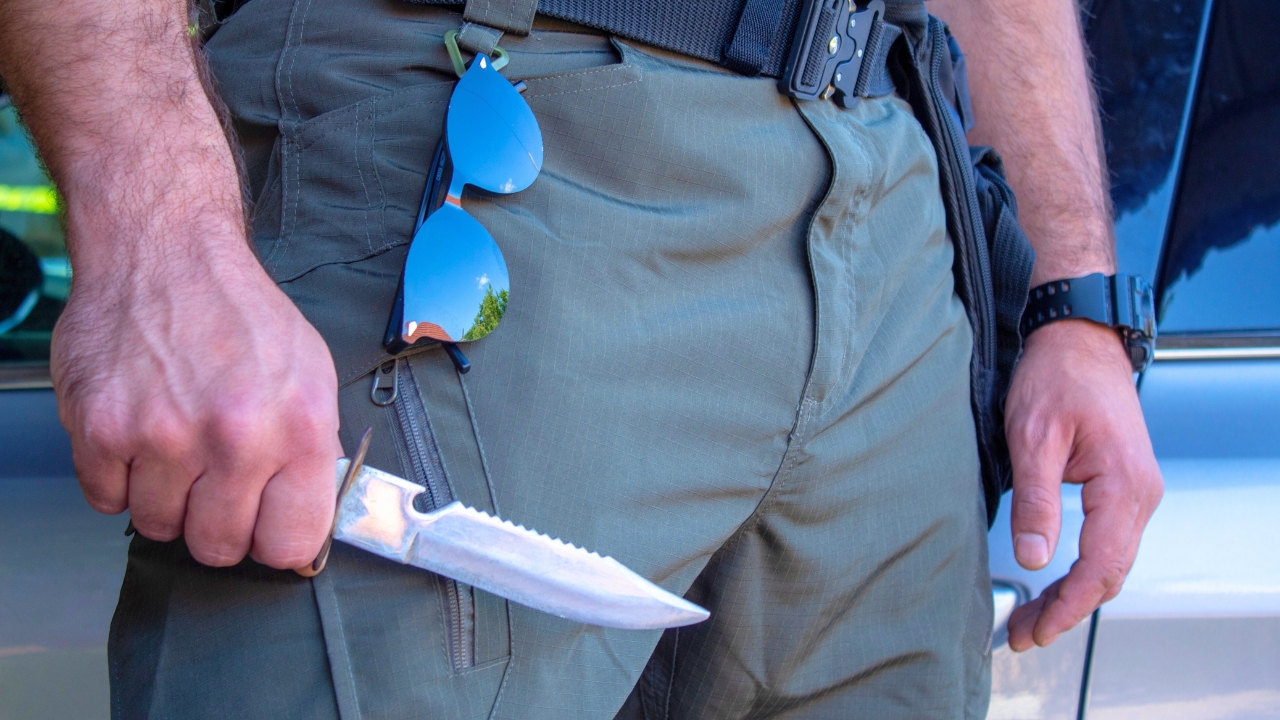
Photo credit: Danre/Shutterstock.com
Every year, otherwise law‑abiding people discover the hard way that the knife clipped in their pocket becomes a crime the moment they cross a state line. The mistake is almost always the same: assuming that if a knife is legal where you live, it will be treated the same way everywhere else. If you carry a blade for work, self‑defense, or simple utility, you need to understand how a patchwork of rules can turn routine travel into legal jeopardy.
The quiet assumption that turns you into a test case
You probably treat your favorite folding knife like a wallet or a phone, something that simply follows you from place to place. The quiet assumption is that if you bought it legally and use it responsibly, you will be fine driving from Ohio to Pennsylvania or flying from Texas to Colorado. That assumption is exactly what gets people in trouble, because knife rules are not national norms, they are a maze of state and local choices that can change the moment you cross a bridge or pass an exit ramp.
Unlike traffic laws, which are broadly similar, knife rules vary in what you can own, what you can carry, how you can carry it, and where you can bring it. A national overview of state knife laws shows that definitions, blade length limits, and carry restrictions shift from one jurisdiction to the next, and some cities add their own twists on top of state rules. When you cross a border with a knife in your pocket, you are no longer dealing with the law you know, you are stepping into a new rulebook that may treat the same tool as a prohibited weapon.
Why there is no single national “knife code” to rely on
The first part of the mistake is believing there must be a single federal standard that settles everything. In reality, knife regulation in the United States is mostly left to the states, much like firearms rules. One analysis notes that, Like firearms, knife laws are largely decided at the state level, which immediately complicates your life once you carry or transport blades across state lines.
There is one major federal statute that touches knives, but it is much narrower than many people think. The only United States law that directly addresses automatic or auto‑open knives is the Federal Switchblade Act, which focuses on how these knives move in interstate commerce and through the mail rather than on your day‑to‑day carry. That structure leaves most questions about what you can own, carry, or conceal to state legislatures and local councils, which is why your legal status can flip from compliant to criminal in a single highway mile.
The Federal Switchblade Act and the myths that surround it
Because the word “federal” looms large, many knife owners assume the Federal Switchblade Act is a sweeping ban that overrides everything else. In practice, the statute is more technical than dramatic. The law, sometimes called the Switchblade Knife Act of 1958, was designed to restrict interstate commerce and importation of certain automatic knives, and enforcement authority sits with agencies such as the Bureau of Alcohol, Tobacco, Firearms, and Explosives, often referred to as the Firearms, and Explosives (ATF). A detailed guide explains that the Switchblade Knife Act of 1958 targets interstate sales and imports, not simple possession in your home state.
Misunderstandings about this law are so common that advocates have had to spell out what it does not do. One breakdown of the statute’s Overview of Interstate Commerce notes that The FSA makes it a crime to ship certain automatic knives through the U.S. Postal Service, but it does not automatically criminalize every automatic knife in private hands. Another explainer tackles the persistent claim labeled “MYTH: THE FEDERAL SWITCHBLADE ACT PROHIBITS SENDING AUTOMATIC KNIVES TO INDIVIDUALS IN OTHER STATES OR WITHIN YOUR STATE,” clarifying that the MYTH, THE, FEDERAL, SWITCHBLADE, ACT is narrower and focuses on knives being sold across a state line. When you assume this federal law either fully protects or fully bans your knife, you miss the real risk, which is how the state you are entering chooses to treat the same blade.
How state and local rules turn a pocket tool into contraband
The second part of the mistake is underestimating how aggressively some states and cities regulate knives. While a few states have moved to standardize rules, others still maintain a tangle of restrictions on blade length, opening mechanisms, and carry methods. A national map of Prohibitions shows that in many states, There are special rules for people with prior convictions, for specific locations such as schools, courthouses, and nuclear power generating stations, and for certain knife types that lawmakers have singled out as especially risky.
Local governments sometimes add their own layers, which is where travelers are most likely to stumble. Reporting on how varying knife laws can confuse across state and local lines notes that Dakota and Wyoming also have laws that prevent local jurisdictions from going beyond state knife laws, and Billeb pointed out that this kind of “preemption” is not universal, which means other states allow cities to be stricter than state codes. When you drive into a metro area that has its own ordinance, the knife that was legal in the suburbs can suddenly violate a city rule you have never heard of.
The “patchwork” problem and why it is not just rhetoric
Gun owners have long complained about a patchwork of state rules, and knife owners are now living the same reality. Advocacy groups sometimes use the word “patchwork” as a talking point, but the underlying problem is concrete: you cannot easily memorize or intuit where a 3.5 inch assisted‑open folder is acceptable and where it is treated like a prohibited weapon. One critique of modern regulation notes that some campaigns follow a pattern that begins with a Step that invites people to Complain about a “patchwork” of state laws, and commentator Tobac has argued that this framing can be used to push national standards in other areas. With knives, however, the patchwork is not an abstract talking point, it is the daily reality of anyone who carries a blade across borders.
Legal analysts have pointed out that, As of January, there are still areas of law where Congress has declined to create a unifying statute, leaving people to navigate a state‑by‑state landscape. One overview of speech‑related litigation notes that As of January 2025, no federal statute has been passed to create a nationwide anti‑SLAPP standard, and knife owners face a similar absence of a single protective rule. Without a unifying code, you are left to piece together your own compliance strategy, and the margin for error shrinks every time you cross into a new jurisdiction.
Travel amplifies every small misunderstanding
Travel is where all of these legal quirks collide with real life. You might toss a multitool into your backpack for a road trip, only to discover that a state you are passing through treats its locking blade as a prohibited concealed weapon. A practical guide for travelers points out that if you move between states or into federal facilities such as a federal court, post office, or military base, you subject yourself to multiple overlapping rules, and the advice for Traveling by Air is blunt: once you pass through security, any knife in your carry‑on is a problem, and Transportation Security Administration officers are trained to pull you aside at the checkpoint for this very reason.
Even seemingly harmless tools can trigger penalties if you carry them the wrong way. A compliance guide for hobbyists explains that knives, including craft knives, utility blades, and similar tools, must be packed correctly when you fly, and that Traveling, Craft Knives and Blades, Complete Safety, Compliance Guide, Can help you understand that these items belong in checked baggage or you may face penalties. When you combine federal aviation rules with state and local knife laws at your destination, a simple weekend flight with a toolbox can expose you to three or four different legal regimes before you even reach your hotel.
The legislative push to give travelers a safe harbor
Recognizing how easily ordinary people can be tripped up, knife advocates have been pushing for federal protections that focus on transport rather than ownership. One proposal, the Interstate Transport Act, is designed to ease the burden on people who simply want to move lawfully owned knives from one place to another. Supporters argue that the burden on knife users of trying to know, understand, and comply with several local and various state laws would be replaced by a clearer standard if About the Interstate Transport Act (ITA) becomes law, giving travelers a predictable rule for how to store and carry knives while in transit.
Congress has already seen similar ideas in other contexts. A Senate document labeled SUMMARY OF PROVISIONS for a bill numbered S. 246 describes how 18 U.S.C. 926A protects the interstate transport of firearms under certain conditions, and knife advocates want a parallel rule for blades. A separate overview of why such a law is needed stresses that a federal standard could help travelers avoid arrest, protect them from prosecution when they are simply passing through, and even allow them to have any official records expunged, as outlined in the section titled Why Do We Need To fix this gap.
KOPA, AKTI, and the fight to modernize knife transport rules
Advocacy has not stopped with a single bill. Earlier this year, Senator Mike Lee of Utah renewed a push to shield ordinary knife owners from what he describes as capricious prosecutions. In a statement announcing that Jan 31, 2025 would mark his latest effort, Senator Mike Lee introduced the Knife Owners Protection Act, or KOPA, legislation that would create clear rules for how you can transport knives across state lines and prevent capricious prosecutions against them. The bill is aimed squarely at the traveler who is legal at home, legal at the destination, and suddenly in trouble in the state in between.
Industry groups have thrown their weight behind these efforts. A June update from the American Knife and Tool Institute notes that Jun 1, 2025 commentary emphasized that There are two major legislative pushes underway right now, spearheaded by the American Knife, Tool Institute, AKTI, which has been lobbying for both the Interstate Transport Act and KOPA. For you, the practical takeaway is that the law is in flux, and while these proposals aim to give you a safe harbor, they are not yet a shield you can rely on, so you still have to plan your travel around the rules that already exist.
What responsible carry looks like when you cross a border
Until Congress acts, your best defense is preparation. That starts with understanding how different jurisdictions classify knives, including the five primary regulations that one travel guide highlights: blade deployment, blade length, locking mechanisms, concealment, and location‑based bans. A practical checklist for Oct travel with knives stresses that The five primary regulations are exactly the areas where states diverge, and it closes with a simple reminder: Always plan ahead.
Planning ahead means more than glancing at a map. It means checking the specific rules in each state you will enter, understanding whether local preemption exists, and deciding whether you should lock your knife in checked luggage, secure it in a vehicle trunk, or leave it at home. A detailed state‑by‑state chart of Switchblade Knife Act of references and local codes can help you see where automatic knives, balisongs, or even certain folders are treated differently, and it underscores that the Switchblade Knife Act of 1958 is only one piece of a much larger puzzle. When you treat your knife like a regulated tool instead of a casual accessory, you dramatically reduce the odds that a routine traffic stop or bag search will turn into a legal crisis.
Why shipping your knife is not a magic workaround
Some travelers try to sidestep the problem by mailing or shipping their knives ahead, but that strategy has its own legal traps. The Federal Switchblade Act, for example, makes it a crime to send certain automatic knives through the Postal Service, and it draws careful lines around what counts as interstate commerce. A detailed resource on the statute explains that it exempts the Postal Service, UPS, FedEx or any other commercial delivery service from being guilty of violating the law while carrying packages, but that does not mean you can ignore the underlying restrictions, as outlined in the section on the Postal Service and private carriers.
Even when shipping is legal, you still have to think about how carriers operate. One safety‑minded explainer about logistics notes that UPS (United Parcel Service) Truck Drivers Avoid Left Hand Turns, You Should Too, and the piece titled Truck Drivers Avoid Left Hand Turns, You Should Too, asks Why a company that has been in business to deliver packages since 1907 optimizes routes this way. The point for knife owners is that carriers design their systems around efficiency and safety, not around your desire to dodge local knife ordinances, and if your shipment violates a rule at any point in its journey, you, not the driver, may be the one facing questions.
Like The Avid Outdoorsman’s content? Be sure to follow us.
Here’s more from us: