Photo credit: Mike_shots/Shutterstock.com
A lot of tense situations do not go bad all at once. They build in small steps. A stranger says something. You answer. He steps closer. You hold your ground. His voice gets louder. You feel your own temper rise. Maybe people start watching. Maybe your family is nearby. Maybe your truck is behind you, the door is open, and now the whole thing feels like it has momentum.
For a concealed carrier, the most important moment to recognize is the point where the situation stops being a disagreement and starts becoming a confrontation. That line can be easy to miss if you’re focused on being right. But once someone starts closing distance, blocking movement, ignoring calm words, or trying to bait you into a reaction, the situation has changed. That is when a responsible carrier needs to stop arguing and start leaving, creating space, or getting help.
The first warning is usually distance
Distance tells you a lot. A person can be irritated from across a parking lot, boat ramp, trailhead, or gas pump and still not be an immediate problem. But when he keeps walking toward you while he’s angry, the conversation is no longer just about words. He is testing space.
That does not mean you should panic. It means you should move. Step back. Angle away. Put a vehicle, cart, table, pump, or other barrier between you if you can. Keep your hands free. Tell him clearly, “Stay back” or “I don’t want trouble.” If he respects that, the situation may calm down. If he ignores it and keeps closing, that tells you something important.
When someone blocks your exit, pay attention
A person who is just venting may yell and leave. A person who steps in front of your path, blocks your truck door, traps you between vehicles, or keeps moving to cut you off is doing something different. He is limiting your options. That is a serious shift.
Responsible carriers need to recognize that moment early. Do not keep debating like nothing changed. Look for another exit. Move toward light, people, or open space. If your family is with you, get them moving first. A blocked exit does not always mean a fight is coming, but it does mean you should stop treating the encounter like a normal argument.
Repeated warnings mean the conversation is over
If you have already said, “Back up,” “I’m leaving,” or “I don’t want trouble,” and the person keeps pushing, the talk is no longer productive. Too many people repeat themselves five or six times because they want the other person to finally understand. That can waste the very time they need to get away.
Once your calm warning has been ignored, change your focus. Stop trying to persuade him. Create distance. Call for help if needed. Get witnesses by moving toward other people, not by turning it into a show. A person who ignores clear boundaries is giving you information. Believe it.
Watch the hands
Hands matter. An angry person’s face may be loud, but his hands often tell you more. Are his fists clenched? Is one hand hidden? Is he reaching toward a pocket, waistband, truck door, backpack, or center console? Is he holding a bottle, tool, knife, tire iron, or anything that could become a weapon?
You do not need to stare like you’re trying to start a fight. Just notice. If hands disappear or start moving toward something, that is another sign the situation may be shifting. Keep your own hands visible and empty if you can. Do not touch your gun to “be ready” unless the situation has reached the legal and practical point where that action is truly justified. There is a big difference between awareness and escalation.
Don’t wait for a perfect threat
A lot of people think they will know exactly when things have gone too far. Real situations are usually messier. The person may not say, “I am going to hurt you.” He may say, “You better watch yourself,” while walking closer. He may not show a weapon. He may keep one hand hidden. He may not swing first. He may crowd, corner, threaten, and test.
You do not have to wait around hoping the situation becomes clearer. Leaving early is usually the best answer. If you can safely leave, leave. If you can get in the truck and drive away, do it. If you can move your family inside a store, toward a marina office, or near other people, do it. The goal is not to stand there until you are forced into a harder decision.
Pride makes the line harder to see
Pride is dangerous because it disguises itself as principle. You tell yourself you are not going to be pushed around. You tell yourself he started it. You tell yourself you have a right to stand there. Maybe all of that is true. It still may not be smart.
A concealed carrier should be allergic to pride-driven conflict. If you’re armed, the cost of a bad argument is higher. You need to be able to let a stranger think he won. You need to be able to leave while he’s still talking. You need to be able to swallow the insult and move. The moment pride starts making the decisions, the situation is already drifting in the wrong direction.
A crowd can make things worse
When people start watching, some folks calm down. Others get louder because now they feel like they have an audience. A person who might have walked away quietly may keep going because he does not want to look weak. If the confrontation starts drawing attention, understand that the pressure may increase.
Do not perform for the crowd. Do not explain your whole side to bystanders while the other person is still escalating. Do not talk tough because people are watching. Use the crowd only in a practical way: move toward witnesses, ask someone to call law enforcement if needed, and keep your own behavior calm enough that anyone watching can see you are trying to end the situation.
Alcohol or impairment shortens the timeline
If the other person seems drunk, high, or mentally unstable, the moment can go too far faster than normal. Slurred words, stumbling, wild emotional swings, glassy eyes, repeated close approaches, and irrational statements all matter. You cannot count on a person in that condition to respond to reason.
Do not debate with impairment. Create distance sooner. Leave sooner. Get help sooner. If you are carrying, this matters even more because an impaired person may misread your words, ignore your warnings, or suddenly become physical. The smart move is not teaching him a lesson. It is getting clear before the situation becomes unpredictable.
Your family nearby changes everything
If your wife, kids, parents, or friends are with you, recognize the moment even earlier. A confrontation that might be manageable alone can become much more complicated when you’re also trying to protect other people. Kids may freeze. A spouse may argue back. A friend may step in and make it worse. The person confronting you may shift attention toward them.
Your priority is getting them away. Put the groceries down. Leave the cart. Skip the launch. Move back to the truck or into the building. Whatever small thing you were trying to finish can wait. Your family does not need to stand there while you try to prove a point to a stranger who is already showing poor judgment.
Know your verbal off-ramp
A verbal off-ramp is a sentence that helps you exit instead of continue. You need one before you’re mad. “I’m not arguing with you.” “We’re leaving.” “Stay back.” “Call the police.” “I don’t want trouble.” Short, clear sentences work better than explanations.
The key is to use the sentence and then act on it. If you say, “I’m leaving,” leave. If you say, “Stay back,” move to keep distance. If you say, “Call the police,” stop debating and focus on safety. Words without action can turn into background noise. A good off-ramp gives you a clean way out and shows anyone nearby that you were trying to end it.
Don’t let your hand drift to your gun
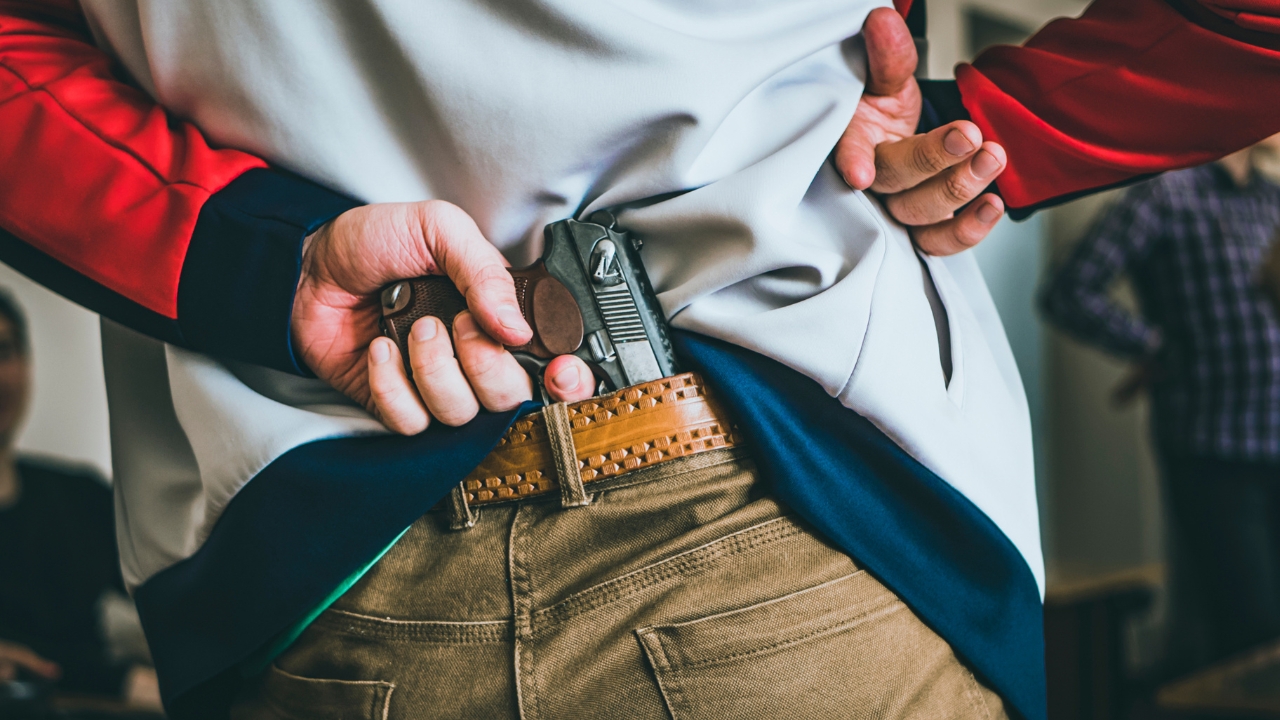
One of the worst things a concealed carrier can do during a tense verbal encounter is subconsciously touch the gun. Maybe you adjust your shirt. Maybe your hand drops near the holster. Maybe you’re trying to reassure yourself it’s there. To the other person, and to witnesses, that can look like a threat.
Keep your hands calm and visible when possible. If the situation is not at the point where a defensive draw is legally and morally justified, do not use the gun as body language. Your firearm should not be part of the conversation. The moment your hand starts drifting because your temper or nerves are rising, recognize that as a warning sign to leave.
If you can still leave, the answer is usually leave
This is the simplest rule and the one people resist most. If you can safely leave, leave. That does not mean every law requires retreat in every place or every situation. It means, as a practical matter, leaving is usually better than standing in a conflict that is getting worse.
Driving away, walking into a store, moving to another ramp, changing parking spots, or ending the conversation may feel unsatisfying. It may also prevent the entire thing from becoming a life-changing incident. Responsible carriers should care more about going home clean than winning the moment.
The moment is earlier than most people think
The key moment is not when a punch lands. It is not when a weapon appears. It is not when you have already been cornered. The moment to recognize is when the situation starts moving that direction: distance closing, exits blocked, warnings ignored, hands hidden, pride rising, crowd forming, or impairment showing.
That is when you still have good options. Once things become physical, your options shrink fast. A concealed carrier’s best skill is not reacting at the last second. It is recognizing early that the temperature has changed and choosing the boring, safe way out before the situation makes the choice for you.
Carrying a gun should make you more alert to the line between annoyance and danger. It should make you quicker to leave, slower to argue, and more serious about distance. The moment every concealed carrier needs to recognize is the one right before pride takes over and the exits start closing. See that moment early, and you may never have to find out how far things could have gone.
Like The Avid Outdoorsman’s content? Be sure to follow us.
Here’s more from us: