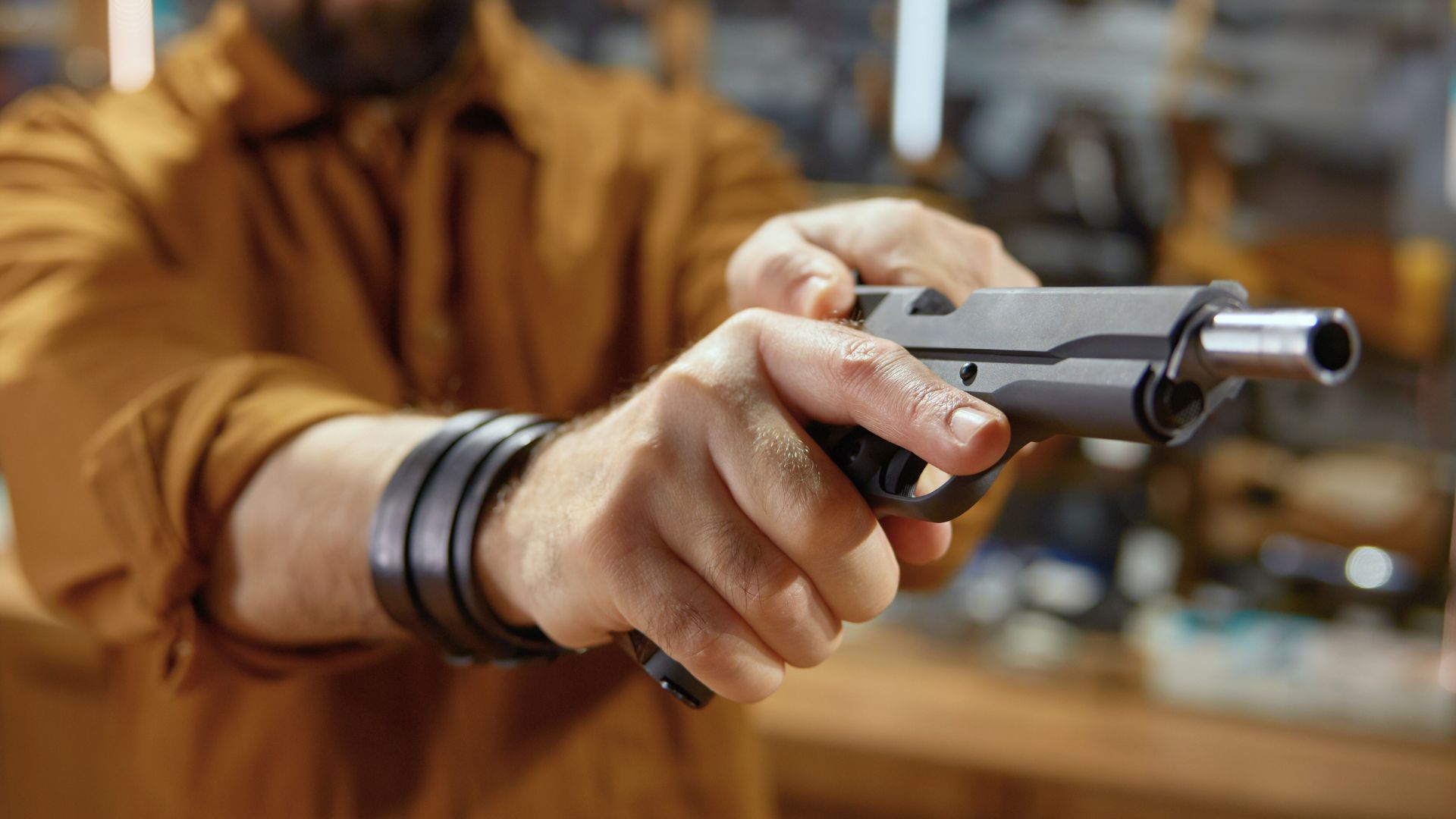
Photo credit: Nomad_Soul/Shutterstock.com
The Supreme Court’s decision to hear a challenge to the federal gun ban for marijuana users on March 2 puts your future firearm purchases and ownership decisions directly in the legal crosshairs. Between now and argument day, what you buy, how you use cannabis, and what you disclose on federal forms could all affect your risk profile. If you follow gun laws closely, you now have a firm date on the calendar and a narrow window to understand what is at stake before the justices step into the debate.
The case will test how far the Second Amendment stretches when it collides with federal drug policy, and the answer will matter whether you are a medical patient, a recreational consumer, or simply a gun owner watching the rules shift under your feet. To navigate the coming months, you need a clear view of the case, the legal theories in play, and the practical choices that could either protect you or expose you to new uncertainty.
1. The March 2 argument and why it matters for your next purchase
The Supreme Court has now locked in March 2 for oral arguments in United States v. Hemani, a case that squarely targets the federal rule that makes it a felony for an “unlawful user” of controlled substances to possess a firearm. That scheduling decision signals that the justices see the dispute as a major Second Amendment test, not a technical sideshow, and it means you can expect a definitive ruling on the federal marijuana and gun collision later this year. If you are weighing a firearm purchase or transfer, you are operating in a narrow window where the law is unsettled but still aggressively enforced.
According to the Court’s own calendar, United States v. Hemani is part of a group of high profile arguments that will close out the justices’ winter sitting, and it focuses on the federal statute that has long treated drug users as categorically disqualified from gun ownership. Separate coverage of the Court’s docket notes that the justices have also agreed to hear a case described as “Supreme Court Schedules Hearing In Case On Marijuana Consumers, Gun Rights, Published,” underscoring that the intersection of Jan cannabis policy and firearms is now firmly on the Court’s agenda. For you, that means the rules you rely on when you fill out a background check form could look very different by the time cherry blossoms are out in Washington.
2. What United States v. Hemani is actually about
To understand how this case could affect you, you need to know what Hemani is and what it is not. The dispute does not ask whether you have a general right to own a gun, which the Court has already recognized, but whether the government can permanently strip that right from anyone it labels a drug user without proving that person is dangerous. The federal law at issue treats all “unlawful users” alike, whether you are a daily cannabis consumer or someone who used marijuana once months ago, and Hemani challenges that one size fits all approach.
Case previews explain that Hemani is a direct attack on the constitutionality of the federal gun ban for marijuana users, and that the justices granted review after lower courts split over how to apply the Second Amendment to people who use cannabis. Separate reporting on “U.S. Supreme Court Schedules Hearing In Case On Marijuana Consumers, Gun Rights, Published” describes the dispute as a test of how the Jan Supreme Court Schedules Hearing In Case On Marijuana Consumers, Gun Rights, Published will interpret the Second Amendment of the U.S. Constitution when it collides with modern drug policy. If you are a buyer who uses marijuana in a state where it is legal, Hemani is effectively asking whether the federal government can still treat you as a prohibited person simply because cannabis remains illegal under federal law.
3. How the federal marijuana gun ban works today
Right now, the federal rule is blunt and unforgiving, and you feel its impact every time you fill out the standard background check form at a gun store. The law treats marijuana as a Schedule I controlled substance, so if you are an “unlawful user” under federal standards, you are barred from possessing or receiving a firearm, even if your state has legalized cannabis for medical or recreational use. When you answer the question about marijuana use on the ATF Form 4473, a “yes” can mean an automatic denial, and a false “no” can expose you to felony charges.
Coverage of the upcoming argument explains that the justices will be reviewing a long standing federal statute that criminalizes gun possession by drug users, and that the case has been framed as a “drug user gun ban” set for Supreme Court review. One report notes that the Court will hear a challenge to this rule after a lower tribunal, the US Court of Appeals, grappled with how to apply the Second Amendment to people who use controlled substances. Another detailed preview of the drug user gun ban highlights that the case has drawn national attention, with John Crawley listed as Editor and a photo credit to Bing Guan, Bloomberg, and even specifies that the scheduling was noted at 9:51 PST. For you, the key takeaway is that until the Court rules, the federal government still treats any marijuana use as disqualifying, no matter what your state says.
4. The Bruen test and the “coming assault” on categorical bans
The legal backdrop for Hemani is the Supreme Court’s recent insistence that gun regulations must fit within the nation’s historical tradition of firearm regulation. Under that approach, often called the Bruen test, the government has to show that any modern restriction is consistent with how guns were regulated around the time of the founding. That standard has already shaken up lower courts, and it is the lens through which the justices will decide whether a blanket ban on marijuana users can survive.
Scholars tracking these developments describe a broader trend they call the coming assault on categorical gun prohibitions, noting that Feb decisions have forced judges to revisit rules that were once considered settled. Those analyses emphasize that Lower courts are grappling with challenges to what were, until recently, settled Second Amendment laws, including bans on certain groups of people and restrictions on where they may be carried. For you, that means Hemani is not an isolated fight but part of a larger wave of litigation that could reshape who is allowed to buy and keep firearms, and on what terms, over the next few years.
5. How lower courts and advocates are already testing the limits
Even before the Supreme Court agreed to hear Hemani, lawyers and advocates were already pushing the boundaries of the Second Amendment in cases that affect your day to day rights. Some of those disputes focus on specific conditions, such as whether courts can bar you from possessing a gun while you are awaiting trial, while others challenge broader categories of people who are automatically disqualified. The common thread is a demand that the government justify each restriction with concrete historical analogues instead of relying on modern policy preferences.
One ongoing tracker of Supreme Court activity on firearms highlights an “as applied Second Amendment challenge to firearms related pretrial release condition,” asking whether a lower court decision that upheld that restriction should stand. That SCOTUS gun watch entry underscores how Jan litigation is probing the edges of what counts as a permissible limit on your right to keep and bear arms. At the same time, advocates like Second Amendment Foundation Founder Alan Gottlieb have been publicly discussing how the Court’s new framework could affect future cases, including those involving cannabis users, in interviews with The Center Square’s Carleen Johnson. In that conversation, Carleen Johnson pressed Gottlieb on how far the Court might go, and he warned about what he called a “vampire rule,” a phrase that captures how some gun restrictions seem impossible to kill even after major Supreme Court decisions.
6. Cannabis, background checks, and the risk of federal charges
If you use marijuana and own or plan to buy a gun, your most immediate concern is the gap between state legalization and federal prohibition. Many states now allow recreational or medical cannabis, but the federal background check system still treats any marijuana use as unlawful. When you walk into a licensed dealer and complete the ATF Form 4473, you are swearing under penalty of perjury that your answers are truthful, and federal prosecutors have not hesitated to bring charges when they believe buyers lied about drug use.
Recent coverage of the Court’s docket notes that the justices will hear a case that directly affects “marijuana consumers’ gun rights,” and that the dispute has drawn intense interest from people who rely on cannabis for medical reasons but also want to exercise their Second Amendment rights. One report on the hearing in case on marijuana consumers explains that the Jan Supreme Court Schedules Hearing In Case On Marijuana Consumers, Gun Rights, Published will be a pivotal test of how the Second Amendment of the U.S. Constitution applies to people who use cannabis in compliance with state law but remain “unlawful users” under federal standards. For you, that means any decision to buy a gun while using marijuana carries real legal risk until the Court clarifies whether the federal ban can stand.
7. What March’s argument signals about timing and outcomes
The timing of the March 2 argument matters for your planning because it sets the outer bounds for when you can expect clarity. Supreme Court decisions in argued cases typically arrive by late June or early July, which means you are likely living with the current rules for at least several more months. During that period, federal law enforcement agencies will continue to apply the existing ban, and lower courts will be reluctant to make bold moves while they wait for guidance from the justices.
Legal analysts tracking the Court’s calendar have noted that March will bring cherry blossoms and a packed slate of Supreme Court arguments, including Hemani, which is part of a broader set of high stakes cases. One overview of the upcoming sitting points out that the Court announced it will hear the gun rights case among several others, citing earlier reporting that highlighted United States v. Hemani in the February sitting. Another newsletter style update framed the development under the banner “TOP THINGS TO KNOW,” emphasizing that The Supreme Court has scheduled oral arguments in a case challenging a federal law restricting marijuana users’ access to firearms. That TOP THINGS KNOW framing is a reminder that, for you, the case is not an abstract constitutional debate but a near term decision point for how you navigate gun purchases, employment eligibility, and even housing opportunities that may hinge on background checks.
8. How to approach gun buying between now and the decision
With the law in flux but still enforceable, your best approach over the next few months is to treat every purchase and transfer as if the current federal rules will remain in place. That means being brutally honest with yourself about your cannabis use before you complete any federal forms, understanding that a false statement can be more dangerous than a denied sale. If you are a regular marijuana consumer, you may decide that the safest course is to pause new purchases until the Supreme Court clarifies whether the government can continue to treat you as a prohibited person.
You should also pay attention to how lower courts and enforcement agencies respond as the March 2 argument approaches. Some judges may start to delay cases involving marijuana and firearms, anticipating that Hemani will provide a definitive answer, while others may continue to apply the existing ban without hesitation. Tracking resources that monitor Second Amendment litigation, including those that catalog Jan developments and as applied challenges, can help you gauge whether enforcement patterns are shifting in your region. At the same time, listening to voices like Second Amendment Foundation Founder Alan Gottlieb, who has been discussing the implications of the Court’s new test in conversations with outlets such as The Center Square, can give you a sense of how advocates expect the justices to rule and what that might mean for your future buying decisions.
9. What to watch on argument day and beyond
When March 2 arrives, you will not get an immediate answer, but you will get valuable clues about where the Court is headed. Pay close attention to which justices focus on history and tradition, and which press the government on whether there is any evidence that marijuana users as a group are more dangerous with guns. If the questions center on whether the federal ban is too broad or untethered from founding era analogues, that could signal a willingness to strike down or narrow the rule, which would directly affect how you are treated as a buyer.
After argument, you should watch for follow up orders in related cases, especially those involving other categorical bans, because they will show how the justices intend to apply their eventual ruling. If the Court vacates and remands lower court decisions that upheld similar restrictions, that will be a sign that the justices expect a more rigorous application of the Second Amendment across the board. For you, the months after March 2 will be a period of close reading and cautious decision making, as you balance your desire to exercise your rights with the reality that, until the final opinion is released, the federal government still views marijuana use and gun ownership as a legally combustible mix.
Like The Avid Outdoorsman’s content? Be sure to follow us.
Here’s more from us: