
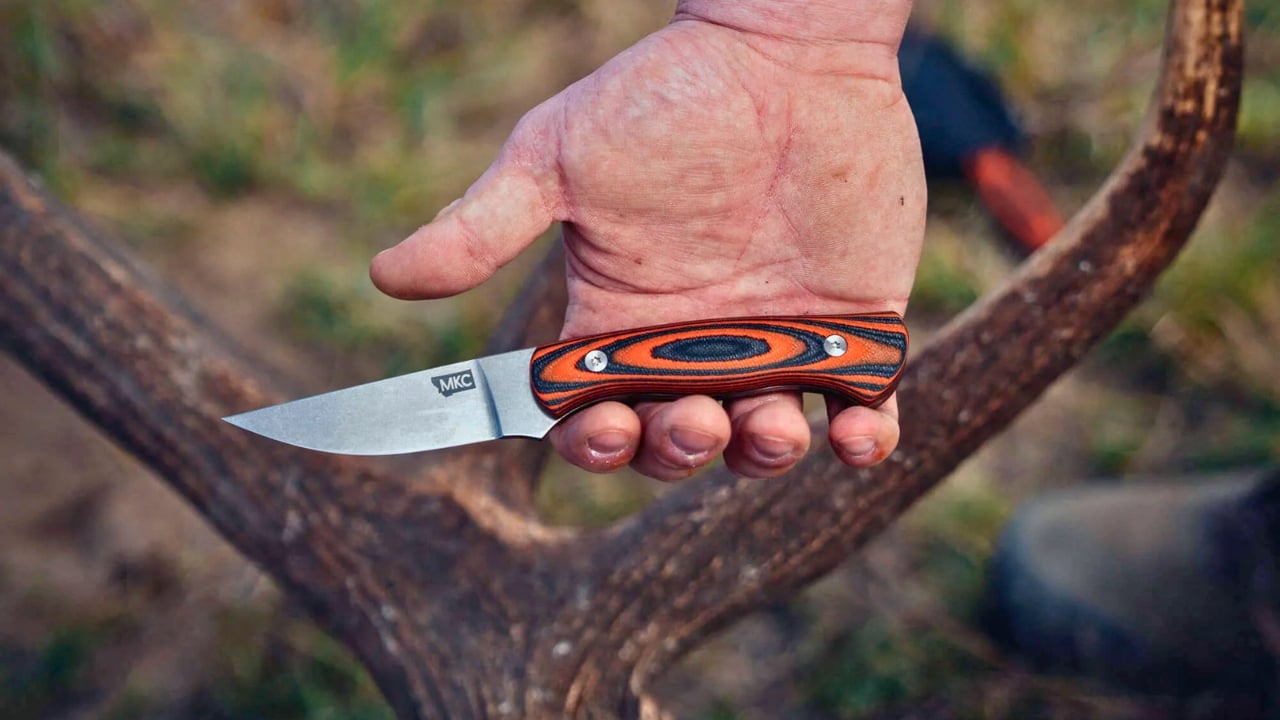
Photo credit: Montana Knife Company
If you want one knife that shows why hunters keep talking about MagnaCut, look at Montana Knife Company’s Blackfoot 2.0 in MagnaCut. On paper it’s simple: a 3.5″ fixed blade with a full tang and G-10 scales, made in Montana. In practice it has turned into a go-to knife for a lot of western hunters who are hard on gear and picky about what stays in the lineup. The Blackfoot 2.0 MagnaCut edition is compact, light, and tuned for real animal work, not internet photos, and the way it uses that steel explains a lot of the current obsession.
A compact knife built around actual hunting jobs
The Blackfoot 2.0 MagnaCut version sticks with the core sizing: about 7.75″ overall length, a 3.5″ blade, and roughly 3.6 ounces thanks to a skeletonized tang under the handle scales. MKC didn’t try to make it a do-everything camp pry bar; they built a slicing tool sized right for getting inside an animal without feeling clumsy. The blade is narrow enough to steer precisely around joints and along bone, the handle is shaped to lock in even when your hands are bloody, and the whole package disappears on a belt without dragging your pants down. That “small knife that still feels big in the hand” design shows they weren’t chasing specs as much as they were chasing the way the thing actually moves through meat and hide.
MagnaCut lets MKC run a thinner, more aggressive edge with confidence
Where MagnaCut really earns its keep on the Blackfoot is in the grind and edge behavior. The blade stock sits around 0.114″, which is pretty slim for a fixed blade aimed at big game, and MKC grinds it to cut, not to impress you with slab thickness. On older stainless choices, running a thin, keen edge like that and then pushing it through joints, cartilage, and the occasional accidental bone hit could mean rolling or micro-chipping by the time you got halfway through a second deer. MagnaCut’s toughness and wear resistance give MKC room to keep that slicing geometry and still trust the edge to stay together through multiple animals before it really needs more than a quick strop or light touch-up. That’s why you see guys calling it their “only hunting knife” in reviews—it actually behaves like one blade that can carry a whole season.
Stainless performance that matters on long, wet hunts
Montana Knife Company built this knife with western hunts in mind: long days, changing weather, and the reality that you might not see a sink for a few days after you finally fill a tag. In that setting, carbon steels and basic stainless both show their limits fast. MagnaCut’s corrosion resistance means the Blackfoot can ride in a leather or Kydex sheath through sweat, rain, snow, and blood without immediately sprouting orange freckles if you don’t babysit it. MKC backs that up with their lifetime sharpening and tune-up offer, so even if you neglect the knife and send it in hammered, they’ll bring it back to life. For hunters who live in their gear for weeks at a time, that combination of rust resistance, real-world support, and predictable behavior is worth more than a dozen marketing terms.
Real-world feedback turned this knife into a MagnaCut reference point
The Blackfoot 2.0 MagnaCut isn’t cheap—around $300 at current pricing—but you’re paying for US-made MagnaCut steel, tight in-house heat treatment, and a knife that’s become a bit of a benchmark among hard-hunting crews. Reviews and field reports talk about guys processing whole elk or several deer on one edge, living with the knife on their belt from scouting through packing, and only needing honest maintenance instead of constant triage. When people point to MagnaCut as “the” hunting steel right now, they’re often thinking of knives like this one—compact fixed blades with thoughtful geometry, solid handles, and a steel choice that finally matches how they actually hunt. The Blackfoot 2.0 MagnaCut ended up as the poster child because it converts that steel’s spec sheet into a knife that just works, day after day, far from the truck.
Why this knife sums up the current MagnaCut wave
You could pick plenty of other MagnaCut blades as examples, but the Blackfoot 2.0 hits most of the common threads: tuned heat treatment, thin cutting geometry, real-world field design, and a brand that actually explains why they chose the steel instead of slapping the name on for attention. It shows you what MagnaCut is good at—balancing strength, edge life, and rust resistance in a hunting-sized blade—and it also shows the limits, because it’s still “just” a well-made knife that you have to use, sharpen, and care for. The reason it keeps selling out is simple: hunters who bought it aren’t babying it, and it keeps earning its spot on the belt. If you want to understand the MagnaCut obsession without reading steel charts all night, this is the blade that explains it in one cut.
Like The Avid Outdoorsman’s content? Be sure to follow us.
Here’s more from us:


