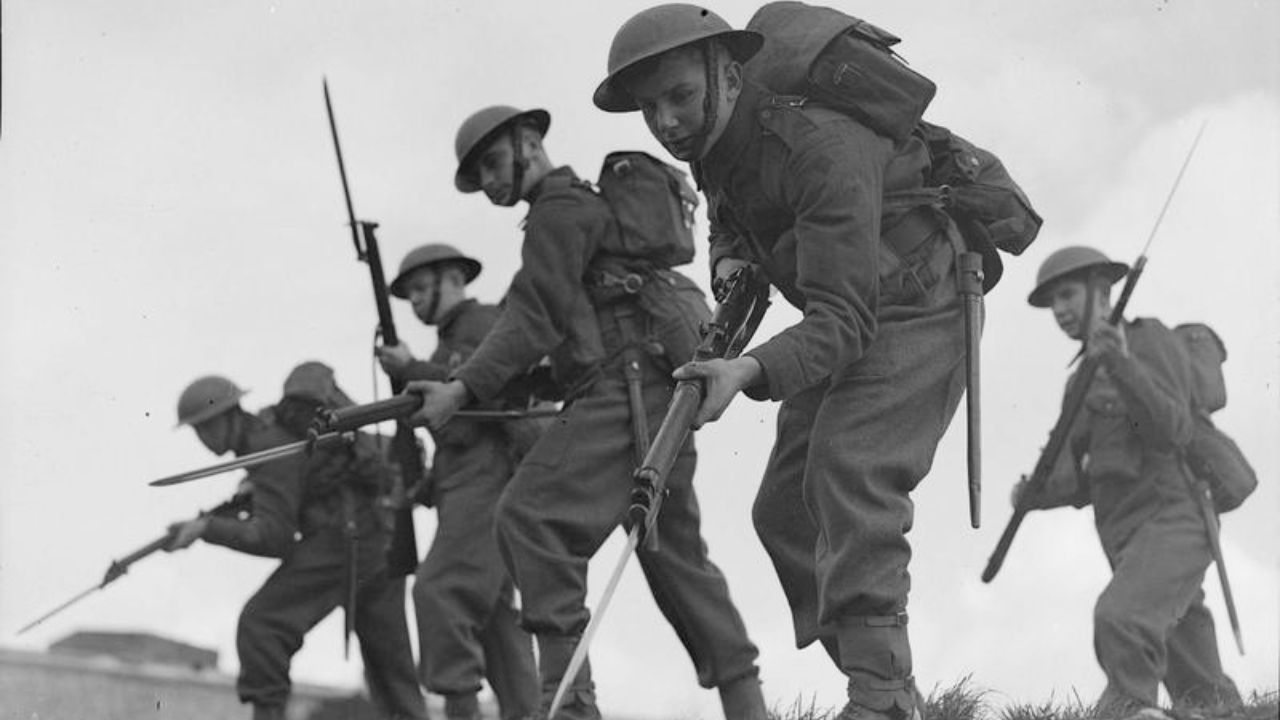
Photo credit: By Pelman, L (Lt) – Public Domain, /Wikimedia Commons
In the chaos of World War I, soldiers needed rifles they could count on when every shot mattered. These weren’t lightweight sporting guns — they were built for mud, rain, and brutal trench conditions. While technology varied from country to country, certain rifles stood out for their reliability, accuracy, and sheer durability under constant abuse. Whether you were holding the line or charging across no man’s land, these rifles became trusted lifelines for soldiers on both sides of the conflict.
Lee-Enfield SMLE Mk III

The British Lee-Enfield SMLE Mk III earned its reputation as one of the fastest bolt-action rifles of the war. With its smooth action and 10-round magazine, soldiers could fire aimed shots rapidly, a major advantage during trench assaults.
It also performed reliably in mud-soaked battlefields where many rifles jammed. Collectors and historians alike respect its contribution to British and Commonwealth forces, where it became the backbone of infantry firepower from 1914 onward.
Mauser Gewehr 98

The German Mauser Gewehr 98 was a precision-built rifle known for its strength and accuracy. Chambered in 7.92x57mm, it offered excellent long-range performance, making it deadly in open-field engagements.
Its controlled-feed bolt and robust design set a standard for future bolt-action rifles. While the five-round capacity slowed sustained fire, German marksmen valued its consistency, and many modern hunting rifles still borrow heavily from the Gewehr 98’s legendary action.
Springfield M1903

The American Springfield M1903 became a symbol of U.S. involvement in the Great War. Known for its accuracy and chambered in .30-06, it excelled in both close-quarters fighting and long-range shooting.
Its design borrowed from the Mauser system but improved ergonomics and sights, making it a favorite among American riflemen. Paired with scoped sniper variants, the M1903 gave U.S. troops a reliable, versatile weapon they could trust under harsh conditions.
Mosin-Nagant M1891

The Russian Mosin-Nagant M1891 may not have been as refined as its Western counterparts, but it was rugged, powerful, and mass-produced — perfect for the Eastern Front’s brutal conditions. Chambered in 7.62x54mmR, it delivered solid performance at range.
While its bolt action wasn’t as smooth as the Lee-Enfield or Mauser, its sheer availability made it invaluable for Russian forces. Many original M1891 rifles still see use today, a testament to their enduring durability and effectiveness.
Lebel Model 1886 M93

The French Lebel Model 1886 M93 brought innovation to the battlefield as the first military rifle chambered for smokeless powder. Its 8mm cartridge offered better range and less fouling than older black powder designs.
The Lebel’s tube magazine slowed reloading compared to box-fed rifles, but it remained France’s standard infantry weapon throughout the war. Its unique role in introducing smokeless technology makes it one of the most historically significant rifles of the conflict.
Carcano M91

The Italian Carcano M91 served as Italy’s primary infantry rifle and earned respect for its lightweight handling and low recoil. Chambered in 6.5×52mm, it was well-suited for soldiers navigating mountainous terrain.
While not as powerful as the Mauser or Springfield, its smooth bolt and accuracy at mid-range distances made it a capable rifle for trench fighting. Original wartime Carcanos remain popular among collectors due to their historic significance and unique design.
Ross Rifle Mk III

The Canadian Ross Rifle Mk III is one of the more controversial rifles of World War I. It was exceptionally accurate, making it popular among snipers, but its straight-pull bolt design struggled in muddy trench environments.
Despite its reliability issues under harsh conditions, Canadian sharpshooters used it to great effect when maintained properly. Over time, most frontline troops transitioned to the Lee-Enfield, but the Ross remains a key piece of Canadian military history.
Arisaka Type 38

Japan supplied its Arisaka Type 38 rifles to Russian forces during the war due to supply shortages. Chambered in 6.5x50mm, it was lightweight, durable, and surprisingly reliable even under heavy use.
While not as well-known as other rifles on the Western Front, the Arisaka Type 38 earned respect from those who carried it. Its strong action design made it a foundation for later Japanese rifles, and many were repurposed in conflicts well beyond World War I.
Mannlicher M95

The Austro-Hungarian Mannlicher M95 used a straight-pull bolt system that allowed for faster cycling compared to traditional turn-bolt rifles. Chambered in 8x50mmR, it gave soldiers decent firepower in both defensive and offensive scenarios.
Its five-round en-bloc clip system simplified reloading, and its rugged construction handled trench conditions reasonably well. While overshadowed by the Mauser, the M95 proved effective throughout the war and remains a favorite among collectors of Austro-Hungarian weapons.
Winchester Model 1895

The Winchester Model 1895 served as a supplemental rifle for Russian forces, chambered in 7.62x54mmR. Its lever-action design was unusual for the era but offered faster follow-up shots than most bolt-action rifles of the time.
Produced under contract for Russia, the Model 1895 brought American manufacturing to the Eastern Front. While limited in overall numbers, it represents a unique intersection of innovation and necessity during the Great War.
*This article was developed with AI-powered tools and has been carefully reviewed by our editors.