Photo credit: AmericanFun351/YouTube
Beretta had already been manufacturing firearms for centuries before the modern semiautomatic pistol arrived. Once the company entered the handgun market, however, it repeatedly produced pistols that influenced military contracts, concealed carry designs, action movies, competition shooting, and police equipment around the world.
Not every Beretta pistol became a commercial success, and some of the company’s designs now appear outdated beside newer striker-fired handguns. Still, few firearm manufacturers can claim a pistol history this deep. These 10 Beretta pistols either introduced an important design, influenced later models, or changed what shooters expected from a semiautomatic handgun.
Beretta Model 1915
The Beretta Model 1915 was the company’s first successful semiautomatic pistol and marked its transition from primarily building barrels and long guns into becoming a serious handgun manufacturer. Developed during World War I, it gave the Italian military a domestically produced alternative to service pistols that were difficult to obtain in sufficient numbers.
The Model 1915 established several visual traits that would remain associated with Beretta pistols for decades. Its exposed barrel and open-top slide created a recognizable profile while reducing the amount of slide material surrounding the barrel. Later Beretta handguns would refine the concept, but the basic appearance began here. It may look crude compared with the company’s later pistols, yet it started a semiautomatic pistol line that eventually became one of the most recognizable in the world.
Beretta Model 1934
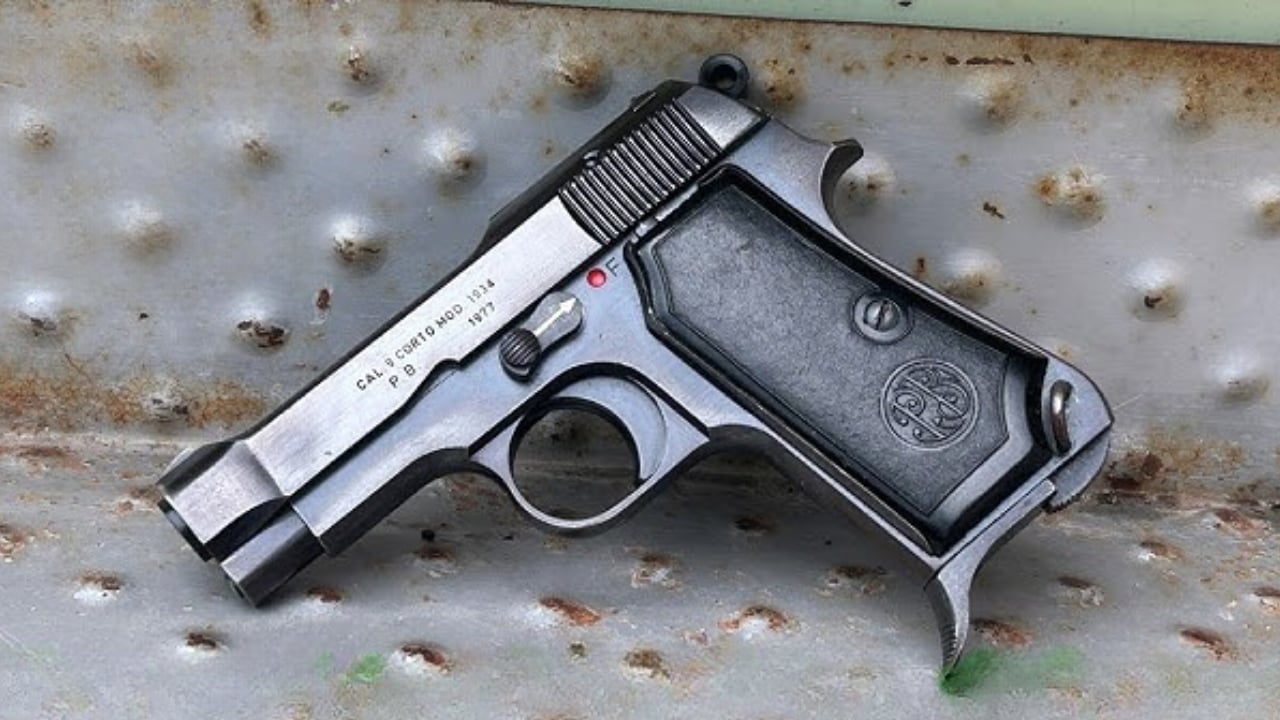
The compact Beretta Model 1934 became one of Italy’s most widely recognized military sidearms. Chambered in 9mm Corto, better known in the United States as .380 ACP, it was smaller and lighter than many full-powered service pistols of its era. The Italian armed forces adopted it before World War II, and large numbers remained in service long after the war ended.
Its blowback action, exposed hammer, and open slide made the pistol relatively straightforward to manufacture and maintain. The Model 1934 was not especially powerful, and its controls feel dated by modern standards, but it proved that a compact semiautomatic could serve as a practical military handgun. Its broad wartime use also helped establish Beretta as much more than a regional European gunmaker. Surviving examples remain common enough that the Model 1934 is still one of the more approachable World War II pistols for collectors.
Beretta M1951
The M1951 represented a major technical leap for Beretta. Earlier pistols generally relied on simple blowback operation, which worked well with smaller cartridges but was less suitable for the full-power 9mm round. The M1951 used a locked-breech system with a falling locking block, allowing Beretta to build a practical military-sized pistol chambered in 9mm Luger.
It was also Beretta’s first postwar service pistol to point clearly toward the company’s future. The exposed barrel, open slide, and locking-block system would later appear in a much more refined form on the Model 92. The M1951 served with Italian law enforcement and military units and was manufactured under license in other countries. It never achieved the fame of the 92, but without the M1951, Beretta’s most successful pistol might have looked very different.
Beretta Model 92
The original Model 92 arrived during the 1970s and combined several of Beretta’s proven ideas into one modern service pistol. It retained the locking-block action and open slide associated with the M1951 but added a double-stack magazine, double-action trigger, and improved controls. These changes made the pistol much more competitive against the new generation of high-capacity 9mm handguns.
The Model 92 also helped normalize the idea that a full-size military handgun could combine substantial magazine capacity with soft recoil and excellent reliability. Its large grip did not fit every shooter, but the pistol was easy to control and unusually smooth for its time. The basic 92 platform eventually became one of the most successful handgun designs ever produced, with Beretta reporting millions manufactured for military, police, and civilian users around the world.
Beretta 92FS and M9
The 92FS became the version that turned the Model 92 from a respected European service pistol into an international icon. Its selection as the United States military’s M9 service pistol placed it in holsters across every branch of the armed forces. It replaced the M1911A1 as the standard U.S. sidearm and remained closely associated with American military service for more than three decades.
That contract also transformed the commercial handgun market. Shooters who wanted the same basic pistol carried by American service members could purchase a 92FS, and Hollywood gave the handgun even more exposure. The pistol appeared constantly in action movies and television shows throughout the 1980s and 1990s. Whether shooters loved its size or disliked its slide-mounted safety, the 92FS helped make high-capacity 9mm pistols the new standard for duty use.
Beretta 93R
Beretta developed the 93R for military and law-enforcement units that needed more firepower than a conventional pistol could provide. Based loosely on the Model 92 family, it could fire controlled three-round bursts. A folding front grip and extended magazine helped the shooter manage a weapon that otherwise produced an enormous amount of movement in a very small package.
The 93R never became a common service weapon, and its specialized role kept production relatively limited. Its influence came through what it represented. It was one of the most recognizable machine pistols ever built and became a fixture in movies, television, and video games. Modern personal-defense weapons eventually offered better control and greater effectiveness, but few matched the 93R’s combination of compact dimensions, mechanical complexity, and unmistakable appearance.
Beretta 84 Cheetah
Long before today’s micro-compact 9mm pistols dominated concealed carry, the Beretta 84 Cheetah offered shooters a smaller handgun without forcing them to accept tiny sights or a narrow grip. Chambered in .380 ACP, it used a double-stack magazine that provided considerably more ammunition than most compact pistols of its era.
The Model 84 also felt and operated more like a reduced-size service pistol than a basic pocket gun. It had a traditional double-action trigger, exposed hammer, usable sights, and the polished appearance expected from an Italian-made Beretta. The blowback action could produce sharper recoil than buyers expected from a .380, but the Cheetah still showed that compact pistols did not have to feel cheap or crude. Beretta revived the concept decades later with the updated 80X Cheetah, proving that the original idea still had an audience.
Beretta 21A Bobcat
The Beretta 21A Bobcat approached the pocket-pistol problem differently. Rather than requiring the shooter to rack a small, stiff slide, it used a tip-up barrel. The shooter could load the chamber directly by lifting the barrel, inserting a cartridge, and closing it. This made the Bobcat especially appealing to people with limited hand strength.
The design also allowed the pistol to remain extremely compact without abandoning an exposed hammer and traditional double-action trigger. Chambered in .22 LR or .25 ACP, depending on the version, the Bobcat was never intended to compete with a full-size defensive handgun. Its contribution was proving how useful a tip-up barrel could be in a true pocket pistol. Beretta has continued developing the same idea through newer models, including updated Bobcat and Tomcat variants designed for modern concealed-carry buyers.
Beretta PX4 Storm
When polymer-framed pistols began taking over military and police markets, Beretta responded with the PX4 Storm. Instead of copying the locked-breech systems used by most competitors, Beretta equipped the full-size PX4 with a rotating barrel. During firing, the barrel rotates rather than tilting, which helps keep it aligned with the shooter’s hand and changes how recoil is transmitted.
The PX4 never matched the commercial popularity of the Glock or Beretta 92, but it earned a loyal following among shooters who appreciated its smooth recoil impulse and excellent durability. It also showed that a polymer-framed duty pistol did not have to use a striker-fired action. The PX4 retained a traditional double-action and single-action trigger, giving police departments and civilian shooters a modern handgun that still operated like the hammer-fired pistols they already understood.
Beretta APX
Beretta built the APX to compete directly in the modern striker-fired duty-pistol market. It abandoned the traditional open-slide appearance of the 92 and the rotating-barrel system of the PX4 in favor of a more conventional locked-breech design. The result was a simpler pistol with a consistent trigger pull, modular internal chassis, and aggressive slide serrations.
The APX did not immediately unseat the leading striker-fired pistols, but it marked an important change in Beretta’s approach. The company was no longer relying solely on the reputation of the 92 or trying to convince departments to remain with hammer-fired handguns. Later APX A1 models added optics-ready slides, improved grip frames, and features expected by current defensive-pistol buyers. The APX proved that even a company known for centuries-old traditions could build a thoroughly modern service handgun.
Like The Avid Outdoorsman’s content? Subscribe to our newsletter so you never miss an article.
Here’s more from us: