Photo credit: AI-generated image created using ChatGPT. Illustrative only
A guy thought he’d done things the right way for an outdoor-loving cat: leash training, a big fenced backyard, and then a barrier on top of the fence when the cat proved he could clear six feet like it was nothing. But a couple minutes of quiet turned into a worst-case scenario he’ll carry for the rest of his life.
In the original post, the cat’s owner says his cat, Stevie, was shot with a .22 and later euthanized because the round destroyed his lower jaw. Weeks earlier, the owner had tried to stop fence-jumping with a topper barrier—something a lot of pet owners and rural folks use to keep animals where they belong. It worked for a while, until it didn’t.
Stevie was raised around the outdoors, but still under control
The owner and his wife got Stevie in early 2019 while living in another state. Stevie liked being outside, so the owner did what many responsible pet owners do when they’ve got a wanderer: he leash trained the cat and took him for walks.
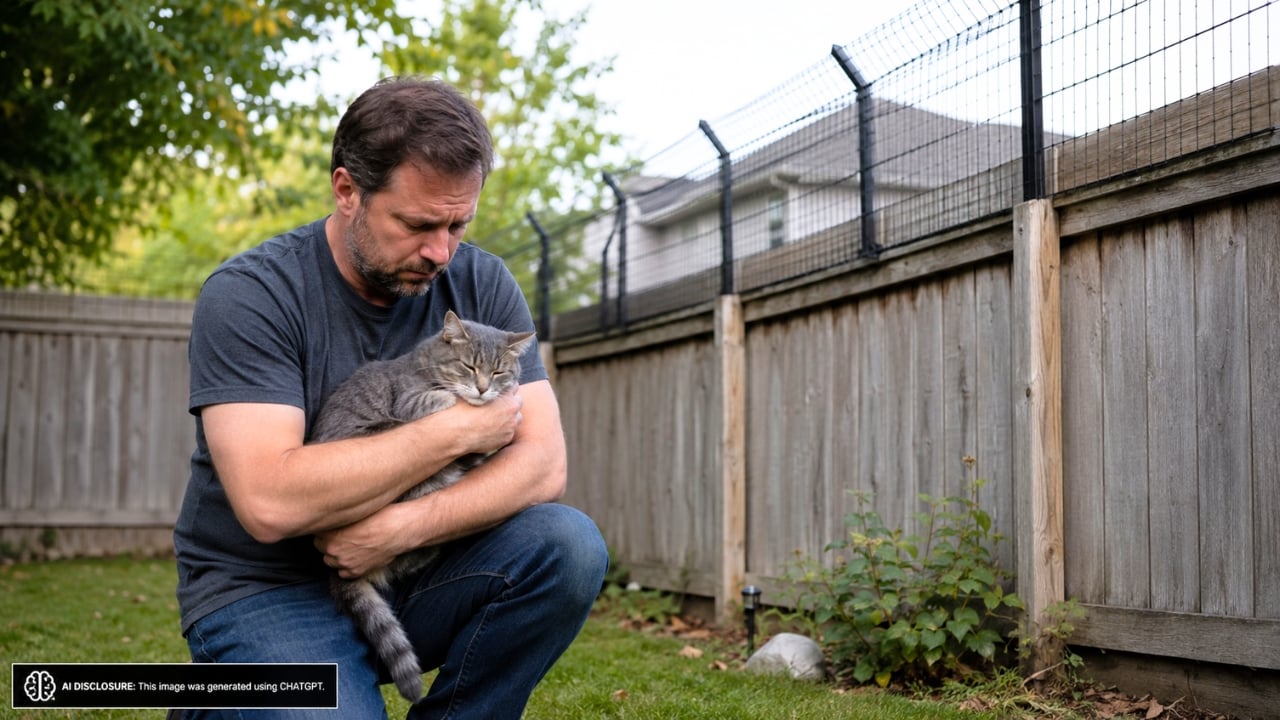
In late 2020, they moved again, this time to a home with a large backyard. The owner enclosed it with a six-foot privacy fence so Stevie could get fresh air and room to run without roaming the neighborhood.
A fence works until an animal decides it doesn’t
Pretty quick, they learned Stevie could jump the fence. Anyone who’s ever tried to keep a determined dog in, or keep coyotes out of a chicken run, understands that moment: you realize your “good enough” setup is an invitation.
So the owner added a barrier at the top of the fence and it seemed to solve the problem—until this past summer. Stevie escaped twice. The owner considered making him indoor-only, but Stevie’s constant begging wore him down, and he decided to let him out again.
A short gap in supervision was all it took
On the day Stevie was shot, the owner says he stayed outside with him. Stevie settled on the deck for a nap. Thinking it was safe, the owner stepped into his shop “for just a couple of minutes.”
When he came back out, Stevie was gone. He walked around the block calling for him—nothing. That’s the sickening part of outdoor pet ownership: the clock starts ticking, and your mind goes through every bad possibility.
He came home bleeding, and the truth followed
A couple hours later, close to dinnertime, the owner went back into the yard and called again. This time he heard scrabbling at the back fence, and Stevie popped back into the yard.
Stevie was covered in blood. The owner carried him inside and called the emergency vet, then made an hour-long drive. At the clinic, they gave pain medication and cleaned him up to assess the injuries. The vet determined Stevie had been shot with a .22, and the lower jaw was destroyed.
The vet told the owner they could keep Stevie alive, but he would never be able to eat solid food again. The owner chose euthanasia.
The part nobody likes to say out loud: a .22 is still a deadly tool
Plenty of outdoorsmen grew up around .22s. They’re common, they’re handy, and they’re often the first rifle you learn on. That familiarity can make some folks forget what a .22 round does when it hits flesh and bone.
In this case, the damage described is exactly why safe gun handling and responsible shooting matter so much around homes and property lines. If someone is taking shots where a family pet can be hit, that also means a neighbor, a kid, or someone working in a yard could be in the wrong place at the wrong time. A fence line is not a backstop, and “I thought it was just an animal” doesn’t make it any better.
A hard lesson for pet owners living in rural and suburban edges
The owner doesn’t dodge responsibility for the decision to let Stevie back outside after prior escapes. He wrote that he feels awful and believes he should have made Stevie indoor-only after the first time he got out. That’s a brutal kind of regret—because it’s not about a scratched truck or a busted gate. It’s about a living thing you’re supposed to protect.
But this story also highlights the reality that a lot of people don’t want to deal with: if your pet leaves your property, you lose control over what happens next. Even if your animal isn’t bothering anyone, you can’t control the neighbor who panics, the person who hates cats, or the irresponsible gun owner who thinks the fence line is a safe direction to shoot.
It’s also a reminder that “cat-proof” fences and toppers are not one-and-done solutions. Animals learn. Seasons change. One loose board, one stacked object near a fence, one new angle, and the escape route is back in business.
When nobody talks, prevention becomes the only sure move
The headline angle here is the most frustrating part: after a backyard barrier went up to stop the fence-jumping, Stevie still ended up shot, and nobody stepped forward. In the real world, that silence is common. People who make reckless choices don’t usually volunteer to own them.
So the practical side of this, for anyone who loves the outdoors and keeps animals, is prevention and documentation. Prevention means assuming an escape will happen again and planning around it—supervised time only, a covered “catio” or run, or changing routines so the animal can’t get to the fence line. Documentation means cameras facing the yard and fence line, good lighting, and keeping a record if you’re seeing repeat problems—because if something happens, memories get fuzzy fast and proof matters.
This isn’t about picking fights with neighbors. It’s about tightening up your own situation so you’re not left with nothing but heartbreak and questions.
The owner summed it up in a way most people understand once they’ve lost an animal: he made a decision that felt reasonable in the moment, and Stevie paid for it. If you’ve got a pet that loves the outdoors, this is the gut-check story that makes you look at your fence, your routine, and your supervision—and decide what you’re willing to risk.