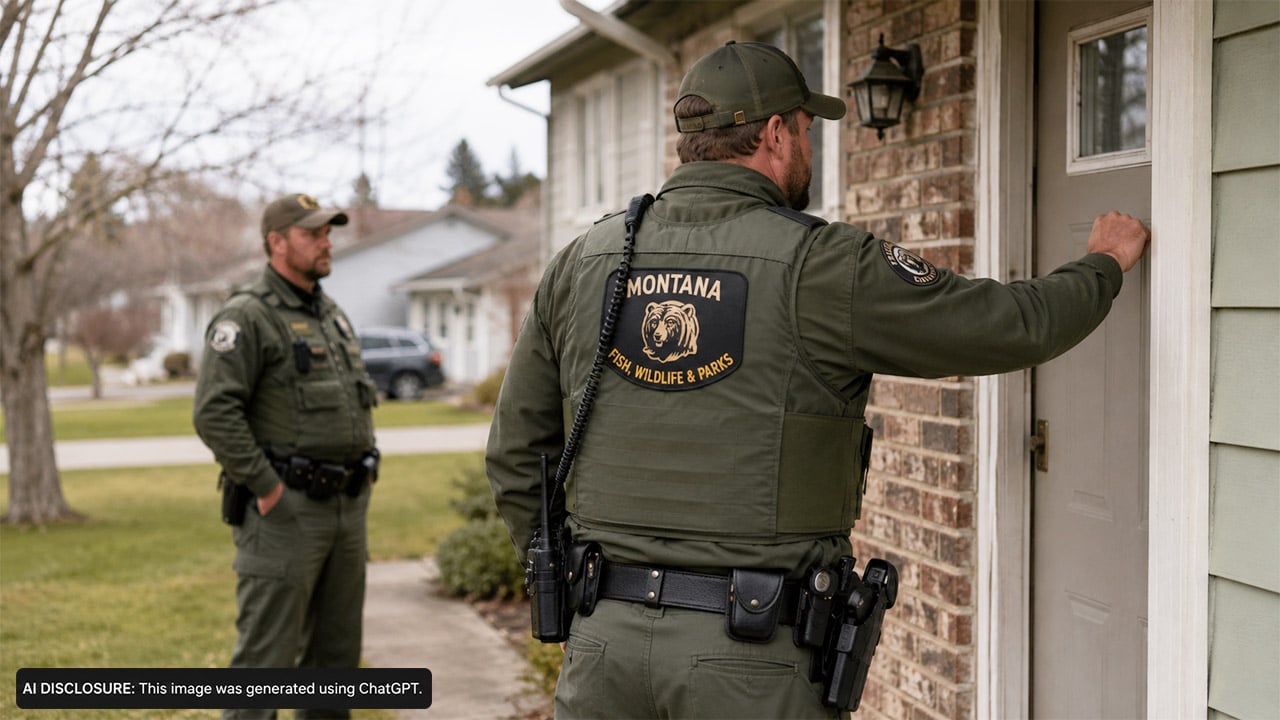
Photo credit: AI-generated image created using ChatGPT. Illustrative only
Game wardens don’t usually put a lot of miles on the truck just to “have a chat.” When Montana Fish, Wildlife & Parks Region 6 wardens Andy Matakis and Dirk Paulsen drove west into Oregon and Washington to interview 10 suspects, they weren’t sightseeing. They were closing the loop on three separate investigations that spread across six Montana counties.
Those door knocks turned into guilty pleas tied to 40 violations, with multiple big-game animals seized along the way, as outlined in the source post. If you hunt Montana—resident or nonresident—it’s a blunt reminder that the paperwork matters, and the enforcement side talks to other states more than most folks realize.
A cross-state trip to tie up three investigations
FWP said the two Region 6 wardens traveled to Oregon and Washington to conduct interviews with 10 suspects connected to three investigations. That little detail matters. Interviews are where a lot of cases get clarified—who shot what, where it happened, whose tag it was, and how the licenses were obtained.
It also shows how these cases don’t always stop at the state line. If the people involved live out of state, wardens still have options. They can work with partner agencies and go straight to the source instead of hoping a phone call or mailed summons does the job.
Forty violations across six Montana counties
FWP reported that the violations were spread across six counties: Lincoln, Superior, Custer, Liberty, Lewis and Clark, and Blaine. That kind of geographic spread usually means it wasn’t one bad decision on one weekend. It suggests repeated hunts, repeated opportunities to do it right, and repeated choices not to.
And that’s why the number “40” hits. When you stack up license issues, tag issues, and where an animal was taken, each hunt can generate multiple violations. A single buck can turn into a mess if the tag is wrong, the district is wrong, and the license was obtained unlawfully.
The violations weren’t “gray area” mistakes
The list FWP shared reads like a greatest-hits album of how to get in trouble fast: hunting without a license, unlawful possession, tag transfers from one hunter to another, buying licenses from another hunter, unlawful procurement of multiple licenses, and using deer B licenses to harvest buck deer.
They also cited using district-specific deer licenses in the wrong district. That one is worth underlining because it’s where a lot of folks get sloppy. Montana’s districts and license types aren’t “close enough” rules. If the license is district-specific, that boundary matters, even if the timber and coulees look the same on both sides of the line.
Seized game included bull elk, antelope, and multiple bucks
FWP said wardens seized animals that were unlawfully harvested throughout Montana: two bull elk, two antelope bucks, four whitetail bucks, and three mule deer bucks. That’s not a stray upland bird tossed in the cooler. That’s serious big-game meat and serious big-game resources.
Seizure is also the part hunters should pay attention to because it’s immediate and tangible. Losing an animal isn’t just losing a trophy photo. It’s losing the meat you planned around, the time you spent scouting, and whatever money you put into travel, fuel, tags, and gear—plus whatever penalties come with the case.
Other states and local counties helped close the cases
FWP specifically thanked the Oregon State Police Fish and Wildlife Division and the Washington Department of Fish and Wildlife Police for their assistance. That’s the cooperative piece most people don’t think about until it’s too late. Wildlife agencies share information, coordinate interviews, and help each other put cases together, especially when suspects or evidence are out of state.
They also thanked the county partners involved—again, Lincoln, Superior, Custer, Liberty, Lewis and Clark, and Blaine—for helping resolve the cases. That tells you the work wasn’t just one warden writing one ticket. These investigations took time, coordination, and follow-through.
This is what “do it right” actually looks like in the field
If you’ve been around hunting long enough, you’ve heard every excuse: “I didn’t know,” “my buddy told me,” “we always did it this way,” “it was just paperwork.” But the violations listed here aren’t the kind you stumble into if you’re making an honest effort. Tag transfers and buying someone else’s license aren’t misunderstandings. They’re shortcuts.
The clean way to avoid being anywhere near this kind of mess is boring: buy your own license, hunt the season and district it’s valid for, tag your animal properly, and don’t treat a B license like a free pass for a buck. When something about a tag or district doesn’t make sense, ask before the hunt—not after a warden is standing at your tailgate.
FWP also reminded the public that tips can be submitted through tipmont.mt.gov, and that people who report information may be eligible for a reward of up to $1,000. In rural country, that matters. A lot of poaching cases get traction because somebody saw a light at the wrong time, a shot where it didn’t add up, or a truck that kept showing up when no one should’ve been there.
Montana’s hunting culture runs on access and trust—between landowners and hunters, and between hunters and the resource. When a small group starts treating licenses and tags like tradable poker chips, it doesn’t just burn their own season. It puts a target on everybody else who’s trying to do it the right way.
Like The Avid Outdoorsman’s content? Subscribe to our newsletter so you never miss an article.
Here’s more from us: