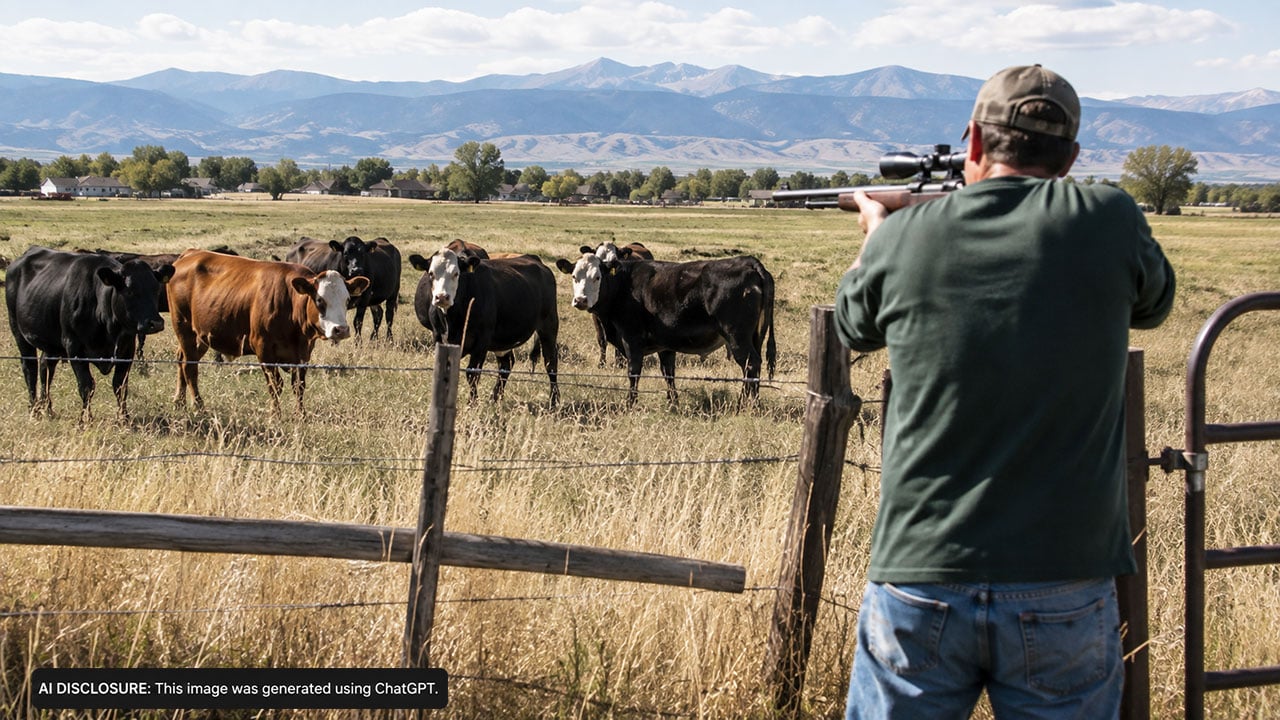
Photo credit: AI-generated image created using ChatGPT. Illustrative only
Out in the foothills and canyon country, neighbors get used to a certain amount of “not my stuff on my land.” Deer hop fences. Dogs wander. And in open range areas, cattle will occasionally drift where they don’t belong. But a Buckhorn Canyon situation northwest of Fort Collins went way past the normal headaches, ending with eight dead head of cattle, a criminal case, and a big restitution bill. Details were reported in the original post.
Michael Hester, 37, got a short jail term as part of his sentence, along with 240 hours of community service, three years of supervised probation, and an order to reimburse the cattle owners more than $27,000. And it all started with cattle crossing onto his property.
Eight cattle crossed a line, and the response was gunfire
According to the account, neighbors called 9-1-1 in April 2024, and Larimer County Sheriff’s Office deputies responded the same day. Deputies, along with a Colorado Department of Agriculture Brand Inspector, found eight dead cattle.
One nearby resident, Kelly Patrick, said many of the animals killed were cows that had recently calved. She said the cattle were on Hester’s property across the road from her home when she witnessed him ride up on an all-terrain vehicle and start shooting. In her words, they were laying down—“fish in a barrel.”
“Open range” isn’t a suggestion, and it changes who’s responsible
This is where a lot of folks—especially people moving into rural areas—get sideways with the rules. Colorado ranchers operate under what’s commonly called the Open Range Law. In plain terms, that means livestock can graze without being contained in certain areas, and if you want them off your place, you’re typically the one responsible for building a fence that keeps them out.
Patrick said there’s an “open range cattle” sign along that stretch of road. That matters because it’s a warning label for everybody: slow down, expect livestock, and understand you’re not in a suburban “keep it in your yard” setup.
The witness account paints a clear picture of how it went down
Patrick said she confronted Hester afterward on his property. She recounted him saying, “I can shoot them; they’re on my property just like a wild animal,” and that he called the animals a “nuisance.”
Outdoorsmen understand nuisance animals. Coyotes in the chicken coop, raccoons tearing up feed, bears breaking into a shed. But cattle aren’t varmints, and they aren’t wildlife. They’re somebody’s property, and they’re also 1,000-plus-pound animals that can soak up suffering if you start punching holes in them without putting them down cleanly and legally.
Some of the cattle that weren’t killed on the spot reportedly stumbled onto other properties and died there. All of the dead cattle belonged to two other residents in the area.
A neighbor’s “pet cow” was shot and survived
One detail that’ll hit anyone who’s spent time around stock: one injured animal was Patrick’s cow that had crossed the road to join the other herd. Patrick described that cow as a pet, not a sale-bound animal, and said Hester shot it in the nose. The cow survived.
Ranchers can be practical to the bone about livestock, and still care deeply about them. Patrick put it in the kind of language you hear in real cattle country: the animals go to sale and “have a purpose,” but “we don’t torture them.” That’s the line most people can agree on, whether they’ve bottle-fed a calf or just driven past a pasture.
The charges started heavy, and the final plea still carried felony counts
Hester was arrested the day of the 9-1-1 call, and he was later released on a personal recognizance bond. The initial case wasn’t treated like a minor dispute over a fence line—authorities originally filed 18 felony counts.
In November, Hester took a deal with 8th Judicial District prosecutors and pleaded guilty to three counts of aggravated animal cruelty and three counts of agriculture animal theft. The cruelty counts are felonies, and he faced up to six years in prison for each count.
The final sentence included a short jail term, 240 hours of community service, three years of supervised probation, and restitution topping $27,000. Patrick said the neighbors who owned the dead cattle have already been reimbursed.
What landowners can do when livestock keeps showing up
If you own rural ground, it’s worth being blunt about this: shooting livestock that wanders over is the kind of decision that detonates your life. Even if you’re mad, even if it’s repeated, even if you think you’re in the right—this case shows how fast it turns into felonies, probation, and a bill that hurts.
There were other options available in the real world. Building or upgrading fencing is the big one in open range areas, because that’s often the legal expectation. And when it becomes a recurring conflict, getting the right folks involved—neighbors, brand inspectors, local deputies—beats turning a rifle into a remote-control problem solver.
There’s also the safety piece that doesn’t get talked about enough. Shooting across a rural property line problem doesn’t happen in a vacuum. Cattle tend to congregate. Homes and roads exist. In this case, Patrick said the cattle were across the road from her home. Bad decisions with bullets don’t stay neatly inside your frustration.
Out in open range country, everyone’s got to do their part: ranchers keeping tabs on gates and drift points, and landowners understanding what the signs mean and what the law expects. But the hard rule is simple—livestock on your place isn’t a free pass to start shooting. The aftermath in Buckhorn Canyon proves that in black and white.
Like The Avid Outdoorsman’s content? Subscribe to our newsletter so you never miss an article.
Here’s more from us: