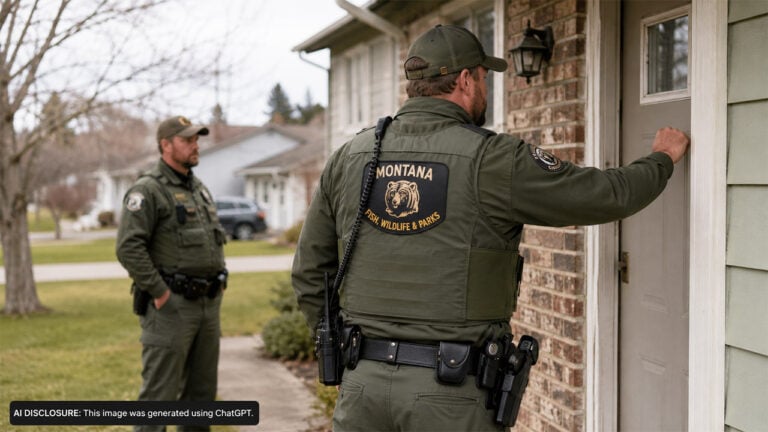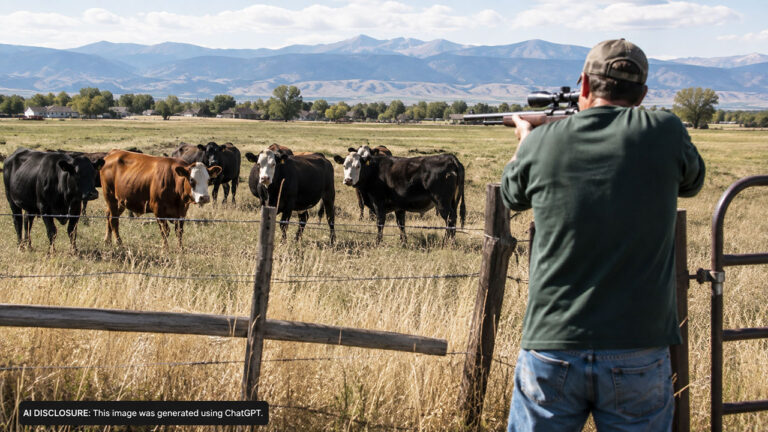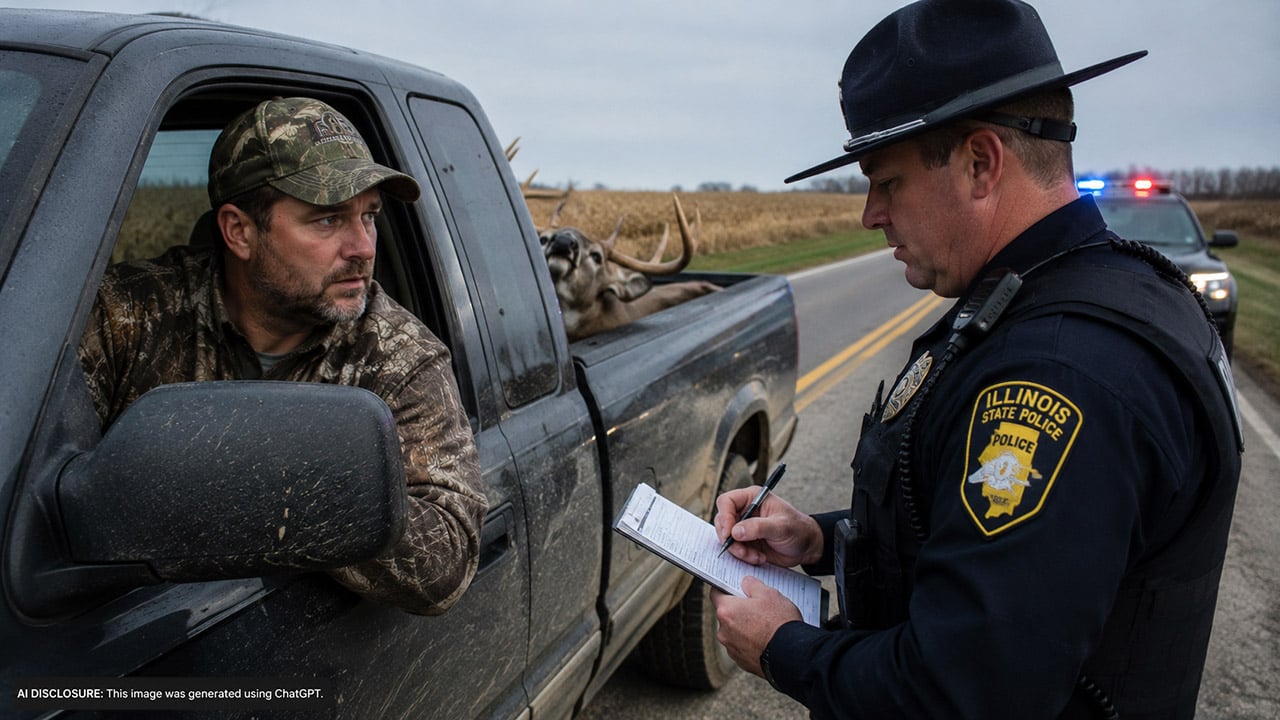
Photo credit: AI-generated image created using ChatGPT. Illustrative only
Most hunters have been there: you’re legal, it’s the right season, you’re within hunting hours, and you’ve got a deer headed home in the truck. Then the blue lights come on anyway.
That’s the situation one Illinois hunter laid out in the original post. He said he was stopped because an officer could see the deer in his truck. The deer itself checked out, but the stop didn’t end there—the officer reportedly pulled up prior harvest records tied to his conservation ID and wrote him up for an older violation from last year that had nothing to do with the deer he was currently hauling.
A deer in the truck turned into a roadside inspection
From the hunter’s telling, this wasn’t a case of sneaking one across state lines, spotlighting, or riding around at midnight with a warm carcass. It was hunting season. It was hunting hours. He believed everything about the current deer was “good,” meaning properly taken and properly in possession.
But the visible deer was what caught the officer’s attention and triggered the stop. That detail matters, because a lot of guys assume that if they aren’t speeding, swerving, or running a light, they’re insulated from getting lit up on the way home from the timber.
When “everything is good” still isn’t the end of the contact
The part that would make any hunter’s stomach tighten is what happened after the officer confirmed the deer itself wasn’t the issue. Instead of sending him on his way, the officer reportedly checked the hunter’s past harvest reports using his conservation ID.
Then came the curveball: the citation wasn’t tied to the deer in the truck at all. It was for something from the previous year—“completely unrelated to this deer,” as the hunter put it. In plain English, he got pulled over over today’s deer and walked away paying for yesterday’s paperwork (or whatever the prior issue was).
The probable-cause question hunters actually care about
The hunter’s main question was straightforward: is a deer visible in the truck enough probable cause to make the stop in the first place?
That’s not just a legal trivia question. It’s a real-world, boots-on-the-floorboards question, because a stop is where everything else starts. Once you’re on the shoulder, you’re talking, you’re handing over IDs, and you’re in a situation where an officer can take a closer look at tags, dates, transport rules, and whatever else they’re tasked with checking.
Whether or not a visible deer should justify a stop, hunters know the practical side: if your deer is in plain view—especially in a pickup bed, on a rack, or even visible through a cap window—it’s going to draw attention. Sometimes it’s just curiosity. Other times it’s enforcement doing enforcement.
Old records, conservation IDs, and how the past shows up fast
The detail that really matters for other hunters is how quickly prior seasons can become part of the conversation. The hunter said the officer accessed past harvest reports using his conservation ID. That’s a reminder that, in many states, your hunting activity is tied together under one number, one profile, one record.
So if you’ve ever had a tagging mistake, a late check-in, a “I thought my buddy did that online” situation, or any unresolved issue, don’t assume it disappears just because you’re doing things right this season. A routine roadside check can turn into a history lesson in a hurry.
And even if the prior matter is “unrelated,” it can still be actionable if it’s a legitimate violation that’s still within whatever enforcement window applies. The hunter’s frustration wasn’t that he was caught doing something wrong with the current deer—his frustration was that the visible deer opened the door to a citation from a different year.
What hunters can do to protect themselves on the way home
This isn’t the part where anyone should get cute or play games. The best move is to make it boring—boring transport, boring paperwork, boring answers. If you’re hauling a deer, keep your license and any required harvest documentation easy to reach, and keep your story simple: where you hunted, that you’re within the season, and that the animal is properly tagged/checked as required.
It also helps to handle the basics that cause the most grief. Know your state’s rules on tagging location (immediately upon harvest versus upon leaving the site), check-in deadlines, and whether proof of check-in needs to be physically with the animal during transport. Some states are strict about leaving evidence of sex attached or other carcass-handling rules—stuff that seems nitpicky until you’re standing on the shoulder trying to remember what the regulation booklet said.
And if you’ve ever had an issue from a prior year, it’s worth making sure it’s actually resolved. “I thought that was taken care of” is a rough sentence to say in a traffic stop, because it usually means you’re about to learn it wasn’t.
A good reminder: enforcement contacts don’t always stay on the original topic
Every hunter I know wants the same thing: hunt legal, get the deer cooled down, and get home without drama. But this Illinois stop is a reminder that the reason you get stopped and the reason you get cited don’t always match up neatly.
If an officer makes contact over a visible deer, the deer is only the beginning of the conversation. Once your conservation ID gets checked, your prior seasons can come up fast, and it might not matter that today’s buck is clean if yesterday’s record isn’t. The safest play is to keep your current hunt airtight and your past loose ends tied off—because a deer in the truck can turn into a whole different kind of roadside lesson.
Like The Avid Outdoorsman’s content? Subscribe to our newsletter so you never miss an article.
Here’s more from us: