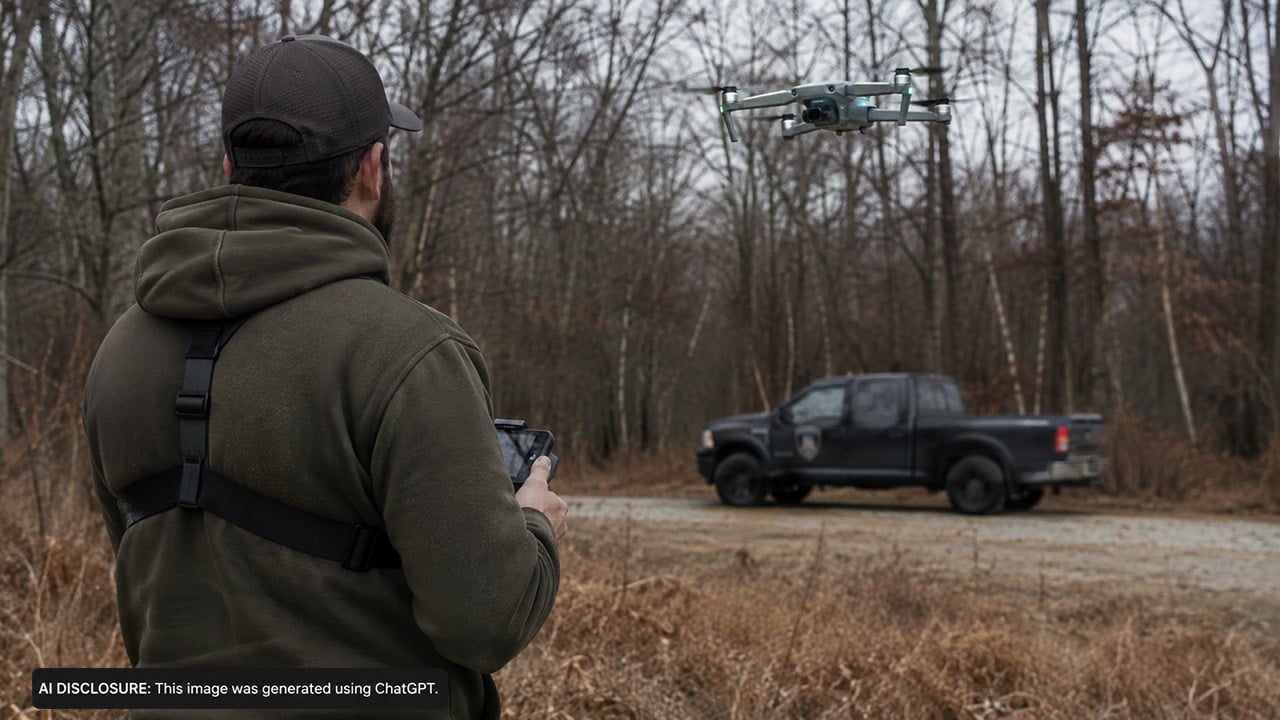
Photo credit: AI-generated image created using ChatGPT. Illustrative only
Most hunters I know will do almost anything to recover a deer, especially when the shot felt right but the blood trail turns into a question mark. That’s the gap a Pennsylvania man said he was trying to fill with a drone and a thermal camera—until a sting call, a confiscated drone, and four convictions turned that “recovery service” into a test case for the state’s hunting laws.
In Lancaster County, Joshua Wingenroth, 35, of Downingtown, was convicted of violating state hunting laws after an undercover operation, as detailed in the original post. He was found guilty on all counts and fined $1,500, and his attorney said he plans to appeal.
A drone “recovery” business built around a real need
Anybody who’s tracked a marginal hit knows the feeling: you’ve got limited daylight, limited sign, and a responsibility to not waste an animal. Wingenroth openly advertised a service that used drones to help people locate deer they believed were already dead so they could retrieve them.
That detail matters because the argument in court wasn’t about whether recovering game is ethical—most hunters agree it is. The argument was whether using a drone in that process counts as “hunting” under Pennsylvania law, and whether the tech he used falls under banned electronic devices and spotlighting rules.
Game wardens warned him, but he kept operating
According to authorities, state game wardens told Wingenroth last year that what he was doing was illegal. The report says he didn’t agree with that interpretation and told them his lawyer “has a different interpretation” of the law.
That’s one of those moments where the outdoors meets the real world. You can be convinced you’re doing the right thing, and you might even have a decent argument about outdated rules, but once the agency tasked with enforcement tells you “no,” you’re operating in the danger zone—especially when you’re running it as a business and advertising it.
The undercover call and the waiver that set the hook
On Dec. 6, an undercover Game Commission officer contacted Wingenroth and asked him to meet and help locate a deer the officer claimed he had shot in the Welsh Mountain Nature Preserve. Wingenroth met him within the hour.
Before launching the drone, Wingenroth had the officer sign a waiver. The waiver stated the officer wanted to recover the deer carcass, but if the deer was found to still be alive, he agreed to “hunt the deer another day.” From a common-sense angle, that reads like Wingenroth trying to draw a bright line between recovery and active pursuit.
But the call itself was part of a sting, and the “shot deer” story was fabricated. Wingenroth didn’t know that when he powered up.
Thermal, infrared, and a spotlight: what he actually did in the field
Wingenroth launched the drone and piloted it remotely while using a thermal camera setting that showed the scenery in black and white. He soon spotted a live deer and switched to an infrared setting that displayed the animal on a heat map.
Then, the report says he turned that setting off and activated a spotlight to view the deer normally. Not long after, a game warden approached, confiscated the drone, and cited him.
He was charged with two counts of using illegal electronic devices during hunting and single counts of disturbing game or wildlife and violating regulations on recreational spotlighting. He was convicted on all four counts.
Why the judge said this is bigger than one guy with a drone
This case wasn’t treated like routine paperwork. The report notes it “apparently marked the first time anyone has been cited and tried in Pennsylvania for using a drone to recover a dead game animal,” and it hinged on whether he was involved in hunting as defined by state law.
Authorities argued that because the legal definition of hunting includes tracking and recovery, using the drone in that context still counts as “hunting” game. District Judge Raymond Sheller agreed with that interpretation when he delivered the verdicts. He also made it plain he wasn’t blind to the technology curve, saying, “The Legislature needs to address this,” and, “Everyone is playing catchup to science.”
Wingenroth’s attorney, Michael Siddons, argued the laws around devices while hunting are “archaic,” patched over time to account for newer technology but not specifically written with drones in mind. Siddons also argued that if Wingenroth used the drone to locate an animal before shooting, that would be illegal poaching—but Wingenroth believed the deer was already dead, only used the drone after hunting hours ended, and wasn’t intending to hunt.
The court didn’t buy the distinction, at least not under the current reading of the rules.
What this means for hunters trying to do the right thing
If you’re a hunter, the uncomfortable part here is that the whole thing started with an idea most of us support: recovering wounded game. This wasn’t a story about someone trying to run deer with a drone to get an advantage before the shot—at least not based on what’s described in the report. It was presented as post-shot recovery help, and it still ended in convictions.
It also shows how quickly “helpful tech” crosses into “illegal equipment” once you mix in electronics, night capability, and spotlighting rules. Thermal and infrared are powerful tools. A spotlight is a classic tool, too—but it’s also tightly regulated in many places for good reason, because it can be used to take game unlawfully.
Wingenroth’s appeal will be worth watching, but the immediate lesson is simple: if your state defines hunting broadly—tracking, pursuing, locating, and recovering—and bans certain electronics while hunting, you can get jammed up even when you think you’re working after-hours and only trying to find a carcass.
In the meantime, this looks like the kind of situation where lawmakers will eventually have to decide what’s acceptable: a hard “no” on drones around game, or a narrow, regulated allowance for recovery work that doesn’t turn into high-tech spotlighting and pursuit. Until then, Pennsylvania hunters should assume that if a drone is involved in finding a deer, the state may treat it as hunting—because in this case, that’s exactly how it played out.
Like The Avid Outdoorsman’s content? Subscribe to our newsletter so you never miss an article.
Here’s more from us: