Photo credit: AI-generated image created using ChatGPT. Illustrative only
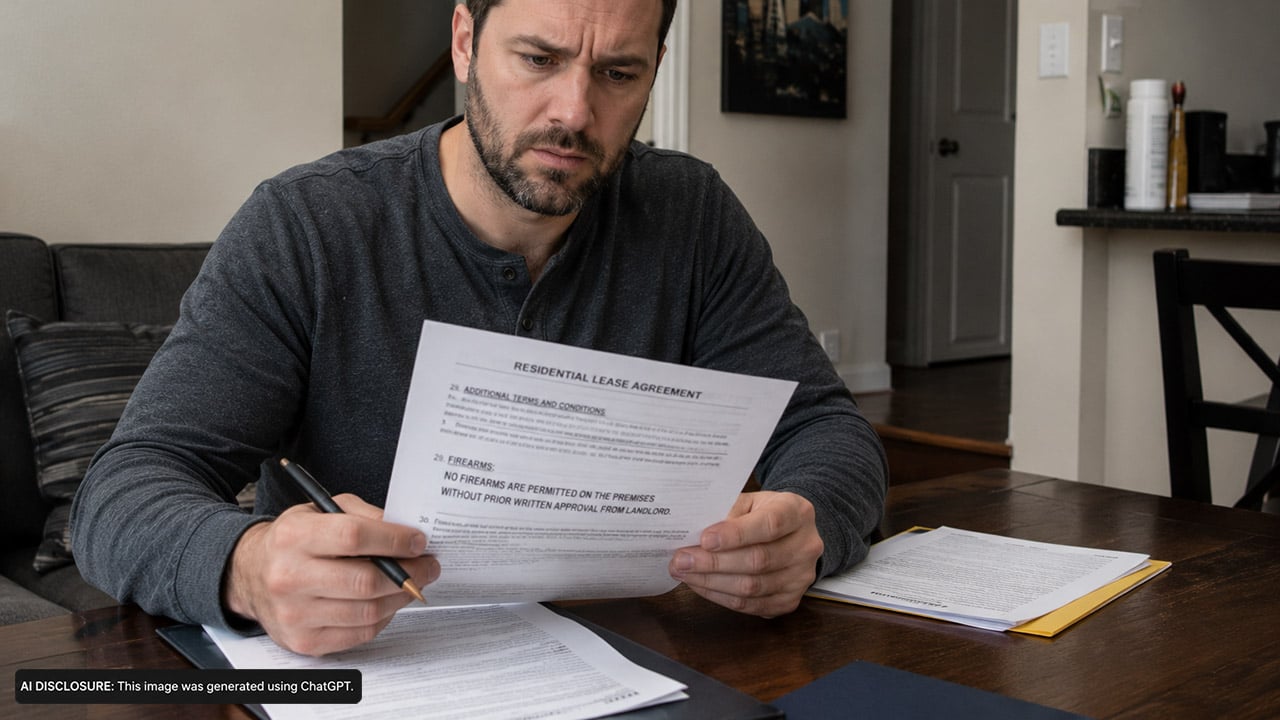
A guy packing up for a move from California to Washington figured his biggest headache would be boxes, change-of-address forms, and maybe learning a new route to work. Instead, the surprise showed up in black-and-white lease language: a clause that flat-out bans firearms on the property unless the landlord gives prior approval.
In the original post, the tenant said he and his girlfriend are set to move in within weeks, but the lease they received includes a “Premises Use” section that lists “unauthorized … firearms” right alongside drugs, excessive drinking, disturbances, and smoking as violations that are “cause for eviction.” His question was simple and practical: if the lease says no firearms without approval, does he need to tell the landlord what he owns to avoid getting tossed out?
The lease clause put firearms in the same bucket as other violations
The language the tenant quoted wasn’t subtle. It laid out typical expectations—use the place as a residence, no illegal activity, avoid “excessive traffic or visitors,” and don’t allow entry to someone violating a protection order.
Then it tightened up with the part that matters to gun owners: “Absolutely no unlawful drug use, excessive drinking, public disturbances, verbal abuse, or unauthorized pet/firearms/smoking on the premises. Violations are cause for eviction.” The tenant read the last portion as a ban unless the landlord signs off ahead of time, and that’s a fair reading of “unauthorized.”
For a gun owner, “prior approval” turns into a real-world decision point
Most outdoorsmen aren’t looking to advertise what’s in the safe. They’re looking to keep things legal, keep things secure, and keep life quiet. This tenant said his firearms are legal, “registered” to him, and “safely locked up and stored away out of sight.” In his mind, that should be the end of it.
But a lease isn’t a friendly handshake—it’s the rulebook for keeping your housing. If the document says firearms require approval and you move them in anyway, you’re betting your home on the idea that it’ll never come up: no maintenance visit that notices a case, no neighbor complaint, no emergency that forces the issue into daylight. That’s a risky bet, even for careful people.
The tenant’s question wasn’t about hiding guns—it was about avoiding eviction
The tone of the post wasn’t “how do I sneak this past someone.” It was “how do I keep from getting evicted.” He asked whether he “should notify the landlord to prevent eviction,” and that’s what most responsible folks worry about when they see a clause like this late in the process.
When a landlord writes “violations are cause for eviction,” it’s not just talk. It’s the landlord telling you up front what they’ll point to if a conflict starts. Even if you believe the clause is overreaching, it can still become leverage in a dispute, especially if the relationship goes sideways for some other reason.
What “disclose what I have” really means in a lease negotiation
There are two separate issues hiding inside the tenant’s question. First: do you need the landlord’s permission to possess firearms in the unit if the lease calls them “unauthorized” without prior approval? Second: if you do need permission, does that mean listing every firearm you own?
The lease excerpt doesn’t actually say “tenant must inventory firearms” or “tenant must disclose make/model/serial.” It just says “unauthorized” firearms are prohibited and violations are cause for eviction. In plain English, that reads like the landlord wants a yes-or-no gate: approved or not. Whether the landlord would demand a list is another matter, and it’s where a lot of gun owners dig in their heels.
From a practical standpoint, if a landlord insists on “approval,” the cleanest approach is to ask what “approval” looks like. Some landlords mean, “No loaded guns sitting around, and I don’t want guns used on the property.” Others mean, “No guns in my rental at all.” And some will want documentation that a safe is present or that the firearms are secured—without any specifics beyond that.
This is where outdoorsmen need to think like tenants, not just gun owners
A lot of us come from places where having rifles and shotguns in the house is as normal as having a rake by the back door. But renting changes the chessboard. You’re living under someone else’s rules in a space they control through a contract, and the consequences are immediate: a notice on the door, a deadline, and the stress of finding another place on short notice.
That doesn’t mean you roll over. It means you slow down and handle it like you would a property-line dispute or a trespass issue—calm, documented, and before it turns into a shouting match. If you’re about to sign, this is the window where you still have leverage: you can ask for the clause to be removed, clarified, or rewritten so “approval” is defined. Once you sign, the landlord has the advantage.
There’s also a bigger lifestyle angle here for hunters and shooters moving into a new state. If you’re going to keep hunting rifles, a home-defense pistol, or even a couple of bird guns for weekends, you need a living situation that doesn’t treat that like contraband. Otherwise you’re always one argument away from someone pointing at the lease.
The clause also raises basic safety and privacy questions
The tenant emphasized safe storage—locked up, out of sight—which is the kind of detail that matters in the real world. It reduces theft risk, reduces the odds of a visitor or contractor seeing anything, and lowers the chance that a curious kid gets into something they shouldn’t.
But privacy cuts both ways. Many gun owners don’t want a landlord knowing what they own, because lists get shared, paperwork gets misplaced, and people talk. On the other hand, a landlord who’s nervous about firearms may be trying—clumsily—to reduce liability or prevent unsafe behavior on the property. Those are two different concerns, and they require two different conversations.
If a landlord’s true issue is negligent handling or discharge on the property, that can often be addressed with common-sense language about lawful possession and safe storage rather than a blanket ban. If the landlord’s true issue is philosophical opposition to firearms, that’s harder to negotiate, and it’s better to find out before move-in day.
Here’s the hard truth: when a lease puts “unauthorized firearms” in the same sentence as drugs and disturbances, you’re being told the landlord views this as a high-priority rule. Ignoring that doesn’t make it go away—it just delays the collision.
For the tenant in Washington, the clean path is to get clarity before signing, in writing, so “prior approval” is defined and the risk of eviction isn’t hanging over routine gun ownership. For everyone else watching this play out, it’s a reminder to read every lease like you read a new hunting access agreement: the little lines are the ones that decide whether you get to stay.
Like The Avid Outdoorsman’s content? Subscribe to our newsletter so you never miss an article.
Here’s more from us: