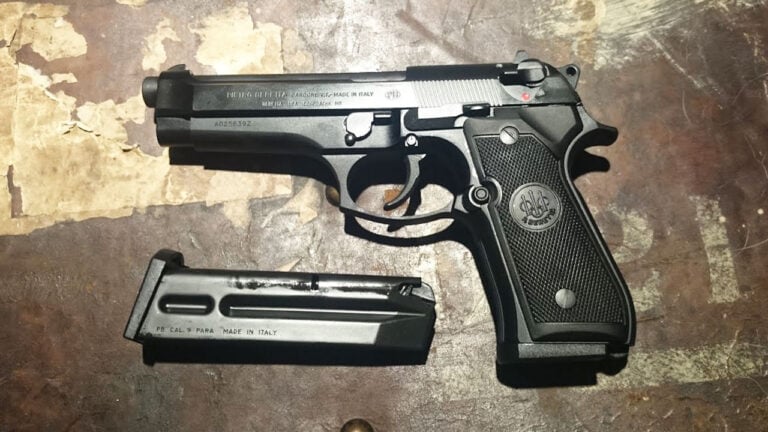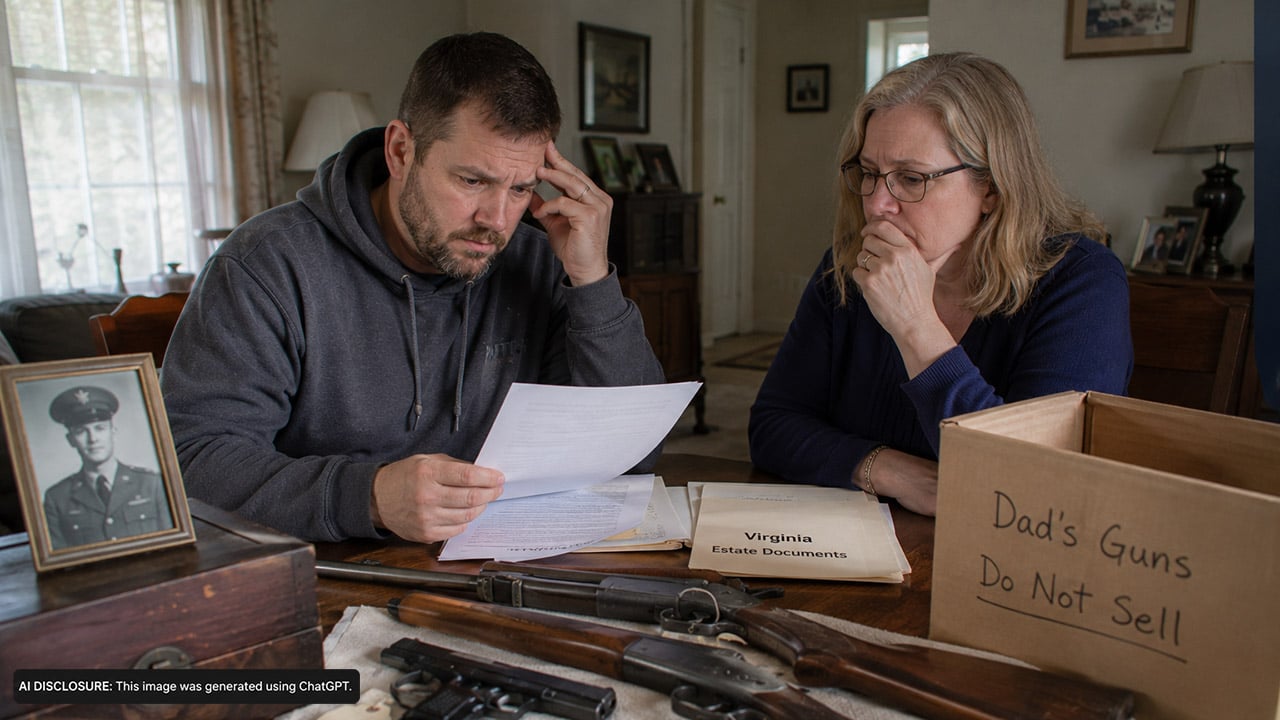
Photo credit: AI-generated image created using ChatGPT. Illustrative only
A lot of gun owners have lived some version of this: a father passes, there are a few well-kept pistols and shotguns in the safe, and everybody in the family knows who Dad “wanted” to have them. But when the paperwork doesn’t match the family understanding, things can get complicated fast—especially when two states are involved.
In the original post, an Ohio man explained that his father died a few years ago and left behind a small collection of handguns and shotguns. His father had told him he wanted him to have them, but it wasn’t spelled out in the will. That means the guns technically belong to his mother, who lives in Virginia. She doesn’t want them and intends for her son to take them—but getting them from Virginia to Ohio is where the simple family handoff turns into a legal maze.
When “Dad wanted you to have them” isn’t the same as “you legally own them”
Out in the real world, families don’t always think like lawyers. If there’s no clear instruction in a will, ownership generally follows the estate process, and in this case the son’s understanding is that the firearms ended up belonging to his mother.
That detail matters. The easiest transfers are usually the clean ones: you inherit directly under a will or by operation of state law, or you buy through the standard process. Here, the son isn’t describing a direct bequest to him. He’s describing his mom owning them and wanting to give them to him after the fact.
In other words, it looks less like “inheriting” and more like an interstate transfer from one private party to another. That’s where gun owners can accidentally step into trouble even when their intentions are solid.
The state-line problem: private transfers don’t stay “private” once you cross borders
The son already understands the usual rule of thumb: if you’re moving a firearm from one state to a resident of another state, an FFL is commonly part of the equation. Federal law is what bites here, not just a picky local rule.
He’s trying to find a practical workaround because his mother is coming to stay with him in Ohio for a few months. The plan is simple on paper: he’ll drive down to Virginia to pick her up, she’ll bring the firearms with her in his car (unloaded and locked in the trunk, etc.), and once they arrive back at his house, she’ll gift them to him.
That’s the kind of plan that feels like common sense. It’s also the kind of plan where “common sense” and “compliance” don’t always shake hands.
Transporting is one thing; transferring ownership is another
There are really two separate actions in the son’s question: the trip itself, and the change of ownership at the end. Folks mix these together all the time, but the law tends to treat them differently.
Driving firearms across state lines can be legal when they’re transported safely and in line with the rules of the states you pass through. But that doesn’t automatically make an out-of-state “gift” legal without paperwork. The trunk, the locks, the unloaded condition—those are smart safety and transport practices, but they don’t magically turn an interstate transfer into an intrastate one.
Put plainly: you can do everything right from a handling and transport standpoint and still get sideways on the transfer if the handoff violates the rules that apply to residents of different states.
Why the “gift at my house” idea feels right—and why it can still go wrong
On a back porch in farm country, this seems straightforward. Mom owns the guns. Mom is physically present in Ohio. Mom gifts the guns to her son. No shady business, no sale, no stranger, no internet deal in a parking lot.
But residency is the hang-up. The mother is still a Virginia resident in the scenario described, and the son is an Ohio resident. Even if the exchange happens under his roof in Ohio, it still looks like a transfer between residents of different states. That’s the moment that typically triggers the FFL requirement for most firearms, with a few narrow exceptions depending on the exact circumstances.
There’s also a practical concern: if anything ever gets questioned later—an insurance claim, a defensive gun use, a lost or stolen report, a probate issue—having a clean, lawful paper trail can save a family a pile of stress. The last thing you want is a hard day getting even harder because the ownership history is murky.
The most practical paths: document the inheritance side and use an FFL when needed
Gun folks hate being told “go pay a fee,” but paying a transfer fee is a lot cheaper than paying for a legal problem. In situations like this, the simplest clean route is often to treat it like what it appears to be: an interstate transfer from mom to son, handled through an FFL on the receiving end, with the right forms and the right checks for the son’s state.
Another angle is to get the estate side squared away so it’s truly an inheritance to the son rather than a gift from the mother. The post makes clear the father didn’t specifically state it in the will, and that’s exactly where families may need proper legal guidance in their state. If the firearms can be legally distributed to the son as part of the estate process (instead of “Mom owns them and gifts them”), the rules can look different.
And regardless of the route, safe storage matters during the move. Long drive, summertime heat, hotel stops, kids in and out of the vehicle—those are real-world situations where “unloaded and locked up” isn’t just legal hygiene, it’s responsible gun ownership.
The key is not trying to get clever with technicalities. If you’re asking, “Can we do this without an FFL?” it’s usually a sign you should spend 20 minutes calling a knowledgeable FFL and, if needed, an attorney who understands both the state and federal angle.
There’s a reason so many outdoorsmen preach “do it once and do it right.” When family firearms are on the line, that advice matters even more. These guns aren’t just hardware—they’re heirlooms. And heirlooms are worth transferring the right way, even if it takes a little more time and a little more paperwork.
Like The Avid Outdoorsman’s content? Subscribe to our newsletter so you never miss an article.
Here’s more from us: