Photo credit: AI-generated image created using ChatGPT. Illustrative only
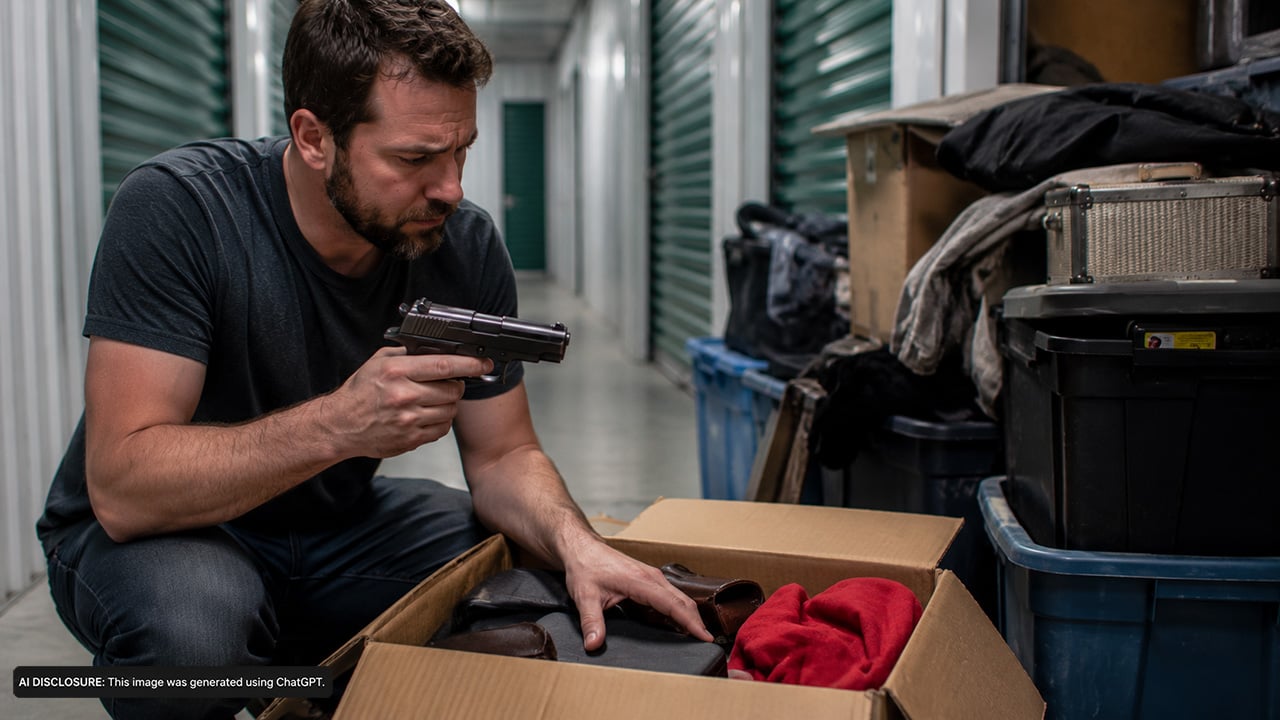
Storage auctions are a little like clearing an old fenceline on a new lease: most of what you find is junk, a few items are useful, and once in a while you uncover something that changes your whole day. That’s exactly what happened in California when a storage-unit buyer cracked open a unit and found a pistol inside—loaded.
In the original post, the person explaining the situation said their friend buys storage units and “discovered a firearm that he wants to get rid of.” The writer wanted to buy it, but a couple red flags popped up fast: whether the gun might be stolen, whether it might still be registered to someone else, and what kind of proof anyone would need to transfer it the right way in a state that doesn’t leave much room for casual gun sales.
A storage-unit “win” turned into a loaded-gun problem
If you’ve ever helped a buddy clean out a foreclosed place, you know the rule: treat every closed case like it could hold something sharp, nasty, or dangerous. Finding a handgun in a storage unit is one thing. Finding one loaded is another.
At that point it stops being a fun flip and starts being a safety and liability issue. A loaded pistol sitting in a box or wrapped in rags doesn’t care who “won” the auction. It’s still capable of hurting someone, and it’s still tied to whatever history it had before it ended up behind a roll-up door.
The first question was the one every gun owner asked themselves
The writer’s main worry was simple and smart: “let’s make sure this weapon is not reported stolen or missing.” That’s the knot in the rope. Because the second you try to do the right thing, you also worry about doing it in a way that doesn’t leave you empty-handed if law enforcement decides it needs to be seized.
That fear isn’t coming out of nowhere. A stolen gun is evidence, and evidence doesn’t stay with the person who found it. If the pistol was reported stolen two years earlier—as the headline angle suggests—then the “best case” for the storage buyer is still losing the gun after turning it in, and the “worst case” is getting dragged into questions about how it was obtained and whether it was handled correctly.
In California, “I bought the unit” doesn’t automatically mean “I can sell the gun”
The writer understood the general outline of private sales, but suspected an exception for firearms—and that’s a good instinct in California. In many states, private-party transfers are fairly straightforward. California is not most states.
The post also raised a second key point: if the firearm is registered to someone else, does the storage-unit buyer have the right to sell it? On a practical level, a gun can be both “in your possession” and “not yours to legally transfer” if it’s stolen property, if it’s tied to an owner of record, or if state rules require a specific transfer process that the seller can’t satisfy.
This is where outdoorsmen get tripped up. We’re used to bills of sale, handshake deals, and keeping paperwork in the glovebox. But for handguns in California, the state’s transfer rules and paper trail expectations are much tighter than “auction paperwork says I own the contents.”
The paperwork question: will auction documents cover “ownership” for a transfer?
The writer asked whether auction paperwork would be sufficient proof if the pistol isn’t registered, and whether a buyer or gun shop would require proof of ownership. That’s the real-world friction point. You can do everything in good faith and still get stuck at the counter because the shop doesn’t want the risk.
Most gun stores and FFLs live by a simple code: if it feels even a little sideways, they don’t touch it. A storage-auction receipt might prove the unit was purchased, but it doesn’t necessarily prove the handgun wasn’t stolen, unlawfully stored, or otherwise prohibited from being transferred. And since California requires most firearm transfers to go through an FFL, the “seller” doesn’t get to just decide the paperwork is good enough. The FFL has to be willing to run it.
That’s also why the writer was trying to thread the needle: check whether it’s stolen “without the risk of Law Enforcement seizing the firearm.” They weren’t talking about hiding anything; they were trying to avoid turning a legitimate question into an expensive headache.
Why “novelty gun” doesn’t reduce the risk
The post mentioned the gun didn’t seem like it would’ve been used in a crime, describing it as “more of a novelty firearm.” That’s a natural thought—folks picture a stolen-gun report involving a common carry pistol, not an oddball piece.
But stolen is stolen, and paperwork problems don’t care if it’s a collectible .22 or a polymer 9mm. A gun can be stolen out of a safe during a burglary, taken from a vehicle, or lost in a move. Plenty of perfectly “non-criminal” guns get reported missing every year, and they still land in a database as stolen property.
And then there’s the loaded part. Even if it’s a quirky pistol that looks like it sat untouched for years, it was still stored in a way that allowed it to be found loaded by a stranger. That alone is enough reason for most responsible gun owners to slow down and get very deliberate about what happens next.
The most practical path: make it safe, then keep the transfer squeaky clean
From an outdoorsman’s standpoint, there are two lanes here: safety first, and legal transfer second. The immediate priority is to treat the firearm as loaded until it’s confirmed otherwise, keep it pointed in a safe direction, keep fingers off the trigger, and store it securely so nobody else handles it casually while the owner figures out the next move.
After that, the goal is to avoid any “backyard solutions” that create bigger problems—passing it around, trading it, or trying to sidestep the rules because the story is inconvenient. The writer even joked about the old “boating accident” line, but also made it clear they weren’t trying to “screw himself or myself over.” That’s the right mindset.
If a person truly wants to sell or buy that pistol in California, the clean way generally involves going through the required legal process with an FFL and being prepared for the possibility that the gun may flag as stolen or otherwise problematic. That may mean the gun goes back to its rightful owner, and the storage buyer learns an expensive lesson about what “unit contents” can include.
Storage units can hold camping gear, old rifles in cases, or grandpa’s tackle box. They can also hold problems. When a loaded handgun is part of the haul, it’s time to stop thinking like a bargain hunter and start thinking like a responsible gun owner who wants to stay on the right side of both safety and the law.
Like The Avid Outdoorsman’s content? Subscribe to our newsletter so you never miss an article.
Here’s more from us: