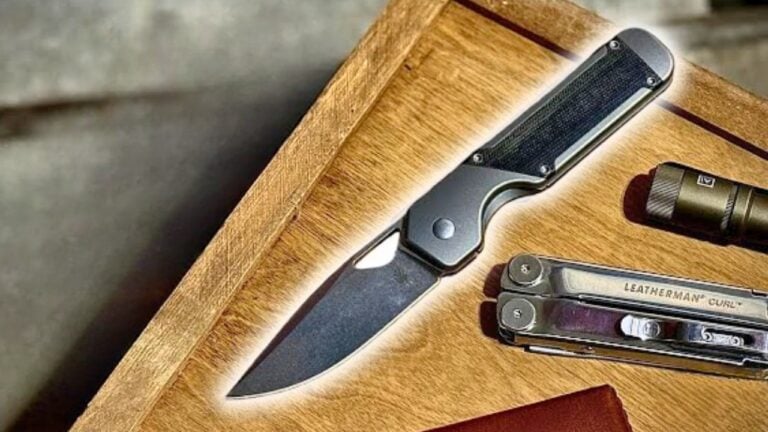
Photo credit: Knife Life EDC/YouTube
There’s something satisfying about a folding knife that opens like it’s been worn in by a decade of use—except it’s brand new and not bank-breaking. You don’t have to spend three hundred bucks to get a blade that flicks open with glassy precision. Plenty of workhorse folders out there open smoother than knives twice their price, without sacrificing reliability or control.
Some of these use bearings, some use washers, and some are tuned so well they put “premium” brands to shame. They don’t rely on hype or exotic materials. They rely on good fit, tight tolerances, and real-world feedback from folks who use their knives every day. Whether you carry a knife to break down boxes, skin small game, or open feed sacks, you know the feeling when a folder opens right—and you notice when it doesn’t.
Civivi Elementum Button Lock
The original Elementum was smooth, but the button lock version kicks it up a notch. It’s got a fidget factor that rivals knives three times the price. The detent is dialed in so well that whether you’re pushing the button and wrist-flicking it or giving it a thumb-stud assist, it flies open every time.
Civivi went with caged ceramic bearings on this one, and it shows. There’s no grit, no hesitation, and no need to adjust anything out of the box. The button lock itself doesn’t rattle or feel mushy either, which is something a lot of budget knives get wrong. If you want a knife that flips smoother than knives in the $200 range but costs around $75, this one keeps earning its spot in the pocket.
Kizer Drop Bear
Kizer’s clutch lock system is basically their take on an axis lock, and it works smoother than most. The Drop Bear opens and closes so fluidly it feels like it’s floating on air. The springs aren’t too stiff, the action isn’t sticky, and there’s no bounce when you open or close it.
This one runs on nested ball bearings, and the tolerances are tight enough that you don’t get side play or that sloppy feel some budget folders have. Kizer doesn’t overdo the blade tension either, so you’re not fighting to flick it open. Whether you use the thumb stud or just pull back the lock bar and let it swing, it’ll move smoother than a lot of high-end knives you’ve probably handled.
CJRB Pyrite
The CJRB Pyrite took the budget world by storm for a reason. That button lock action is tuned so well it makes you double-check the price tag. It uses ceramic ball bearings and a drop-point blade that swings out with barely any effort. There’s no grit, no drag, and it closes just as effortlessly.
You’ll find yourself fidgeting with this one without even thinking about it. And unlike some other button lock knives in this price range, there’s no lock stick or button rattle. CJRB dialed in the detent and tolerances so it opens the same way every time. If you didn’t know better, you’d think it came out of a boutique shop instead of a budget line.
Ontario RAT II D2
The RAT II has been around a while, but the D2 version with upgraded steel keeps up with anything twice the price. It doesn’t ride on bearings, but that doesn’t stop it from opening smoother than some ball-bearing folders. The phosphor bronze washers are broken in straight from the factory, giving you a consistent, fluid opening.
This knife doesn’t try to be flashy. It doesn’t need to. The thumb stud is positioned perfectly, and the blade glides out without hesitation. For a work knife, it’s hard to beat. The action feels broken in the second you unbox it, and it keeps getting better with use. If you’re looking for no-fuss smoothness, this one’s a sleeper.
QSP Penguin
The Penguin might not look fancy, but the action punches way above its price. It rides on copper washers that are polished enough to feel like bearings. There’s a deliberate smoothness to it—not fast and snappy, but controlled and glassy.
Once you get the flick of the thumb stud down, it opens reliably every time with zero grit. What really makes the Penguin stand out is how consistent it feels. There’s no change in resistance, no play, no bounce—it moves like it was tuned by hand. And at under fifty bucks, it leaves a lot of “higher-end” folders looking sloppy.
Vosteed Raccoon
The Raccoon is one of those knives you almost don’t want to admit is as smooth as it is. The button lock is crisp, the bearings are quiet, and the whole thing moves like it’s riding on oiled rails. It’s the kind of action you usually associate with knives north of $200.
Vosteed didn’t try to reinvent anything—they just made sure every piece fits right. You won’t feel any lock stick, and you won’t need to play with the pivot tension. Whether you’re flicking it with your thumb or disengaging the button and letting gravity do the work, it opens and closes like it was tuned by a pro.
SOG Terminus XR LTE
SOG’s XR lock can be hit or miss depending on the model, but the Terminus XR LTE nails it. The action is snappy and consistent, and it rides on ball bearings that are tuned for real-world use, not flashy opening tricks. It’s not too fast or loose—it’s precise.
This is one of those folders that rewards you for using it. The more you carry it, the more you appreciate how the lock bar slides, how the blade pops out with a flick, and how nothing ever feels sticky or misaligned. For a featherweight knife with carbon fiber scales, the action is surprisingly solid.
Kershaw Iridium
The Iridium surprised a lot of folks when it dropped. That DuraLock mechanism is smoother than expected, and the ball bearing pivot system gives it the kind of action that feels like it belongs in a higher price tier. It opens with authority and closes like it’s on rails.
Kershaw really got the pivot tension right on this one. There’s no blade play, no bounce, and the thumb studs are well-placed. It’s a pleasure to use one-handed, and you’ll notice how quiet and clean the action feels compared to a lot of folders in the same range. For a knife in the $60 to $70 range, it holds its own against much more expensive options.
Ruike P801
The Ruike P801 has long been one of the best budget folders, and part of that is how smooth it opens. The stainless steel handles give it a little weight, which helps the blade fly out with minimal effort. It runs on bearings that feel like they were broken in before shipping.
You won’t find any crunchiness here. The flipper tab is shaped just right, and the detent is tuned to launch the blade consistently. It’s not flashy or fidget-focused, but it’s smooth in a way that feels reliable. For under $50, it’s one of the best opening actions you’ll find.
Bestech Lizard
The Lizard doesn’t get as much attention as some other folders, but it’s got an action that’ll catch you off guard. It uses caged ball bearings, a strong detent, and a perfectly placed flipper tab to give you a smooth, snappy deployment every time.
What makes it stand out is how clean and confident the action feels. There’s no slop, no overtravel, and the blade locks up tight. Whether you’re flipping it open fast or easing it closed with two hands, it’s smooth through the whole arc. It feels like something twice the price.
Artisan Cutlery Arion
The Arion is a titanium frame lock that still manages to sneak in at a price that feels too low for how it performs. It’s got a thumb hole deployment that glides thanks to ceramic bearings and excellent machining. It’s not flashy or gimmicky—it’s smooth and intentional.
You can slow roll it open or flick it with your thumb, and it’ll respond with the same smooth glide either way. The lockbar pressure is balanced, so you don’t feel resistance or grinding when closing it. For those who like minimal designs with top-tier action, this one feels premium without the price tag.
Like The Avid Outdoorsman’s content? Subscribe to our newsletter so you never miss an article.
Here’s more from us: