
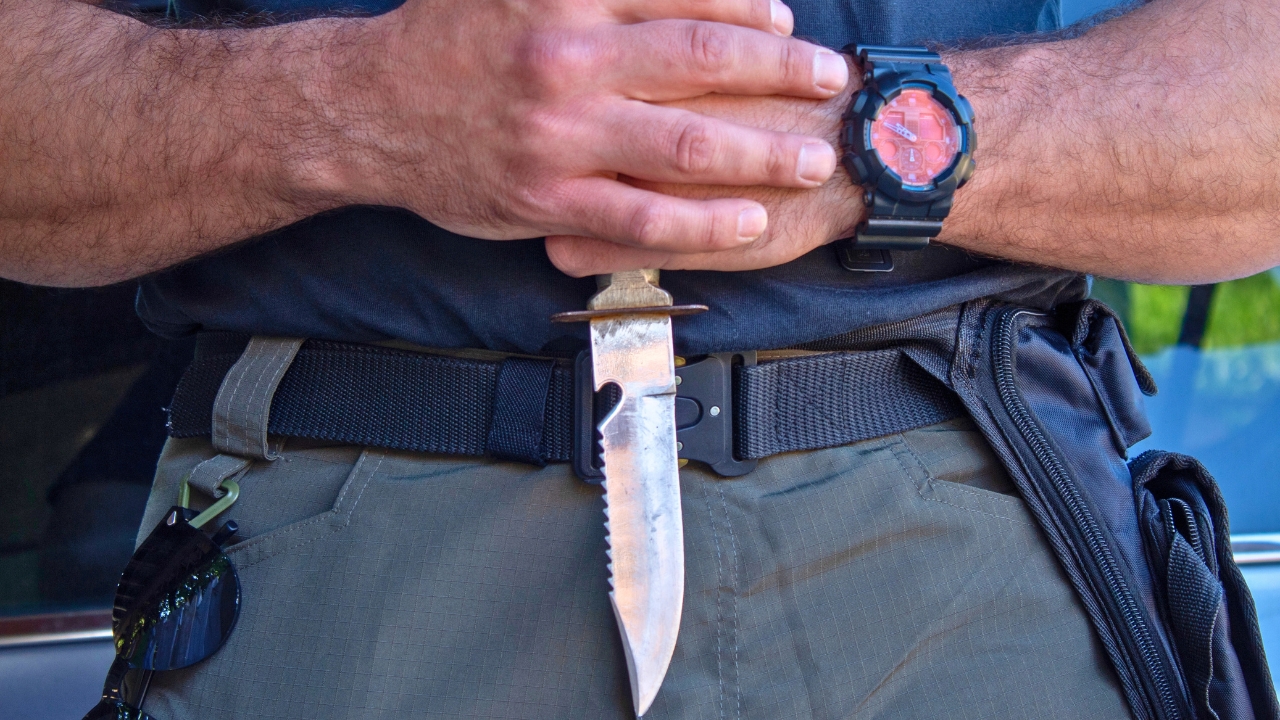
Photo credit: Danre/Shutterstock.com
Knife preemption laws are quietly redrawing the map of who governs everyday life in your city. As state legislatures expand their reach, local officials are finding that even something as basic as deciding where you can carry a pocketknife is slipping out of their hands. The result is a growing clash between statewide uniformity and local control, with knife policy becoming a sharp edge of a much broader power struggle.
The new face of preemption politics
If you want to understand why knife rules are being pulled away from city halls, you have to start with the broader wave of state preemption. In many states, legislators are using their authority to override local decisions on everything from labor standards to public health, often targeting large, politically liberal cities. Analysts have noted that present-day pre-emption trends are mostly driven by red states limiting liberal municipalities, with state leaders prioritizing partisan alignment over loyalty to their largest cities.
You see the same pattern in fights over diversity, equity and inclusion, where statewide bills explicitly block local governments from adopting DEI policies. One Florida report describes proposals whose core purpose is to prohibit local governments from enacting DEI-related policies, ordinances or resolutions, a template that mirrors the logic behind knife preemption. In each case, the state is not just setting a floor for rights or safety, it is setting a ceiling, telling cities that they may not go further even if local voters demand it.
How knife preemption works in practice
Knife preemption laws are designed to erase the patchwork of city and county rules that used to govern what you could carry in your pocket, truck or toolbox. Under these statutes, state law becomes the only law that matters on knives, and any local ordinance that is stricter is either repealed or rendered unenforceable. Advocates describe how knife law preemption repeals and prevents local ordinances that are more restrictive than state law, arguing that those local rules only serve to confuse or entrap law-abiding residents and visitors.
Supporters frame this as a consumer protection and civil liberties issue, insisting that you should not need a lawyer to drive from one county to the next with a folding knife in your glove box. They argue that a single statewide standard is easier for you to follow and for law enforcement to apply, and that it reduces the risk of selective enforcement in neighborhoods that already face heavy policing. Critics counter that this uniformity comes at the cost of local problem solving, but under preemption, city councils are barred from tailoring knife rules to dense downtowns, transit systems or nightlife districts even when residents ask for tighter controls.
The advocacy machine behind the bills
Knife preemption did not spread on its own, it has been pushed by a tight network of advocacy groups that specialize in rewriting state law. One of the most active players is Knife Rights, which has built a track record of legislative wins and court fights across the country. Its own list of legislative and litigation accomplishments highlights how, in 2024, Idaho Knife Law Preemption Signed repealed dozens of local knife restrictions and blocked any future local rules, a model the group is now promoting elsewhere.
Another key player is The American Knife & Tool Institute, which openly states that The American Knife, Tool Institute Supports Knife Preemption Laws to Protect Law, Abiding Citizens. In its policy materials, the group explains that some cities, municipalities and local jurisdictions have adopted knife ordinances that go far beyond state law, and that it backs preemption as a way to shield ordinary users from those local experiments. Together, these organizations draft model bills, testify in hearings and mobilize collectors, manufacturers and outdoor enthusiasts to press lawmakers for statewide control.
Idaho, Arkansas and Ohio as case studies
Idaho offers a clear example of how this playbook works from bill introduction to final passage. Earlier in 2024, legislators advanced a proposal that would prohibit cities and counties from regulating knives at all, shifting every decision to the state level. During that debate, lobbyist Todd Rathner, representing Knife Rights, appeared before lawmakers to argue that local rules were unworkable, with coverage noting that Todd Rathner, representing Knife Rights, helped move the bill toward the Senate.
Arkansas shows what happens after preemption is in place. Advocates there describe the state as a friendly jurisdiction for knife owners, with no statewide prohibitions and only a handful of local rules that are now being swept away. A recent review of legislative wins notes that Arkansas has always been a good state from the perspective of knife owners, and that new preemption measures are marketed as victories for enthusiasts and lovers of freedom. In Ohio, the same advocacy network persuaded lawmakers to amend a firearms bill so that, as one summary puts it, In Ohio, a bill that originally focused on enhancing firearms preemption was amended to include knives, folding blade policy into a broader fight over weapons regulation.
Model language and the legal scaffolding
Behind those statehouse victories sits a set of template statutes that can be dropped into almost any bill file. Advocacy groups have circulated detailed Model Legislation that spells out how preemption should work, from definitions to enforcement. One widely used template explains that knife preemption will render null and void any local ordinances that are not repealed, and even includes a full Model Legislation Title and enacting clause so lawmakers can simply paste the language into their own code.
These templates are not just about knives, they are part of a broader strategy to centralize authority in state capitols. Legal scholars have documented how, in public health, legislatures have adopted sophisticated tactics to pass, enhance and even obscure preemption, sometimes burying key provisions deep inside unrelated bills. One analysis notes that, although the federal government can and has preempted state and local control over public health issues, state legislatures are increasingly using similar tools, concentrating power in their statehouses and limiting what local officials can do even in emergencies. Knife preemption fits neatly into that architecture, giving state lawmakers the final word on a specific category of weapons.
Why cities say they are being sidelined
From a city’s perspective, knife preemption is one more example of what local leaders describe as interference from above. Municipal officials argue that they are closest to the ground, dealing with the day-to-day realities of crowded transit systems, nightlife corridors and school zones where a blade can quickly escalate a confrontation. A national report on preemption warns that the abuse of state power is a growing problem not only because of the number of new laws, but also because of the rights they strip away, describing this trend as interference with city rights that undermines local democracy.
City attorneys also point out that preemption can freeze outdated standards in place, preventing them from responding to new technologies or crime patterns. If a downtown business district wants to restrict large fixed blades in bars after a series of incidents, a statewide preemption statute can make that impossible, even if local police and business owners agree on the need. For mayors and council members, the message is clear: when it comes to knives, you are increasingly governed by decisions made in the statehouse, not in the city hall you vote for.
The Second Amendment and the courtroom front
As knife preemption spreads, litigation is reshaping the legal backdrop, especially around the Second Amendment. Advocates have seized on the Supreme Court’s Bruen decision, which held that the Second Amendment conveys an individual right to carry a weapon outside the home and that modern regulations must be consistent with historical traditions. In one high-profile case, challengers to a city ordinance argued that, under Bruen and the Supreme Court’s Second Amendment test, knife bans must show some historical antecedent, a standard that makes sweeping local restrictions harder to defend.
Knife Rights has also taken the fight to federal court over specific federal statutes, not just local rules. Its legal team has filed an Appeal Brief Filed in Knife Rights’ Federal Switchblade Act Suit, challenging long-standing national limits on certain blades. Legislative updates from the group describe how, in Dec, an Appeal Brief Filed in Knife Rights’ Federal Switchblade Act Suit became a key step in testing whether modern knife laws can survive under the new constitutional framework. For cities, that means their room to regulate is being squeezed from both directions: by state preemption statutes on one side and by expanding Second Amendment interpretations on the other.
Industry pressure and the “roadblocks” narrative
Knife manufacturers and retailers have their own reasons to favor preemption, and they have not been shy about saying so. Companies that sell to hunters, tradespeople and collectors argue that a maze of local rules makes it harder to design, market and distribute products nationwide. Industry voices describe how, after years of strict regulations, some softening has been experienced, particularly due to the efforts of groups like Knife Rights and the Am, with one trade analysis noting that Knife Rights and the Am have helped remove roadblocks at the federal or state level.
For you as a consumer, that industry push can translate into a wider array of knives on store shelves and fewer surprises when you cross a city line with a work knife in your truck. But it also means that local concerns about youth violence, nightlife safety or transit security are often filtered through the lens of manufacturing and retail priorities. When statewide preemption is justified as an economic development tool, city leaders who want tighter rules in specific neighborhoods find themselves arguing not just with legislators, but with a supply chain that sees local regulation as a threat to its bottom line.
Where cities still try to draw the line
Despite the spread of preemption, some local officials and lawmakers are still looking for ways to carve out limited zones of control. In a number of states, debates have focused on “location-restricted” categories, where certain knives are barred only in sensitive places such as schools, courthouses or amusement parks. One advocacy alert describes a bill, HB 2239, that would create an exception for two commonly visited places where Location, Restricted Knives (defined as knives over 5 1/2 inches) are currently banned, while noting that other states like Utah, West Virginia and Wisconsin have already loosened similar rules.
Older debates show how long cities have been wrestling with these questions. In Vermont, talking points prepared for lawmakers emphasized that, over the years, many local governments have enacted laws banning the possession, carry, use and manufacture of certain types of knives, and that these overlapping rules created confusion. The document, titled Over the years many local governments have enacted laws, was used to argue for statewide preemption, but it also underscores how local officials once saw knife ordinances as a basic tool of urban governance. Today, as more states adopt blanket preemption, those local levers are disappearing, leaving cities to rely on broader disorderly conduct or weapons statutes instead of tailored knife rules.
What this power shift means for you
For residents, the spread of knife preemption is not an abstract constitutional debate, it is a change in who answers when you demand action or accountability. If you are worried about knife-related incidents on your bus line or in your neighborhood park, your city council may no longer have the authority to respond with a targeted ordinance, even if every member agrees with you. A national analysis of preemption warns that this pattern is part of a larger trend of what it does: these bills prohibit local governments from acting on issues that used to be squarely within their remit, shifting the conversation to distant state capitols where urban concerns can be outvoted.
At the same time, if you are a hunter, contractor or collector who travels across county lines, you may welcome the predictability that statewide knife rules provide. Groups like Knife Rights argue that preemption protects you from accidental violations and selective enforcement, and that their legislative and litigation campaigns are rolling back what they see as overreach. Their own year-end summaries celebrate how, in Dec, new preemption language in Ohio expanded where knives can be carried in many public places, and they are already looking to replicate that success elsewhere. Whether you see that as a win for freedom or a loss of local control depends on which level of government you trust more, and how close you want the people writing your knife laws to be to the streets where you live.
Like The Avid Outdoorsman’s content? Be sure to follow us.
Here’s more from us:


