Photo credit: The Avid Outdoorsman
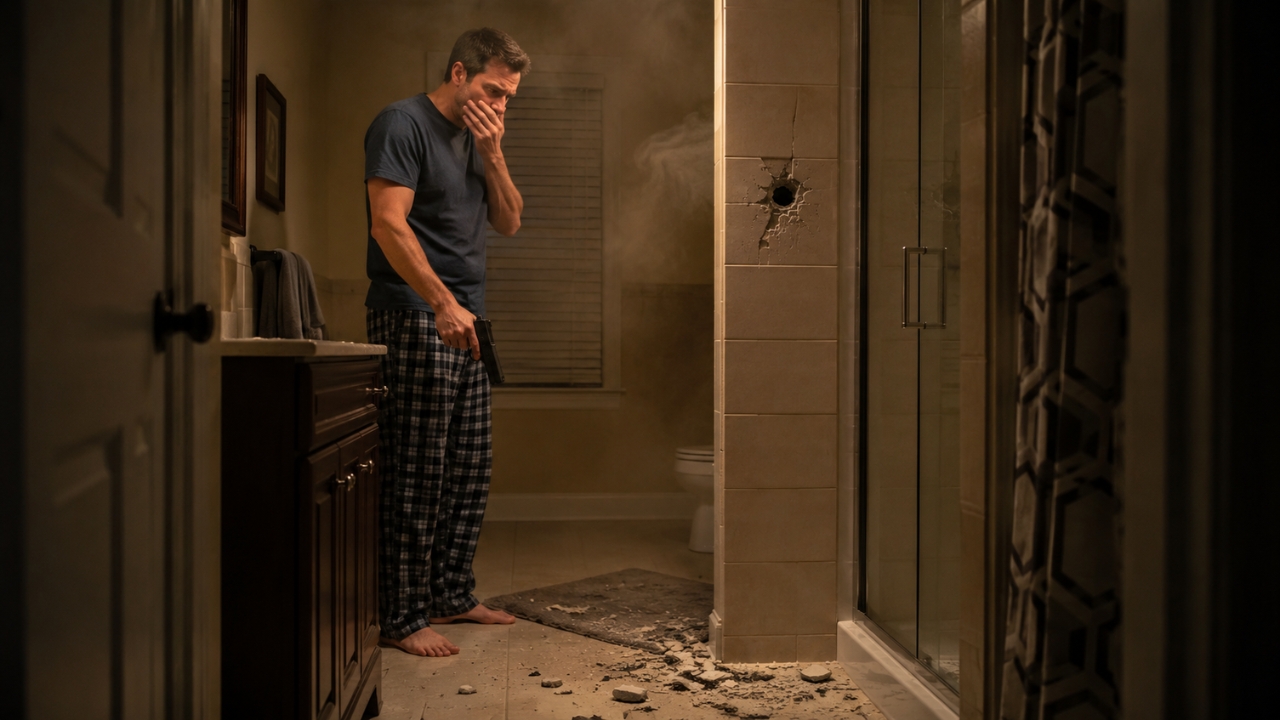
A gun owner in Reddit’s r/Firearms shared the kind of mistake that sounds impossible right up until the second it happens in your own house. In his post, he said he was handling his handgun late at night and doing what he thought was a quick check before putting it away. Instead, the gun fired, sending a round through the shower wall and into the bathroom. He posted the story himself, admitted it was a negligent discharge, and described the aftermath in a way that made it clear he was still sitting with the shock of how fast a normal moment had gone bad. The original Reddit thread is here: https://www.reddit.com/r/Firearms/comments/18fzv0p/had_a_negligent_discharge_feel_like_an_idiot/.
He did not write like somebody trying to dance around what happened. He wrote that he felt like an idiot. That tone matters, because it shaped everything that followed. He was not coming in hot with excuses about the gun malfunctioning or some outside force causing the shot. He was describing one of the oldest and ugliest patterns in firearms handling: a person convinced he is just doing one last routine thing, one last check, one last manipulation, and then realizing too late that the gun in his hand was not in the condition he thought it was.
The damage inside the bathroom drove that point home. According to his post, the shot went through the shower wall, and he later ended up pulling fragments out of the bathroom floor. That detail gives the whole story a much harder edge than the usual vague “put one into the wall” confession. It means the round did not just make noise and embarrassment. It moved through the room violently enough to leave behind physical evidence in multiple places. Once you picture someone bent over afterward, picking fragments out of the floor and tracing where the bullet went, the whole thing stops feeling like one stupid pop and starts feeling like a much longer few minutes of disbelief, cleanup, and mental replay.
From the way he described it, the real damage was not only the bathroom. It was the instant collapse of confidence that comes after a negligent discharge. A lot of gun owners build their self-image around being the careful one, the disciplined one, the person who knows better than to let routine handling turn sloppy. That is part of why these stories read so raw when people tell them honestly. He was not only dealing with drywall, tile, or flooring. He was dealing with the fact that the mistake came out of a moment he likely would have described as normal right up until the shot broke.
That is also what makes the setup feel familiar in a bad way. Home gun handling is where a lot of people get lazy. There is no range officer. No timer. No class instructor. No crowd watching. It is just the house, the room, the safe, the sink, the mirror, the bed, the bathroom, the soft confidence of a routine you think you have done enough times to trust. That kind of setting can make people less sharp than they realize. The gun starts feeling like part of the furniture instead of the one object in the room that can punish a small lapse immediately.
The bathroom itself is a strange but telling setting. It is a place where people often go to unload pockets, change clothes, take gear off, and break down the day. That is exactly what makes it dangerous for casual gun handling. A person is distracted, transitioning, maybe tired, maybe thinking about the next thing instead of the gun in his hand. Once a “quick check” enters the picture, especially late at night, the chance of mentally filling in the wrong assumption gets a lot higher. If the gun was loaded when the shooter thought it was not, then the entire event likely came down to one of the oldest failures there is: believing the check had already happened well enough and acting on that belief instead of verifying again.
In the comments, people reacted the way gun forums usually do when someone posts a negligent discharge and owns it without hedging. Some were hard on him. Others were more constructive. A lot of the serious replies focused on process. They talked about having a dedicated unloading routine, a dedicated safe direction, and a hard rule against mixing administrative handling with casual mental drift. More than one person emphasized that if the gun is coming out for any reason at home, the person handling it needs to be fully locked in or not handling it at all. That kind of advice comes up over and over in these threads because everybody reading it knows the same ugly truth: a negligent discharge usually is not the result of one bizarre mystery. It is a chain of ordinary shortcuts that finally catches up with somebody.
Other commenters got into the physical side of it. People talked about where they point a gun when unloading or function-checking at home, what they use as a safer backstop, and how little trust they put in ordinary interior walls. That part of the conversation always carries a different kind of weight after a story like this, because nobody has to imagine anymore. The poster had already shown what a single round could do in a bathroom. Once fragments are being picked out of the floor, the debate about “safe enough” directions inside a house gets a lot more concrete.
There was also the usual mix of anger and relief that comes with these posts. Relief that nobody was hit. Anger that the shot happened at all. A few people likely saw themselves in it more than they wanted to admit, because the phrase “quick check” is exactly the kind of thing experienced gun owners say right before they do something that does not deserve to be treated as quick. It is supposed to sound small, harmless, routine. In stories like this, that phrase almost becomes the warning sign.
The outcome, at least from the way the post was framed, was that the shooter was left with a damaged bathroom, fragments in the floor, and the kind of humiliation that comes from knowing the whole mess started with a moment he probably would have described as under control. He did not present some dramatic medical emergency or legal nightmare. The punishment here was simpler and, in some ways, harsher: he had to stand there in his own house looking at the path of the bullet and knowing every bit of it belonged to one lapse in judgment.
That kind of aftermath has a different feel than the range or workplace stories. At home, once the noise is over, there is no crowd to absorb it. No manager. No instructor. No stranger at the next lane. Just the shooter and the room he changed with one shot. That seems to be what hangs over the post most strongly. The bathroom was still there. The fragments were still there. And the person who fired the round had to live with the fact that the damage came out of a moment that probably felt completely ordinary until the instant it was not.