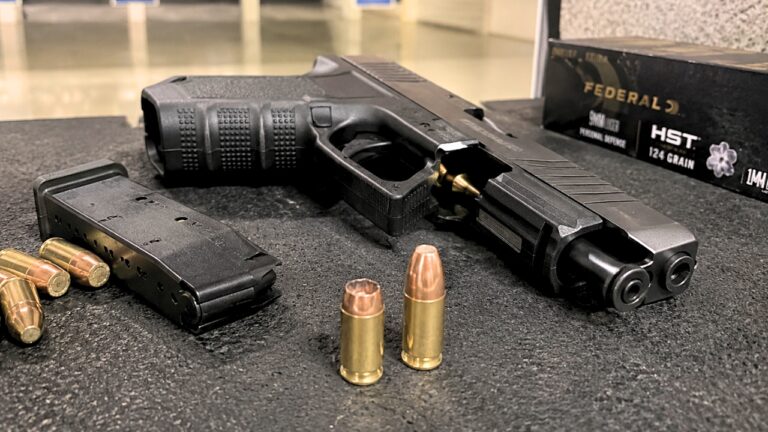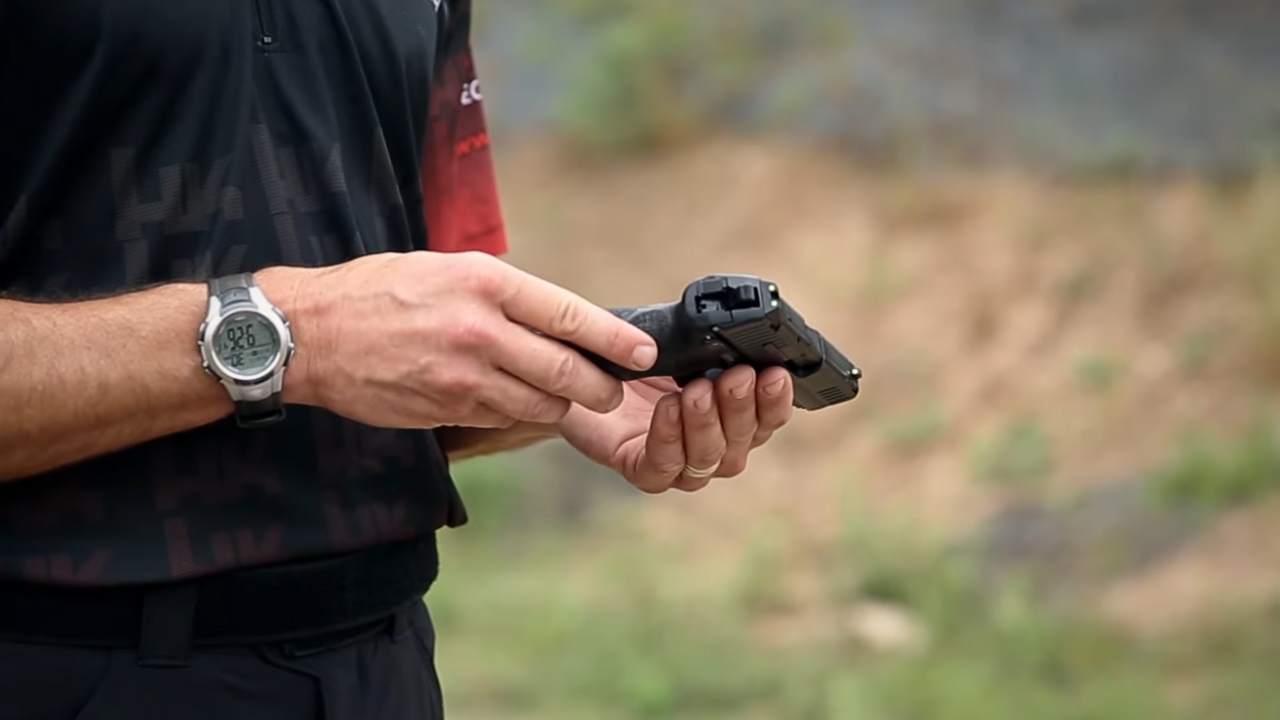
Photo credit: Heckler & Koch/Youtube
The gun owner trusted his HK P30 for a reason.
It had earned it.
He said the pistol had gone through several thousand rounds without a single malfunction. Not just one clean range trip. Not just a few boxes of easy ammo. Thousands of rounds. It had eaten 90-grain frangible rounds, 115-grain aluminum and steel-cased ammo, and premium 124- and 147-grain nickel-plated hollow points without giving him trouble.
That is the kind of reliability that makes a person stop worrying.
Then he changed his carry ammo.
In a Reddit post, the gun owner said he switched from Critical Duty to Speer Gold Dot in his P30. Gold Dot is not some no-name ammo someone found loose in a range bag. It is a well-known defensive load with a strong reputation, which is exactly why the failure bothered him.
He shot a box of 50.
The gun had two malfunctions.
One was a failure to feed. The other was a stovepipe. And they happened with two different magazines, which made the problem feel less like one bad mag and more like that particular ammunition simply did not get along with that particular pistol.
That is the part a lot of people do not want to hear.
A good gun can dislike good ammo.
That does not mean the pistol is junk. It does not mean the ammo is trash. It means reliability is not a brand slogan. It is something that happens, or does not happen, in your specific gun, with your specific magazines, using the exact rounds you plan to carry.
For this guy, the P30 had already proven itself with all kinds of ammunition. That probably made the Gold Dot test feel almost like a formality. Load the box, shoot it, confirm it runs, and move on. Instead, two stoppages showed up in the same 50-round test.
That is enough to kill confidence fast.
A failure to feed in a defensive gun is bad for obvious reasons. The round does not chamber. The gun stops. Now the shooter has to clear it under pressure, assuming he even has time. A stovepipe is not much better. The spent casing fails to eject cleanly and gets caught in the slide, leaving the pistol out of action until it is cleared.
At the range, those are irritating.
In a defensive moment, they can be catastrophic.
That is why his post was framed as a reminder, not a complaint. He was not saying nobody should ever buy Speer Gold Dot. He was saying you need to test your carry ammo before you trust it. Even reputable rounds can get hung up in the wrong firearm.
That is the lesson that matters.
A lot of people buy defensive ammo, load it, and never shoot enough of it to know if the gun likes it. It is understandable. Defensive ammo is expensive, and running hundreds of rounds of premium hollow points can feel painful when range ammo is much cheaper. But the cost of not testing it can be much worse.
A gun that runs cheap ball ammo all day can still choke on a hollow point with a different bullet profile, overall length, recoil impulse, or case coating. Some guns are picky about feed ramps. Some magazines present rounds at a slightly different angle. Some loads run hotter or softer. Some pistols cycle one hollow point beautifully and stumble on another that looks almost identical in the box.
You do not know until you shoot it.
That is what this range trip proved. The P30 had a great track record, but the Gold Dots broke the streak. The gun owner did not have to guess in a real emergency. He learned it on paper, under range conditions, where the only thing wounded was his confidence in that ammo-gun pairing.
That is exactly where you want to learn it.
The smart move after a test like that is not to panic. It is to isolate the problem. Try another box from a different lot if you want. Try the same ammo in a different gun. Try different defensive loads in the P30. Clean and lube the pistol. Check the magazines. Pay attention to whether the failures repeat. If they do, stop carrying that combination.
A defensive setup has to be boring.
The gun should load, fire, extract, eject, and feed again without demanding special treatment. The shooter should not be carrying a load while quietly hoping the next round does not hang up. Once that little doubt gets planted, it is hard to ignore.
For this gun owner, the P30 stayed trustworthy. The Gold Dots in that P30 did not.
And that distinction is the whole point. A reliable carry setup is not just a reliable gun. It is the gun, the magazines, the ammo, and the shooter all working together. If one piece does not cooperate, the whole system is weaker than it looks.
He spent money on a box of defensive ammo and found a problem.
That is annoying.
It is also exactly why the test was worth doing.
Commenters mostly agreed with the poster’s main point: test the ammo you actually plan to carry.
Several people shared examples of guns that were picky with certain loads. One commenter said he had a race gun that was tuned so tightly it only ran with its special handloads and one kind of factory ammo. Another said he had a P226 that hated half the ammo he tried. Those stories backed up the idea that reputation does not guarantee compatibility.
Some commenters were surprised because they had run Gold Dots through their own P30 variants without problems. That became part of the larger point. The same ammo can run fine in one person’s pistol and fail in another. Your gun is the one that has to prove it.
A few people debated how much defensive ammo should be tested. One commenter said to run 500 rounds of your carry ammo, while another pointed out how expensive that would be. That cost is real, but the thread still landed on the same practical advice: shoot enough of your carry load to know whether your gun handles it.
The strongest takeaway was simple. Do not assume a premium defensive round works because the box has a respected name on it. Put it through your actual carry gun before betting your life on it.