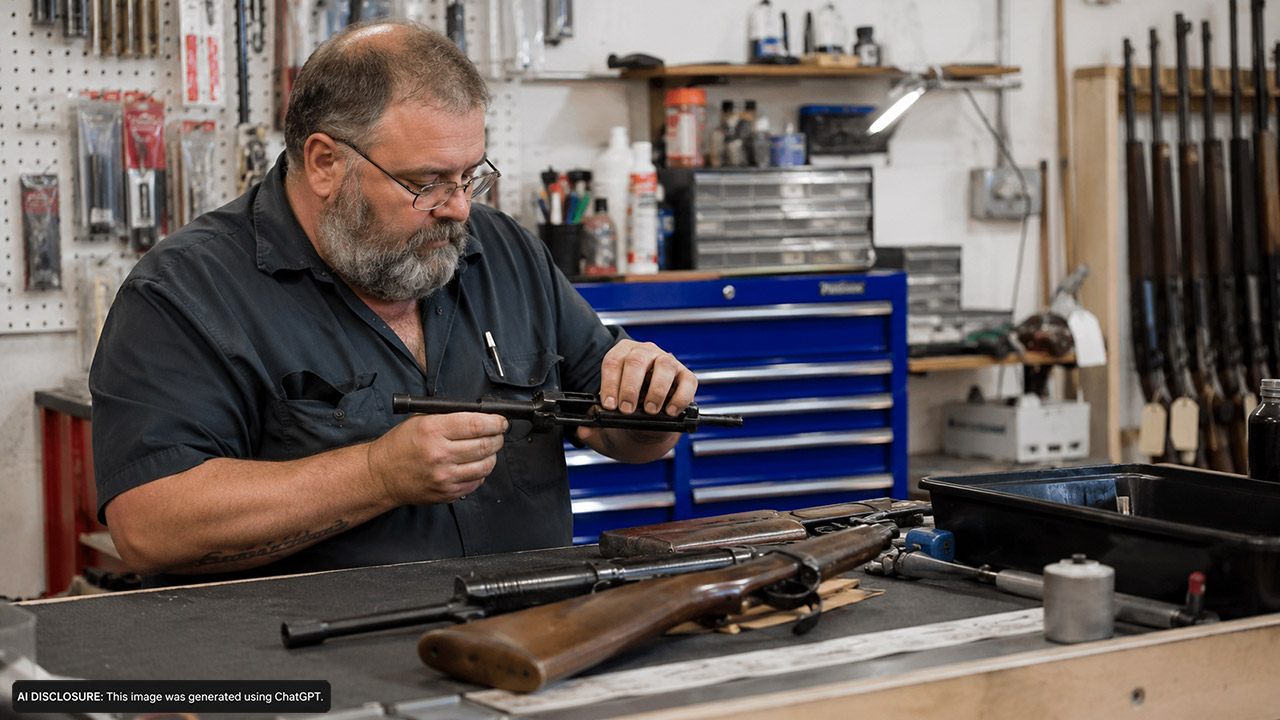
Photo credit: AI-generated image created using ChatGPT. Illustrative only
There are plenty of reasons a gun ends up sitting at a gunsmith’s shop longer than you’d like. Parts backorders. Life happens. A job that turns into a bigger headache once the rifle is on the bench. But when the work never gets done and the firearm still doesn’t come home, that’s when it stops being an inconvenience and starts feeling like a real problem.
That’s the situation one gun owner laid out in the original post, saying a onetime friend—who also does gunsmithing—has had his AK for over a year and hasn’t performed any of the agreed-upon services.
A year is a long time for an “agreed-upon” job to go nowhere
In the post, the owner said his AK and “associated parts” have been in the gunsmith’s possession for more than a year with none of the planned work completed. That’s not a normal “busy shop” delay. Even reputable shops that are stacked up will typically communicate where you are in line, what’s waiting on parts, and what the new timeline looks like.
What makes this one sting is the relationship angle. The owner described the gunsmith as a “once friend,” which hints at the kind of slow-motion breakdown many outdoorsmen have seen before: favors turn into expectations, expectations turn into frustration, and pretty soon it’s hard to tell whether you’re dealing with bad business or a soured personal deal.
A late-night holiday meetup turned into a standoff
The owner said he saw the gunsmith on Labor Day and asked to go to the shop and retrieve the AK and parts. The gunsmith refused, pointing to the timing—8 p.m. on a holiday—while both had been out drinking.
From a pure safety standpoint, refusing to open a shop and start handing over firearms late at night while alcohol is in the mix isn’t the worst call. Even if everyone’s calm, it’s just not the time to be moving guns around, sorting parts, and making decisions.
But the owner wasn’t asking for a new timeline for the repair. He was trying to get his property back. That’s where this goes from “I get it, not tonight” to “then when?” fast.
The gunsmith promised delivery in two weeks—again pushing the can down the road
Instead of setting a firm appointment during business hours, the gunsmith told the owner he would bring the firearm and parts to him in two weeks. The owner also noted they live in different states, which takes away the simplest solution—just drive over, show up at the counter, and pick it up like any other customer.
Distance changes everything. When you can’t “pop over,” you’re stuck negotiating by phone and text, and the other person controls the pace. Two more weeks can sound reasonable in a calm moment, but when you’ve already been waiting a year with no progress, it feels like another delay that buys the shop time and leaves you with nothing but promises.
And for most gun owners, there’s a hard line: nobody wants a firearm they own floating in limbo, especially if they don’t trust the person holding it anymore.
The owner threatened an ATF theft report and asked whether local police should come first
The owner said he told the gunsmith that if the firearm wasn’t returned within two weeks, he would call the ATF and report it stolen. He then asked a practical question: is going straight to the ATF the right move, or should he start with local law enforcement?
He also worried he’d get “guff” because he’s out of state and the situation could be treated like an interstate issue. That’s a real concern in the sense that jurisdiction and paperwork can slow everything down. A firearm owner wants a clean, documented path that doesn’t get bounced from one desk to another while the gun stays out of reach.
He added that he’s familiar with the local police process for reporting a stolen firearm, but had never reported one stolen to the ATF and didn’t know what that process looks like.
Why this kind of dispute matters to everyday gun owners
Most of us don’t think about “chain of custody” in day-to-day life, but the minute a firearm is in someone else’s hands for an extended period—especially across state lines—you’re dealing with more than an awkward business disagreement.
There are the obvious concerns: Is the gun stored securely? Does the shop have insurance? Is it logged properly if the gunsmith is operating as an FFL? If something happens—burglary, fire, a sloppy employee—how quickly would you even learn about it?
Then there’s the personal side. A lot of hunters and shooters lean on informal networks: a buddy who can thread a barrel, a guy who can press a sight, a friend-of-a-friend who “does AK work.” Sometimes that’s great. Sometimes it’s how you end up waiting a year with no work done and no clear path to getting your rifle back.
One of the simplest lessons here is boring but important: treat even “friend” work like business. Written estimates. Clear scope. A timeline. And a clear agreement about what happens if either side wants to terminate the job and retrieve the firearm and parts.
The practical path forward is documentation and calm pressure—not late-night confrontation
The owner’s frustration is easy to understand, but the holiday-night context also shows why it’s best to keep these situations out of bars, parties, and emotional conversations. When firearms are involved, you want to be the calm, organized adult in the room every single time.
Even without getting into legal weeds, there are a few common-sense steps that tend to help no matter what state you’re in: keep records of what you dropped off (serial number, photos, parts list), save messages where the gunsmith acknowledges possession, and communicate in writing with a clear request to return the firearm and parts by a specific date.
If it does escalate to law enforcement, that documentation is what keeps it simple. You’re not trying to win an argument. You’re trying to show, clearly and calmly, that you own the firearm, you entrusted it for agreed work, the work wasn’t performed, and it hasn’t been returned.
And if alcohol is involved in any meetup, the right move is to walk away and schedule a business-hours handoff. The goal is getting the rifle back safely, not “winning” a conversation in the moment.
At the end of the day, a gunsmith holding onto a customer’s firearm for a year with no completed work isn’t just bad service—it puts the owner in a spot where he has to start thinking about theft reports, interstate headaches, and how to get his property back without making a bigger mess. The cleanest outcomes usually come from doing the unglamorous stuff: written communication, firm deadlines, and handling the handoff like adults in the daylight.
Like The Avid Outdoorsman’s content? Subscribe to our newsletter so you never miss an article.
Here’s more from us: