Photo credit: GUN QUALITY ENFORCEMENT/YouTube
Every military has passed on rifles and carbines that could have changed the way troops fought. Some were ahead of their time, offering better handling, more reliable operation, or layouts that worked naturally in close quarters. Others simply didn’t fit into the logistics pipeline, even though they performed well in trials or limited field use. When you look back at the carbines that almost made it—or easily should have—you see real opportunities to equip troops with tools that handled modern combat better than the rifles issued at the time.
You’ve probably run a few of these yourself and wondered why they never got the nod. In many cases, the guns already had the accuracy, durability, and controllability needed for hard use. They weren’t perfect, but they were closer to the ideal fighting carbine than what wound up in service. History moved in a different direction, leaving these rifles to collect what-ifs instead of contracts.
Colt 605 Carbine

The Colt 605 was one of the earliest attempts to make the M16 more manageable for close-range work without redesigning the entire system. It used a shortened 15-inch barrel paired with a rifle-length gas system, which gave it better balance and a handier profile compared to the original full-length rifle. In the jungle environments of the Vietnam era, that shorter configuration would have offered troops a noticeable advantage.
Its main drawback was reliability with the long gas system on a shortened tube, but those issues were solvable with later tuning methods. When you shoulder a 605, the balance immediately feels improved, and the rifle transitions quicker through tight cover. Had development continued instead of shifting to other models, the 605 could have become a capable service carbine during a time when soldiers needed exactly that.
Colt 607 Carbine

The Colt 607 was one of the first collapsible-stock AR carbines, created long before compact rifles became mainstream. Its sliding stock and short 10-inch barrel made it easier to maneuver in vehicles, dense brush, or tight structures. Units that tested it quickly noticed how much more controllable it was in confined environments compared to the standard M16.
The short barrel created a loud, high-pressure muzzle signature and some reliability challenges, which held it back. But its basic layout was ahead of its era, offering troops the kind of mobility that later carbines eventually delivered. With the gas system refinements that became common decades later, the 607 could have filled a real role for airborne units, special operations, and vehicle crews. Instead, it remained a stepping-stone to the carbines that finally entered service.
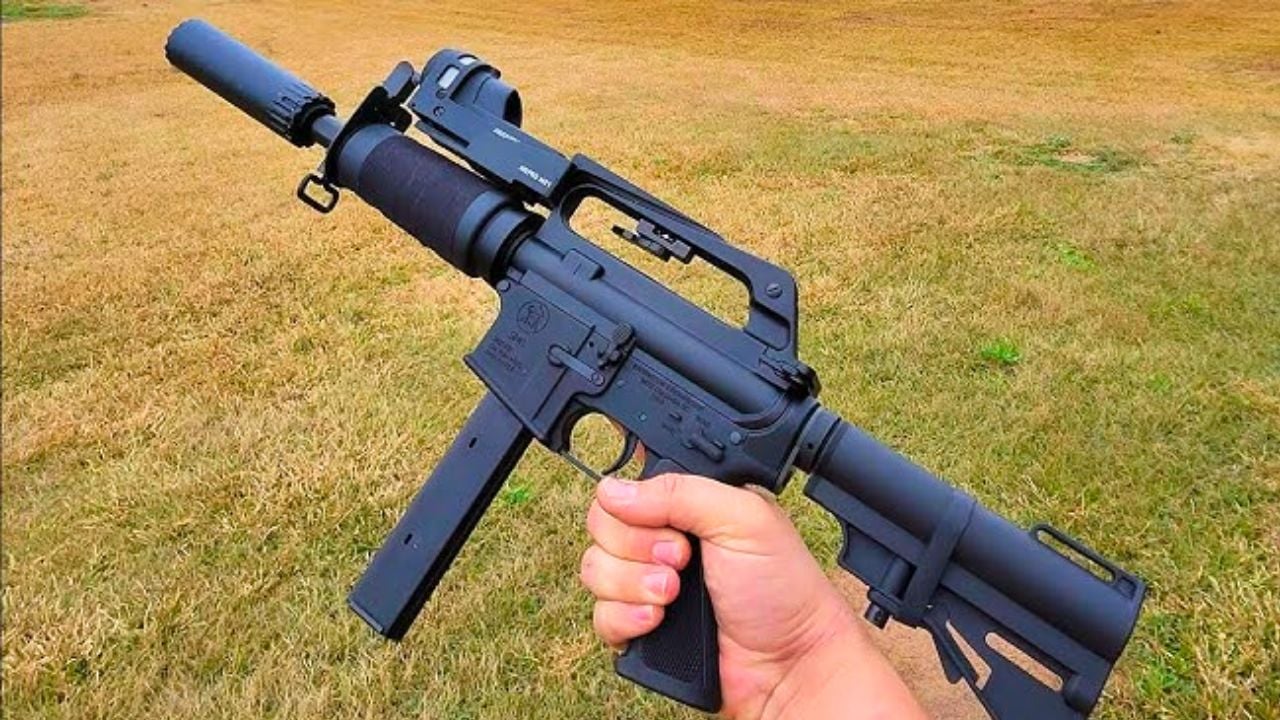
Colt Model 633 “DOE Carbine”

The Colt 633, closely associated with the Department of Energy, stands out as one of the smoothest-shooting 9mm AR-pattern carbines ever made. Its hydraulic buffer kept the action under control, reducing felt recoil and keeping the gun on target during rapid fire. That made it far easier to manage than many submachine guns used at the time.
The familiar AR controls shortened the training curve, and its accuracy at close range made it effective for protective roles. In tight spaces or interior work, the 633 provided a controllable and dependable option with real benefits over older pistol-caliber platforms. The military never explored it seriously because pistol-caliber carbines weren’t a procurement priority, but for certain security and convoy roles, it could have served well.
Steyr AUG A1

The Steyr AUG A1 delivered full-length rifle performance in a compact bullpup package, long before the U.S. military was willing to consider unconventional layouts. Its modular design, durable construction, and quick-change barrel system gave it a level of flexibility unmatched in its era. Soldiers in other countries praised its handling in tight urban settings and its natural balance.
In U.S. trials, the AUG showed strong accuracy and reliability, but adopting it would have meant abandoning established training, magazines, and support systems. That logistical resistance overshadowed its performance. When you handle an AUG today, you immediately feel how well it moves through barriers and vehicles. It could have provided troops with a capable, compact service rifle decades before shorter ARs became refined.
HK53

The HK53 shrank the HK33 into a compact, hard-running carbine that handled almost like an MP5 while delivering rifle-caliber capability. Its roller-delayed action gave it predictable recoil and strong reliability, even when pushed through heavy firing schedules. Units that tested it appreciated how controllable it was for such a short 5.56 system.
Its compact size made it ideal for vehicle operations, boarding actions, or environments where a full-length rifle slowed troops down. The rifle never saw broad adoption because it required a different manual of arms than the AR platform. Still, it delivered accurate fire, excellent durability, and a fast, natural feel. With wider support and updated accessories, the HK53 could have been a highly effective service carbine.
HK G36C

The G36C offered a lightweight polymer-framed design that resisted corrosion and handled rough environments well. Its piston system kept the gun running clean during high-volume shooting, and its extremely compact layout worked well for troops who needed fast transitions in close quarters. Early models earned praise for their handling and reliability.
The U.S. examined the platform briefly, but switching to a new weapon system wasn’t feasible with the AR platform already established. When you pick up a G36C, the immediate impression is speed—it points quickly and stays manageable even when you push it hard. For vehicle crews, reconnaissance teams, or units working tight terrain, it would have made sense. Logistics kept it out of consideration, not performance.
SIG SG 551

The SIG SG 551 is widely regarded as one of the finest 5.56 fighting rifles ever made. Its long-stroke piston system, exceptional machining, and smooth recoil characteristics made it a favorite among units that tested it. The rifle handled adverse conditions well and delivered consistent accuracy across long sessions.
Its folding stock and balanced design allowed easy carry in mountains, vehicles, and airborne operations. The only real obstacle to adoption was the dominance of the AR platform in U.S. logistics. When you shoot a 551, it becomes clear it could have served effectively. It runs clean, cycles smoothly, and maintains accuracy even after extended firing. It was easily capable enough for military service.
FN FNC

The FN FNC brought tough construction, dependable piston operation, and good accuracy to a package that blended AR ergonomics with AK-like durability. Several NATO forces used it for decades, and it impressed in sand, mud, and rain. It offered a stable shooting experience, a folding stock, and consistent reliability under rough handling.
The U.S. never considered it seriously because of its timing—it appeared when the M16 platform was already well entrenched. But in many ways, the FNC could have filled the role of a transitional fighting rifle until modern carbines matured. It stayed manageable during extended firing and continued working when conditions turned harsh.
FN SCAR-L

The SCAR-L delivered a refined piston-driven system, steady recoil, and excellent ergonomics. It offered real advantages during high-volume shooting, and its adjustable gas system made it work well in both suppressed and unsuppressed setups. The folding stock and modular construction gave it flexibility across multiple roles.
Special operations units used it effectively, but the broader military stayed with the AR platform to avoid complicating logistics. For troops working in varying terrain or units that needed a reliable suppressor host, the SCAR-L would have been a strong option. Its smooth cycling and dependable accuracy make it obvious why some still believe it should have been adopted on a larger scale.
Robinson Armament XCR-L

The XCR-L offered caliber interchangeability, a long-stroke piston system, and a rugged, side-charging layout that worked well during hard use. Its quick-change barrel setup allowed units to adapt the rifle without major armorer support. For special operations and units needing flexible platforms, the design made practical sense.
Shooters appreciated its reliability and its ability to manage heat during extended firing. The folding stock and overall balance made it comfortable in fast-moving roles. Despite these strengths, the rifle never gained traction because it stood outside the well-established AR ecosystem. With a broader support system behind it, the XCR-L could have filled several military roles effectively.
Colt SCW (Sub-Compact Weapon)

The Colt SCW was built for tight spaces, especially for vehicle crews or air crews needing a compact rifle with AR controls. Its unique folding stock made it more portable than most AR carbines of its era, and its short barrel kept it maneuverable in cramped conditions. Testing showed it handled fast transitions well and offered more firepower than submachine guns.
Despite its strengths, it never moved beyond limited programs. The SCW could have provided a lightweight, capable solution for units needing instant access to a compact fighting rifle. It stayed controllable, pointed quickly, and maintained the familiarity of standard AR controls.
HK416 (early stages)

The HK416 eventually became well known, but early in its development it competed directly with carbines the military already had in huge numbers. Even in those early days, the 416 offered cleaner operation, better durability under heavy firing, and steady accuracy when pushed hard. Elite units recognized those benefits quickly.
If adopted earlier, the 416 would have improved reliability during long engagements and reduced fouling issues that plagued older carbines. Its piston system kept temperatures manageable, and the rifle handled rough conditions well. It took years for its advantages to be fully acknowledged across major programs, but its early performance showed real potential.
LWRC M6A2

The LWRC M6A2 brought a refined short-stroke piston design to the AR layout, giving it strong reliability and consistent operation during long sessions. It stayed clean internally and handled heat better than traditional direct-impingement carbines. Units that tested it noted its controllability and smooth feel under recoil.
Its rail options, folding sights, and balanced profile made it solid across close- to mid-range roles. Even with those strengths, the military stuck with established carbines because switching platforms introduced logistical challenges. The M6A2 demonstrated how dependable a piston-based AR could be during demanding use.
Barrett REC7

The Barrett REC7 offered a strong, piston-driven system built from the ground up to survive hard environments. Its durability in sand, dust, and extended firing schedules made it a practical option for units needing dependable performance in rough terrain. Shooters testing it liked how stable it felt during rapid strings.
The rifle maintained accuracy under heavy use and kept internal parts cleaner than standard carbines. The military looked at piston variants, but large-scale adoption never materialized. The REC7 had the durability and control needed for demanding missions, and in many settings, it would have served effectively as a frontline fighting carbine.
Like The Avid Outdoorsman’s content? Be sure to follow us.
Here’s more from us:
The worst deer rifles money can buy
Sidearms That Belong in the Safe — Not Your Belt
*This article was developed with AI-powered tools and has been carefully reviewed by our editors.