Photo credit: Tomasz Wozniak/Shutterstock.com
If you ask ten people “what’s the world’s largest gun,” you’ll get twelve answers, and most of the arguing comes down to one thing: people are using different definitions. Some mean the largest gun that actually fired in combat, some mean largest by bore diameter, and some mean the largest surviving cannon sitting in a tourist spot. So I’m going to lay it out the way a normal reader can follow it: the biggest gun most people mean is the German 80cm railway gun built by Krupp, and then I’ll cover the bigger-bore “guns” that beat it on caliber but didn’t do the same job or didn’t see action.
What counts as “largest” depends on what you’re measuring
“Largest” can mean weight, length, caliber, shell weight, or practical impact. By overall size and mass, the WWII railway supergun is hard to beat because it was a moving siege weapon the size of a building, built for a specific mission, and it did fire for real. By bore diameter, the winners often aren’t “guns” in the way people imagine; they’re mortars or bombards that were more like fortress weapons and test rigs. Even Guinness World Records separates record categories like “largest mortar,” because a mortar is a different type of artillery than a long-barreled gun. Once you accept that the word “gun” gets used loosely, the topic gets way less annoying and a lot more interesting.
The one most people mean: the 80cm railway gun “Schwerer Gustav”
If you mean the biggest “gun” in the popular sense, you’re almost always talking about the German 80cm railway gun often called Schwerer Gustav (and its sister gun Dora). This thing was built to crush hardened fortifications like the Maginot Line, and the size numbers are wild even on a spec sheet: about 1,350 tonnes, around 47 meters long, and an 800 mm bore. Sources commonly cite it as capable of firing shells measured in tons, and in typical descriptions you’ll see the big headline details repeated because they’re the whole story: it was huge, it was heavy, and it took major resources just to move, assemble, protect, and fire it.
“Largest” also has a practical side, and this gun was brutally impractical
The reason the railway gun is famous isn’t only the caliber; it’s the logistics. It needed massive crews and support to lay rail, prepare firing positions, and defend it, which meant it was never going to be a flexible battlefield tool. It was siege artillery in the purest sense, and even references that focus on its capabilities still highlight that it required large numbers of personnel and significant setup time. It could fire slowly—on the order of one round every 30–45 minutes in some summaries—and it was so obvious from the air that it demanded serious protection. That’s the part people skip when they say “largest gun,” but it’s the most important lesson: the bigger the weapon gets, the more it starts acting like a construction project, not a combat system.
Where it actually got used: the Siege of Sevastopol
The clearest “it really happened” chapter for the railway gun is its use during the siege of Sevastopol in 1942. Accounts vary on the exact round count depending on what’s being measured, but it’s widely reported that it fired dozens of rounds there, and one commonly repeated figure is 48 shells fired during that operation. Even if you ignore the internet hype and focus on the plain facts, it still reads like a case study in extreme engineering: an 80cm gun firing gigantic shells at fortified positions, with the whole effort designed around cracking defenses that were difficult to reach by other means. The problem is that this is also the era when air power and more flexible artillery systems were proving they could do similar jobs without tying up that kind of manpower and rail infrastructure.
The bigger-bore “world’s largest gun” that didn’t see combat: Little David
If we switch the definition to largest caliber among famous modern-era artillery pieces, the conversation often points to “Little David,” an American 36-inch (914 mm) heavy mortar built during WWII. This one matters because it’s larger in bore diameter than the 80cm railway gun, and it’s backed by solid record-style sources: Guinness World Records notes that the largest mortars ever constructed include Mallet’s Mortar and Little David, each at 91.4 cm (36 in), and that neither was used in action. Little David’s own technical summaries describe it as testing-only, with a limited range compared to the German railway gun, and it never reached combat deployment before the war ended.
The old-school giant that wins on caliber and tourism: the Tsar Cannon
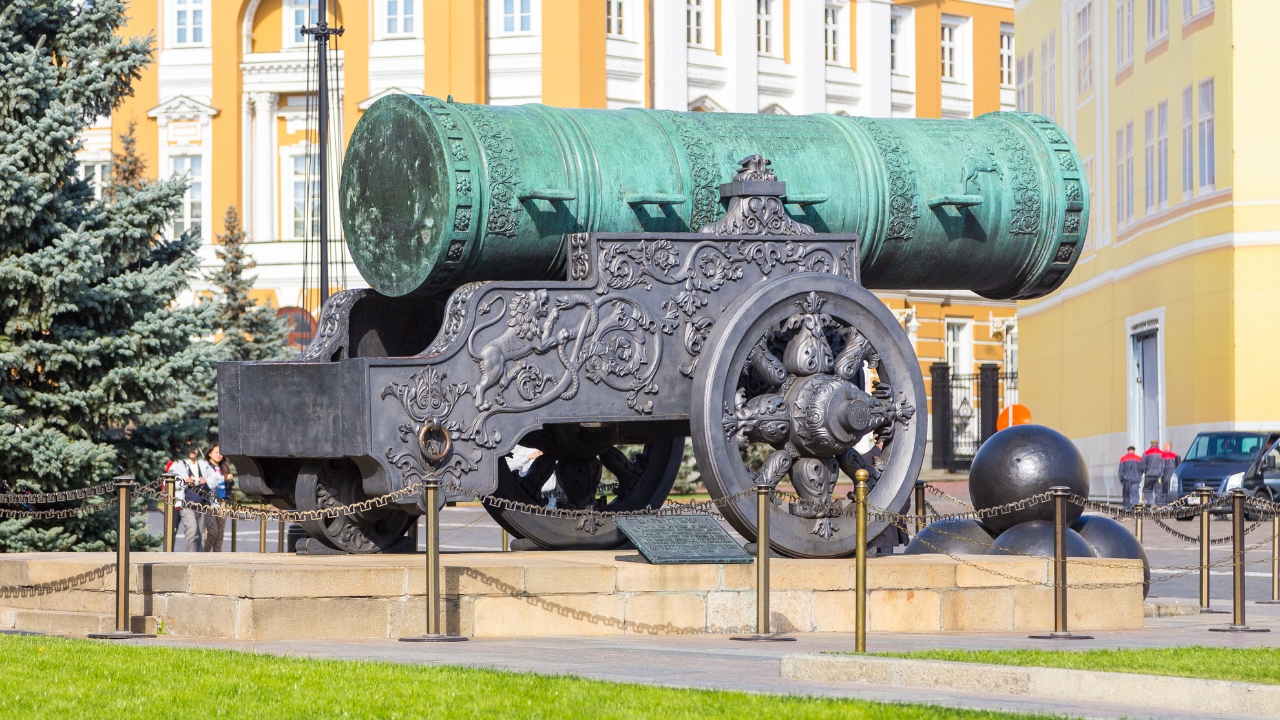
Now, if someone wants to be a smartass at the dinner table and say “Actually, the biggest cannon is…,” they’ll usually bring up the Tsar Cannon at the Moscow Kremlin. It’s commonly listed at a 890 mm caliber and is often described as the largest bombard by caliber, plus it’s one of the most famous surviving giant cannons on display. The important nuance is that it’s not “largest” in the same way as the WWII superguns; it’s a massive historic piece designed for a different era and purpose, and the way it’s presented today is as much cultural artifact as weapon. If your goal is “largest bore cannon you can stand next to,” it’s a strong contender in the public imagination, and that’s why it keeps showing up in these debates.
What the “largest gun” story really tells you about modern warfare
When you line these monsters up by category—railway supergun, test mortar, historic bombard—the pattern is consistent: once weapons get truly enormous, they stop solving everyday problems and start solving extremely narrow ones. The WWII railway gun was built to smash fortifications, but it was slow, obvious, and resource-hungry, which is why it’s remembered as a spectacle more than a war-winner. The largest mortars by caliber didn’t see action because the tradeoffs weren’t worth it. And the Tsar Cannon lives on as a symbol because by the time you can cast and move something that huge, you’re also learning that size alone doesn’t guarantee usefulness. “Largest” makes a great headline, but in real-world terms it usually translates to, “Impressive, expensive, and hard to justify when more flexible options exist.”
Like The Avid Outdoorsman’s content? Subscribe to our newsletter so you never miss an article.
Here’s more from us: