Photo credit: Lubos Chlubny/Shutterstock.com
Handguns are a last-resort defensive tool in black bear country, but history and incident reports show that certain calibers have worked when used correctly. “Worked” does not mean instant stops or cinematic outcomes. It means the bullet penetrated deeply enough to disrupt the central nervous system or break critical skeletal structure, giving the shooter a chance to survive. The difference between calibers that can work and those that usually fail comes down to penetration, bullet construction, recoil control, and realistic deployment at close range under stress.
10mm Auto
The 10mm Auto has become one of the most commonly carried calibers for black bear defense because it offers a rare combination of penetration, capacity, and controllability. With heavy hard-cast loads in the 200–220 grain range, the 10mm can produce deep, straight-line penetration capable of breaking shoulder bone and reaching vital structures. Unlike heavy revolver calibers, it allows faster follow-up shots and higher magazine capacity, which matters when a bear is closing distance quickly. The tradeoff is that not all pistols cycle reliably with heavy loads, and shooters must confirm function in their specific handgun. When paired with a reliable platform and proper ammunition, the 10mm has a growing real-world track record among hikers, guides, and backcountry workers.
.357 Magnum
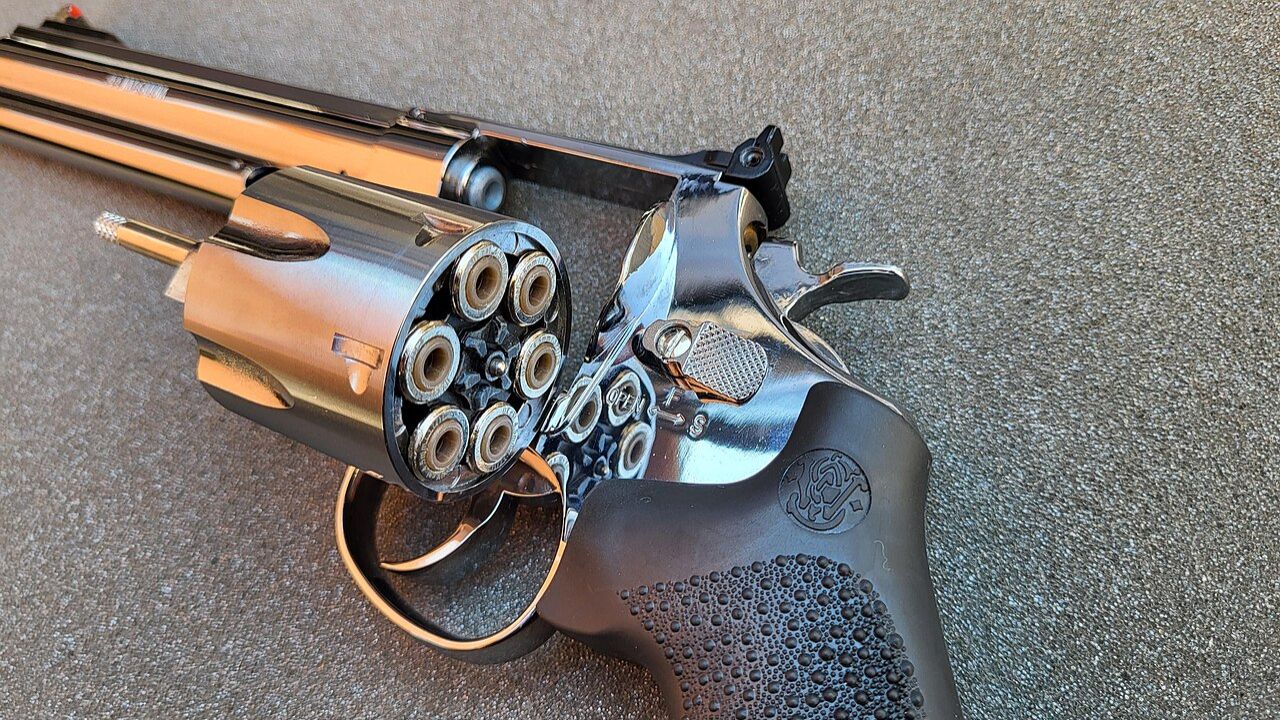
The .357 Magnum remains one of the lowest-powered handgun calibers that has still proven capable against black bears when loaded correctly. Heavy-for-caliber bullets, typically 180 grains in hard-cast or solid form, are essential because lighter defensive hollow points often lack sufficient penetration. The .357’s advantage is shootability; many shooters can control it better than larger magnums, allowing faster, more accurate shot placement. Its limitation is margin for error. Shot placement matters more with the .357 than with larger calibers, and penetration becomes questionable if bullet selection is wrong or angles are unfavorable. In practiced hands, however, the .357 Magnum has documented success and remains a realistic option for shooters who cannot manage heavier recoil.
.41 Magnum
Often overlooked, the .41 Magnum sits in a practical middle ground between the .357 and .44 Magnum. It pushes heavier bullets with greater sectional density than the .357 while generating less recoil than full-power .44 Magnum loads. With hard-cast bullets in the 210–250 grain range, the .41 Magnum delivers excellent penetration and bone-breaking capability while remaining controllable for experienced shooters. Its downside is availability; ammunition choices are more limited, and practice ammo can be harder to find. For those who shoot it well, the .41 Magnum offers a strong balance of penetration and shootability that makes it particularly well-suited to black bear defense.
.44 Magnum
The .44 Magnum is one of the most established handgun calibers for bear defense, with decades of documented field use. When loaded with heavy hard-cast bullets, typically 240–300 grains, it offers deep penetration capable of breaking major skeletal structures and reaching the central nervous system from poor angles. Its primary limitation is recoil. Full-power .44 Magnum loads can be difficult to control, especially for shooters who do not train regularly. Slow follow-up shots and flinching can negate the cartridge’s power advantage. For shooters who can manage it effectively, the .44 Magnum provides substantial penetration and remains a proven defensive option against black bears.
.45 Colt (heavy modern loads)
Standard-pressure .45 Colt is not suitable for bear defense, but modern heavy loads designed for strong revolvers are a different category entirely. When loaded with hard-cast bullets in the 255–325 grain range at higher velocities, the .45 Colt can deliver penetration comparable to the .44 Magnum with a different recoil impulse that some shooters find more manageable. These loads must only be used in firearms rated for them, as they exceed traditional .45 Colt pressures. The advantage of the cartridge is heavy bullet mass and straight-line penetration. The risk is misuse in weaker firearms or assuming all .45 Colt ammunition performs the same. Used correctly, it is a legitimate bear-defense caliber.
.454 Casull
The .454 Casull represents a significant step up in power and penetration, capable of driving very heavy bullets at high velocities. With hard-cast loads, it offers extreme penetration and the ability to break large bones even on poor-angle shots. That power comes at a cost. Recoil is severe, muzzle blast is intense, and follow-up shots are slow for most shooters. The .454 Casull is best suited for experienced revolver shooters who train regularly and can maintain control under stress. In exchange, it provides one of the highest penetration margins available in a handgun, making it effective when shots must punch through heavy structure.
.480 Ruger
The .480 Ruger trades velocity for bullet mass, pushing very heavy bullets at moderate speeds. This results in deep penetration with less violent recoil than ultra-high-pressure magnum cartridges. With hard-cast bullets often exceeding 325 grains, the .480 Ruger is well-suited for breaking bone and driving straight through dense tissue. Its recoil is still substantial, but many shooters find it more controllable than the .454 Casull. Ammunition availability and firearm options are limited, making it a niche choice, but in capable hands it offers excellent penetration and reliability for black bear defense.
Like The Avid Outdoorsman’s content? Subscribe to our newsletter so you never miss an article.
Here’s more from us: