Photo credit: AI-generated image created using ChatGPT. Illustrative only
If you’ve ever had a rifle or pistol tied up in an evidence locker after a defensive shooting, a theft case, or even a simple mistake, you know the deal: that gun isn’t just “a gun” anymore. It’s a piece of a court case, and the chain of custody matters as much as the serial number.
That’s why this Indiana story caught my attention. A firearm trace request tied to an upcoming criminal trial reportedly led investigators to a Taurus G3 that wasn’t sitting in an evidence room at all—it was sitting at a pawn shop. From there, the case took a hard turn, with New Chicago Police Chief Earl Mayo charged after investigators alleged he sold the evidence gun and then tried to get it bought back, as detailed in the original post.
The trace request that kicked the door open
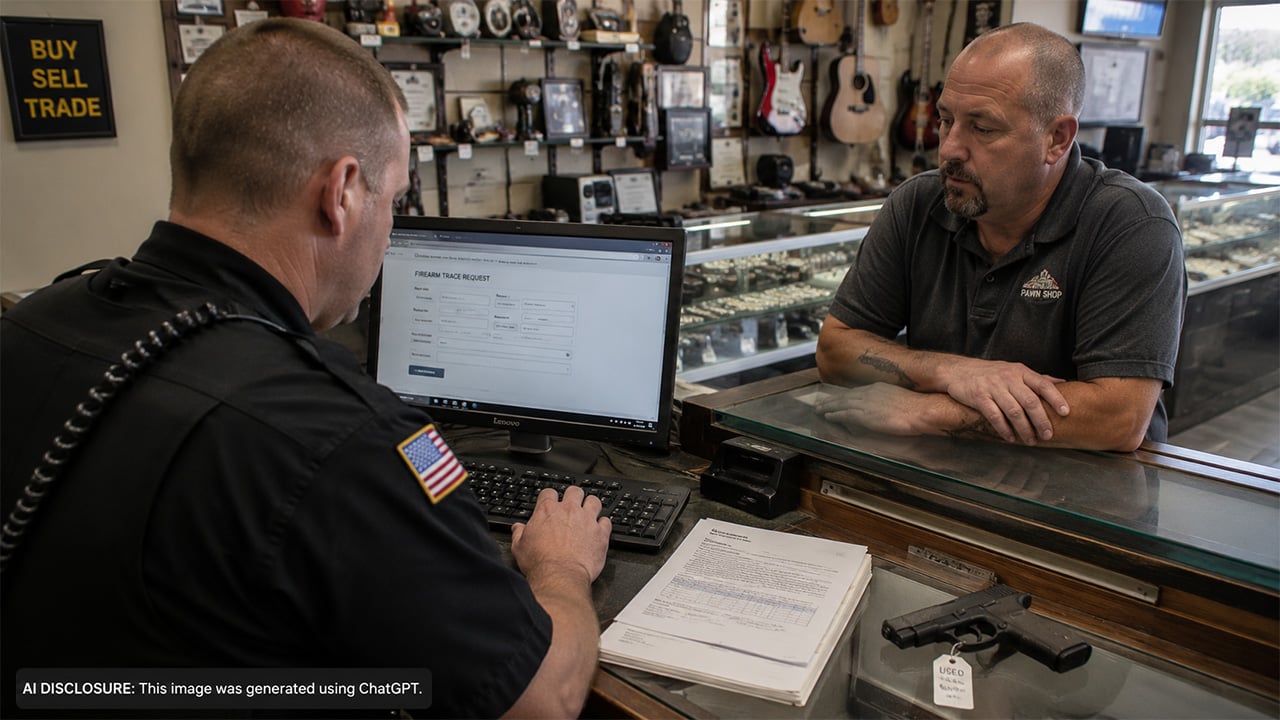
According to court documents referenced in the report, the ball started rolling when a Lake County, Indiana, sheriff’s police commander received a firearm trace request on a gun connected to an upcoming trial. That’s a pretty normal administrative step in a lot of cases—until the response points somewhere it shouldn’t.
The trace reportedly showed the firearm, a Taurus G3, had been sold to a pawn shop in Hobart, Indiana. A Lake County sheriff’s detective described that as unusual, because this particular gun was supposed to be held as evidence in a criminal investigation.
Why an evidence gun at a pawn shop is a big deal
For gun owners, “chain of custody” can sound like courthouse jargon, but it’s simple in practice: when a firearm is evidence, the case depends on showing it was handled, stored, and transferred in a documented, accountable way. If that chain breaks, you’re not just talking about sloppy paperwork—you’re talking about whether a trial can be trusted to be fair, whether victims get justice, and whether innocent people get a clean defense.
It’s also a public-safety issue. An evidence gun is often connected to a violent incident, and it may be critical to ballistics work, fingerprint work, or just proving what happened. If it wanders into private hands through a pawn counter, it can create risk for the buyer, the shop, and the public—especially if that gun later gets flagged.
The allegations point back at the town’s chief
Investigators later determined it was Chief Earl Mayo who allegedly sold the Taurus G3 to Mega Cash Pawn in Hobart, court documents said. The report also states Mayo was the arresting officer in the case the gun was associated with, which makes the alleged conduct even more serious—because it suggests direct access and responsibility.
Charging documents cited in the story say Mayo was charged with theft, official misconduct, attempted obstruction of justice, and unlawful possession of an anabolic steroid. He was booked Sunday in Clark County, Ohio, after authorities said he tried to evade arrest.
The attempt to “buy it back” and collect other guns
One detail in the court documents that reads like something out of a bad movie: another New Chicago officer told detectives he got a call from Mayo asking him to go to the pawn shop and buy the gun back. That’s not just awkward—that’s the kind of move that makes investigators dig harder, because it looks like someone realized the walls were closing in.
The same officer also told investigators that Mayo asked him to go to the chief’s home and retrieve other guns. Specifically, Mayo allegedly wanted suppressors or suppressed firearms pulled from a safe. The officer said Mayo claimed he had things in his home the “feds” would never find, according to the court documents.
A second person charged and the steroid allegations
The case didn’t stop with the chief. Another person, Taneka Borders, was also charged. Investigators said when a Lake County Sheriff’s commander went to Mayo’s Merrillville, Indiana, home, Borders was at the front door.
According to the court documents summarized in the report, Borders allegedly tried to destroy several glass vials. When questioned, she allegedly admitted Mayo told her to go to his home and collect his testosterone and steroids. The charging document against Borders accuses her of trying to help Mayo obtain a gun.
The pawn shop manager told investigators, per the report, that a woman came in trying to buy back the Taurus G3 from its new owner while wearing a tracksuit like the one Borders was wearing when questioned. The manager did not identify her.
The pawn shop angle gun owners should pay attention to
This part matters for regular folks who buy and sell firearms the right way. The pawn shop manager reportedly said he had purchased multiple guns from Mayo in the past, and documents listed Mayo as the seller of 12 guns to the shop.
Most reputable pawn shops and FFLs try hard to stay clean—bound books, ID checks, forms, waiting periods where applicable, the whole routine. But even when a shop is doing everything by the book, it can still get burned if someone in authority position brings in a firearm that has no business being sold. A working guy behind a counter can’t always see what’s in an evidence room, and he shouldn’t be expected to read minds.
If you’re the kind of outdoorsman who picks up a used shotgun or a budget carry pistol from time to time, this is your reminder to keep your paperwork squared away and your purchase records organized. If a gun you bought legally ever gets wrapped into an investigation due to a prior link, clean documentation can save you a pile of headache.
A family statement and an odd side note
Chief Mayo’s father, Jerry Williams—identified in the report as the Democratic nominee for Lake County sheriff—released a statement saying the family was deeply concerned by the allegations. The statement emphasized that Earl Mayo is presumed innocent unless and until proven otherwise, and that if the alleged conduct is established, he should accept responsibility and face consequences.
CBS News Chicago also noted Mayo wrote a self-published book titled “When Lines Are Crossed: Love, Trust, Betrayal,” described as a story about a bad cop turned good battling his morals. In a situation like this, that detail doesn’t change the facts, but it’s hard not to notice when real life starts to echo someone’s fiction.
If you’re a hunter, a landowner, or a concealed carrier, you don’t have to be a cop to understand what’s at stake here. Evidence control is part of how communities keep trust—trust that the right person gets charged, that the wrong person gets cleared, and that the system isn’t being gamed. When the allegations point at the very top of a small department, it doesn’t just create a scandal. It shakes the confidence of everybody who expects the rules to be the same for all of us.
Like The Avid Outdoorsman’s content? Subscribe to our newsletter so you never miss an article.
Here’s more from us: