Photo credit: AI-generated image created using ChatGPT. Illustrative only
Most folks who buy and sell boats privately in Florida think the hard part is the cash, the test run, and getting the trailer lights to work. Turns out the paperwork can bite you a lot harder than a busted hub on the shoulder.
In the original post, a Florida boat owner said he sold his boat and trailer about six months ago for $11,000 cash. He signed over the Florida titles for both, handed the buyer the paperwork, and watched him drive off. No bill of sale. No copies of the signed titles. Just a handshake-style deal that now has him worried he’s still the one on the hook.
A clean sale on the driveway turned into a lingering liability
The seller said the buyer never transferred the titles. At first, the buyer offered excuses. Then he stopped responding altogether. And when the seller checked into it, it looked like he was still listed as the registered owner.
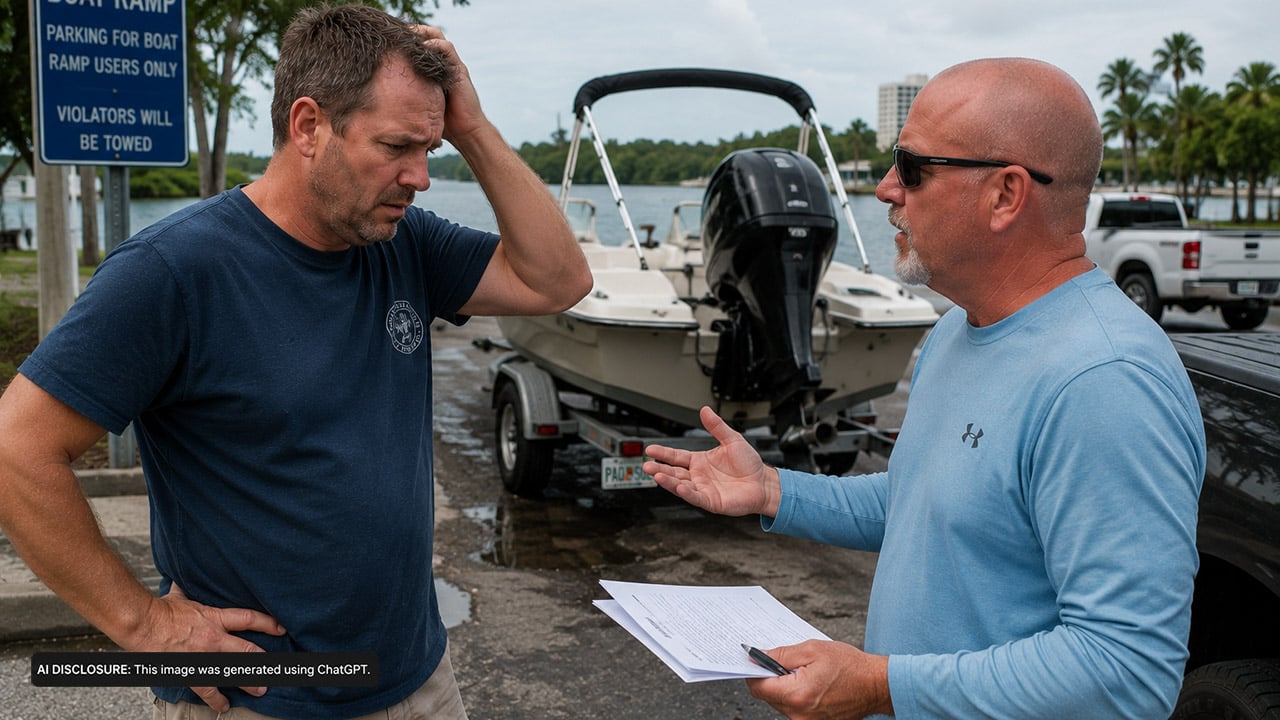
That’s when the “simple transaction” stops feeling simple. Boats and trailers don’t just sit quietly in a garage forever. They get towed. They get parked at ramps. They get left in storage lots. They get in wrecks. And if the paperwork still points back to you, the knock on the door might too.
Why no bill of sale is a problem, even if you signed the title
A lot of outdoorsmen treat a title like it’s the whole deal: sign it, hand it over, done. But when you don’t keep any proof—no bill of sale, no photo of the signed title, no copy of the buyer’s ID—you’re depending on the buyer to finish the job. If he doesn’t, you’ve got a gap in your own records you can’t easily fill later.
The seller in this situation said he may have a bank record showing a cash deposit. That might help establish a timeline, but it doesn’t prove what the cash was for, who handed it over, or what specific hull and trailer were sold. In the real world, a paper trail matters because it gives you something solid to point to when an agency, a tow yard, or an insurance company starts asking questions.
What can go wrong if your name stays on the registration
The seller said he hasn’t received tickets or legal issues yet, but he’s worried about what could happen. That’s the right concern. Boats and trailers have a way of creating problems when they’re neglected—especially in a state with heavy boating traffic and a lot of public ramps.
If a trailer gets abandoned on the side of the road, gets impounded, or racks up storage fees, the “registered owner” is often the first person agencies look for. If the boat gets tied to violations on the water—like registration issues, ramp citations, or being left somewhere it shouldn’t be—the easiest name to chase is the one still attached to the record. Even if you’re not ultimately responsible, dealing with the mess can cost time, phone calls, and sometimes money.
The seller’s main question: how do you report a sale after the fact?
His questions were the ones any practical person would ask once the stomach drop hits: How do I protect myself now? Can I report the sale to the Florida DMV and get my name off it without a bill of sale? Do I need to notify the Florida Fish and Wildlife Commission (FWC) about the boat title? Am I totally exposed without documentation?
Those are fair questions, because boat ownership is a mix of agencies and paperwork. There’s the title and registration side, and then there’s the on-the-water enforcement side. When the buyer disappears, you’re trying to figure out who to call first—and what you can prove when you call.
What most people focused on: document, notify, and stop waiting on the buyer
Even without seeing a stack of comments, the practical theme in situations like this is always the same: stop relying on the buyer to “do the right thing” and start building your own record. The longer you wait, the more time there is for the boat or trailer to get into a situation that circles back to you.
The seller already knows the core mistake: no bill of sale and no copies of the signed titles. The best move now is usually to start creating documentation from this point forward—written communication attempts, any proof of the date of sale, and any identifying details tied to that boat and trailer. It’s not as good as doing it right on the front end, but it’s better than nothing if the situation ever becomes a dispute.
A hard-earned lesson for private boat sales in Florida
This is the kind of thing that happens when you sell to someone who seems normal at the ramp or in a parking lot, pays cash, and acts like he’s on his way to register it tomorrow. Six months later, you’re staring at the possibility that the boat you don’t own anymore could still cause you trouble.
If there’s a takeaway for the rest of us, it’s simple: treat a private boat sale like you’d treat a firearm transfer or a land lease—paper it up and keep copies. A bill of sale, photos of signed documents, and basic buyer information aren’t “being difficult.” They’re what keep a clean day on the driveway from turning into a long-term liability you can’t shake.
Like The Avid Outdoorsman’s content? Be sure to follow us.
Here’s more from us: