Photo credit: AI-generated image created using ChatGPT. Illustrative only
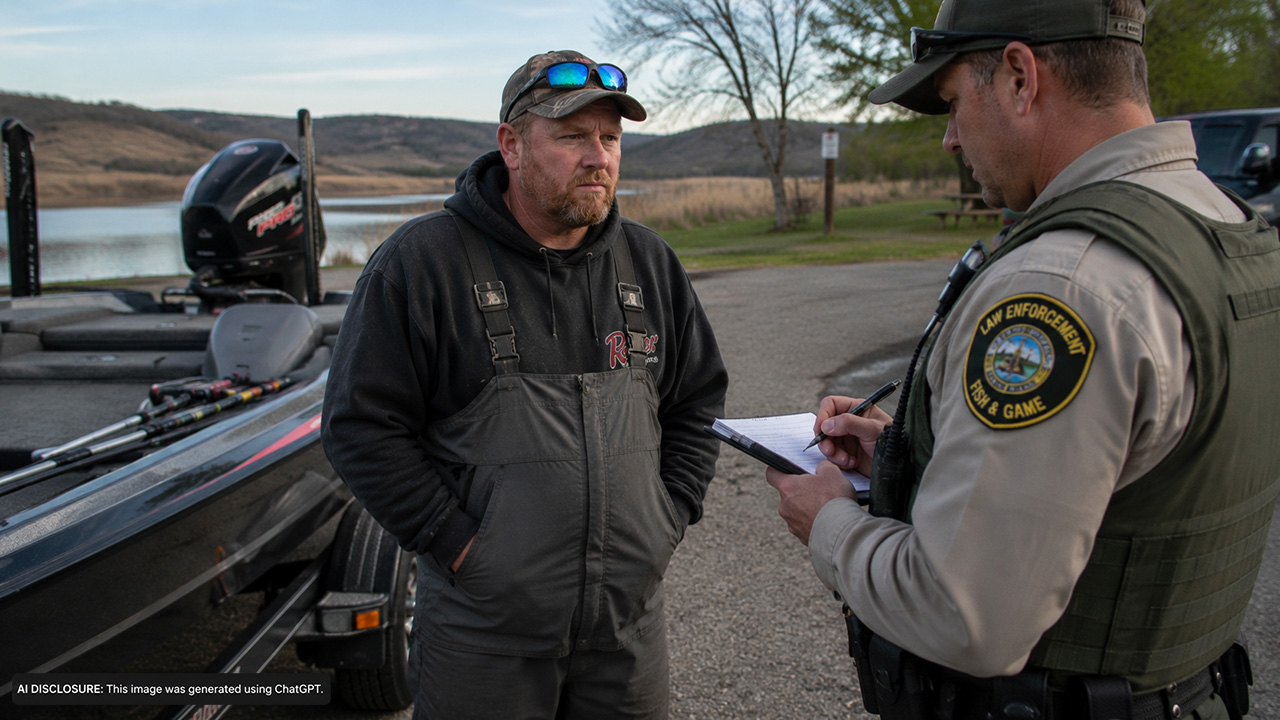
One of the quickest ways a relaxing day on the water can turn into a headache is a simple oversight: forgetting to buy the fishing license. That’s exactly what happened to an angler who was fishing in Missouri, got checked by an officer, and realized too late he hadn’t purchased the proper permit.
He didn’t argue, didn’t posture, and didn’t try to make excuses in the moment. He admitted he messed up. But once the ticket was in hand and the total cost came into focus, a new worry kicked in—whether paying it off would follow him around like a criminal charge instead of a simple outdoorsman’s mistake.
A routine license check turned into a nonresident citation
The angler explained that he’s technically a resident of Arizona, but he was fishing in Missouri when an officer approached and asked for his license. He didn’t have one, because he’d forgotten to buy it. Since he wasn’t a Missouri resident, the ticket was written as a nonresident violation.
That distinction matters for cost and sometimes for how the state treats the violation. Nonresident licenses are typically more expensive to begin with, and when enforcement is involved, “it’s just a fishing license” can turn into “it’s a citation in a court file” quicker than most folks expect.
The price tag wasn’t just the fine
The numbers he listed are what made him stop and think. He was fined $149.50, and then hit with $97.50 in court fees, for a total of $247. That’s not the kind of money most people want to throw away over a forgotten purchase.
Those court costs are what surprise a lot of anglers. People assume they’re paying a set fine like a parking ticket. But when the system routes it through a court process, fees can stack on top of the actual penalty, even when the underlying issue is straightforward.
The real concern: does this become a “record” problem?
What really had him nervous wasn’t only the $247—it was what comes after. He asked whether he should go to court, apologize to the judge, and hope to get it reduced. He also wondered if buying the license afterward and bringing proof would help his situation.
Underneath that question is something many outdoorsmen don’t think about until it’s too late: some states can treat certain fish-and-game violations more seriously than people assume. Depending on how the state writes the law and how the citation is filed, it may be handled more like a criminal misdemeanor than a simple payable civil ticket. And when you’re dealing with court fees and an assigned court process, it’s fair to ask what lands on your record if you just mail a check and move on.
He laid out his options plainly in the original post: show up and try to make it right face-to-face, or pay the fine and be done with it. He also made it clear he understood it was his fault and wasn’t trying to dodge responsibility—he just didn’t want an honest mistake to create bigger problems later.
Showing up in court: sometimes it helps, sometimes it doesn’t
A lot of folks raised on the idea of “own it and talk to the judge” lean toward showing up. And sometimes, that approach can help—especially if the court has discretion, if you’re polite, and if you’re not a repeat offender. Judges and prosecutors are human. They’ve seen every flavor of excuse, and they notice the difference between someone who got careless and someone who thinks rules don’t apply to them.
But it’s not a guarantee. Some courts have set fines, set fees, and set outcomes. In those cases, you can stand there hat in hand and still walk out owing the same amount, because the court isn’t really in the business of negotiating—just processing. That’s why the “should I appear” question often comes down to risk management: are you trying to reduce the financial hit, or are you trying to protect yourself from a lasting record issue?
Buying the license after the fact can still be worth doing, even if it doesn’t erase the violation. It shows you corrected the problem and intend to comply going forward. Whether it changes the outcome depends on the court, the conservation rules involved, and how the case is set up.
Paying and moving on feels simple—until you realize what you’re admitting
Here’s the part a lot of anglers miss: paying certain tickets can be treated as a guilty plea. In plain English, sending in the money may close the case, but it can also lock in the violation the same way as if you stood in court and pled guilty.
That matters when you’re worried about background checks for jobs, professional licensing, security clearances, or even just not wanting to answer “yes” on forms that ask about misdemeanor convictions. Not every fishing-without-a-license ticket becomes that kind of problem, but some states do attach criminal penalties to wildlife violations. When someone sees “court fees” on top of the fine, it’s a sign the matter may be routed through a criminal-style court docket rather than a simple administrative fee.
In other words: paying it might be the easiest path, but easy doesn’t always mean “clean.” If a violation is categorized as criminal in that state, the long-term cost can be more than $247.
What outdoorsmen can learn from this before the warden shows up
This whole mess started with something that’s preventable. Licenses lapse. People travel. Phone apps glitch. It happens. The fix is building a simple habit: before you leave the house (or the campsite), confirm your license is valid for that state, that water, and that date—and that you can actually show it if asked.
If you’re crossing state lines, treat it like packing a life jacket or checking your trailer lights. Nonresident rules are their own animal, and “I’m a resident somewhere else” doesn’t help you when you’re standing on a Missouri bank without the right paperwork.
And if you do get cited, it’s worth slowing down long enough to understand how your state treats the charge. A “ticket” isn’t always just a ticket. Sometimes it’s a court case in miniature, with fees, consequences, and a paper trail that lasts longer than the memory of that afternoon bite.
The angler in this situation did the one thing that always helps: he kept it respectful with the officer and owned the mistake. From there, the smart play is making sure the fix doesn’t create a bigger problem—because in some places, a forgotten fishing license can carry more weight than most people think until they’re staring at that court total and wondering what it means for their record.
Like The Avid Outdoorsman’s content? Subscribe to our newsletter so you never miss an article.
Here’s more from us: