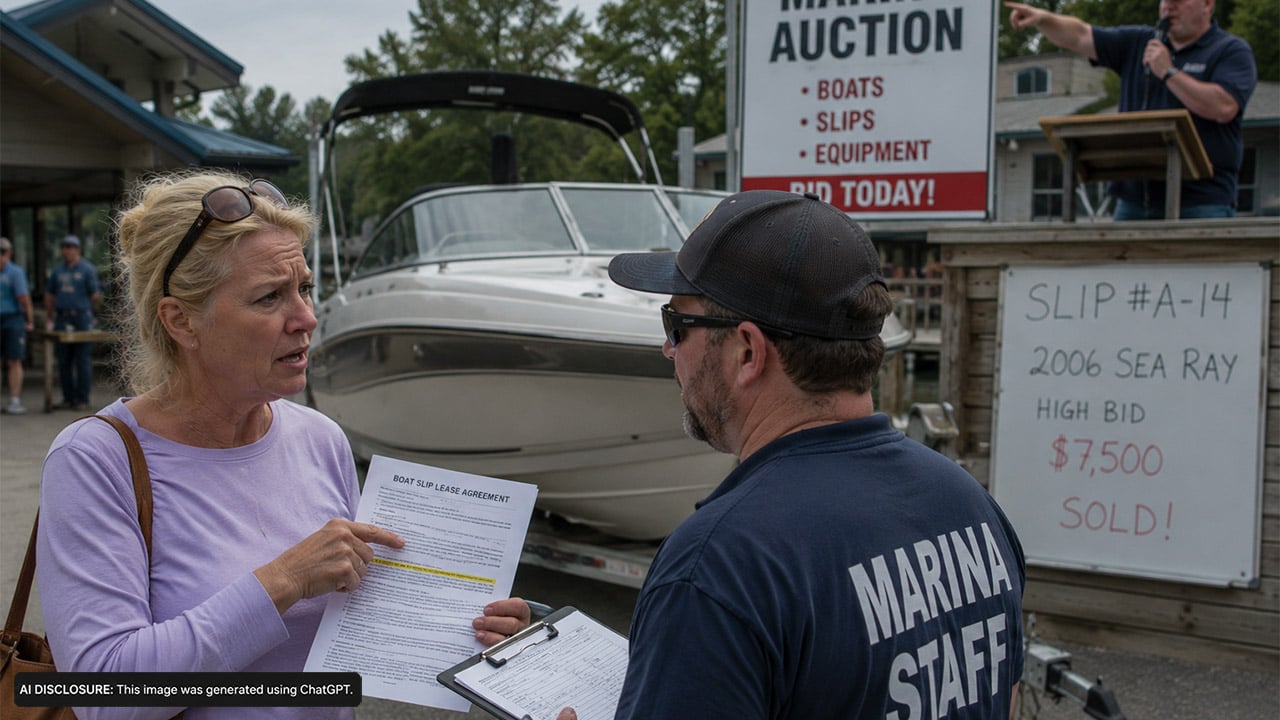
Photo credit: AI-generated image created using ChatGPT. Illustrative only
There’s a particular kind of punch-in-the-gut that comes with losing a spouse and then getting hit with paperwork that feels like it was written to trap you. That’s the situation a Georgia widow described when she said a marina took her boat off her private dock and sold it at a public auction after a single missed payment.
In the original post, she explained that her “lease is for a lake lot” inside a marina, but the underlying property is owned by the U.S. Army Corps of Engineers. After her husband died, she missed one month, and she says the marina—acting as landlord—removed her boat and held it for auction. What really bothered her wasn’t just the speed of it; it was the lease language the marina relied on: “bailment for hire.”
A lake-lot lease that doesn’t feel like a normal lease
If you’ve ever rented a slip, leased a dock, or paid for a little piece of access on a reservoir, you know these agreements can be their own animal. You’re not buying land. You’re paying for the privilege to keep a boat there, use a dock, park a trailer, and have a spot to launch from.
According to the widow, the document is a one-year lease for a “lake lot” in a marina. The twist is the ownership chain: the marina runs the show, but the Corps of Engineers owns the property. That matters because Corps-managed lakes often come with special rules about what’s allowed, who can occupy space, and how those agreements get enforced.
The day the boat disappeared from her dock
From an outdoorsman’s perspective, the boat isn’t just a toy—it’s access. It’s how you get to your fishing spots, how you run trotlines, how you check on family, how you spend your off days. So when a marina reaches down and takes a boat off what the owner sees as “my private dock,” it’s not a small thing.
She said the marina took the boat and held a public auction after one missed payment during the period when she was dealing with her husband’s death. That timeline is what makes this feel especially cold. One month is a short window for anything involving probate, estate accounts, frozen funds, or just the plain fog that follows a funeral.
The clause she can’t get past: “bailment for hire”
The heart of her question was whether this was truly a real property lease or something else entirely. She pointed to a clause using “bailment for hire,” and she believed that concept applies to personal property—not land. In plain English, bailment is when you hand your property over to someone else for a limited purpose, with the expectation it will be returned. Think of leaving a boat with a repair shop, or dropping a rifle off with a gunsmith, or parking a camper in paid storage.
Her confusion makes sense. If you sign a land-style lease, you expect land-style remedies when you’re late—late fees, termination, eviction-type procedures. But if you sign something that treats your boat like stored personal property under a bailment theory, the operator may claim broader power to take possession quickly when payments stop.
That’s the “loophole” she’s trying to figure out: did she unknowingly sign a contract that let the marina treat her boat like collateral or abandoned property after a short delinquency, even though the agreement is framed as a lease for a lot?
Corps property, marina control, and the eviction question
She also mentioned a key detail: “Corp. policy states owners of trailers can be evicted using the real estate laws.” That’s an interesting comparison because it suggests the Corps, at least in some scenarios, expects something closer to a real-property process when someone has a trailer on the lot.
Out on these lakes, you’ll see everything from fishing rigs to pontoons to campers that barely move all season. The rules for removing a boat from a dock, removing a trailer from a lot, or terminating a user’s access aren’t always the same—even if they’re all happening in the same marina footprint.
Her point was basically this: if Corps policy treats trailers like something that requires real estate-style eviction procedures, why would a boat be different? Why would a one-month late payment lead straight to seizure and auction instead of termination and removal with notice?
What people tend to focus on in situations like this
When outdoors folks talk about marina disputes, they usually zero in on a few practical questions fast. What exactly did the contract say you were signing? What did it say about default, notice, repossession, and “abandoned property”? And what did it say about liens, storage fees, and the marina’s right to take possession?
The widow’s post shows why reading every clause matters, even the ones that look like legal filler. “Bailment for hire” isn’t a normal phrase you see on a simple cabin lease or a pasture lease. It’s the kind of term that can be used to reframe the entire relationship: instead of “you rent land from us,” it can become “you store your property with us under our rules.”
Another thing people watch closely is process. Auctioning someone’s boat is a big step. Even when a business claims it can do it, there are often requirements about notice, timelines, and accounting. If any of those steps were skipped, that’s where disputes tend to live.
The real-world lesson for boat owners who lease slips or lots
Most of us are willing to pay what we owe. The trouble is life happens—death in the family, medical bills, job changes—and marinas aren’t known for being sentimental. If your access to the water depends on a contract, that contract is the boss when things go sideways.
The practical takeaway is to treat marina paperwork like you’d treat a land lease and a storage contract at the same time. Look for language about “bailment,” “warehouseman,” “storage,” “lien,” “default,” “abandonment,” and “right to sell.” If you see it, don’t assume it’s harmless boilerplate. It may be the clause they use if you’re even briefly behind.
And if you’re dealing with a major life event—especially the death of the person who handled the bills—get eyes on those due dates fast. A single missed payment shouldn’t cost someone a boat, but the widow’s experience shows how quickly a business can move when a contract gives them room to do it.
Like The Avid Outdoorsman’s content? Be sure to follow us.
Here’s more from us: