Photo credit: AI-generated image created using ChatGPT. Illustrative only
You don’t have to be a forester to know when something’s wrong. When a line of mature trees suddenly turns into a fresh-cut opening overnight, that’s not “cleanup.” That’s somebody making a decision on land that isn’t theirs.
In a Colorado case shared in the original post, a family woke up to find roughly 50 trees on their property cut down in the middle of the night. And whoever did it didn’t just cut and leave—they tried to cover it up.
A nighttime cut that didn’t look like storm damage
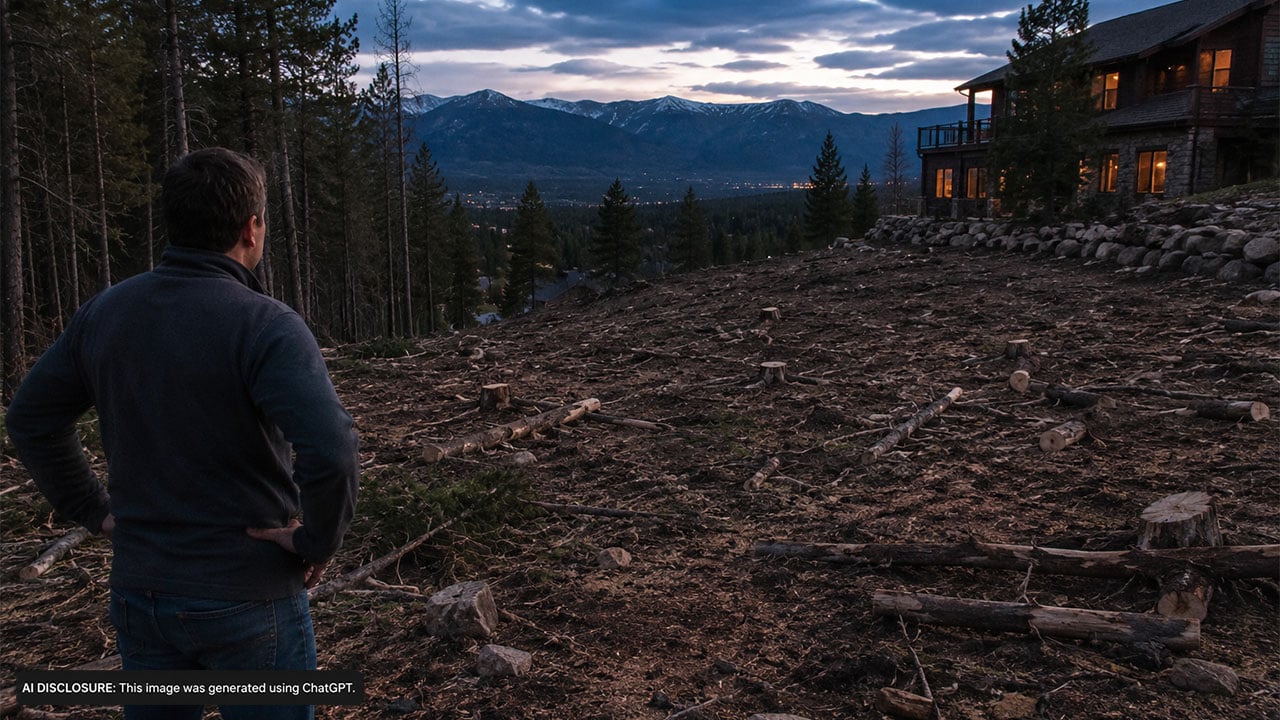
The description is the kind of thing that makes your stomach drop if you’ve ever managed acreage. Some smaller trees—about 6 to 8 feet tall—had only the top half cut off. But the older timber, trees said to be 60-plus years old, were dropped completely.
That mix matters. It sounds less like random vandalism and more like someone “shaping” a view corridor—topping what they could and removing what blocked the sightline.
The cover-up attempt made it feel intentional
What really separates this from a simple trespass is the effort to hide it. The family said branches and rocks were placed over stumps, and some felled trees were leaned up against others to make it look like they were still standing.
That’s not the behavior of somebody who thinks they’re allowed to be there. That’s somebody trying to buy time—hoping you won’t notice until they’ve enjoyed that new view long enough to argue about it later.
The “new view” pointed to a likely suspect
The family said it was “quite obvious” which neighbor likely did it because the only trees cut down formed an alley directly in front of one specific home. Where that neighbor used to look into trees, they now reportedly had a clear view of the mountains and a lake.
Anybody who’s lived in the timber knows how precise a view cut can be. When the opening lines up with one set of windows and one deck, that’s not an accident. But “obvious” and “provable” are two different things, and that’s where these situations get frustrating.
Privacy and safety took a hit, not just the property value
This wasn’t just landscaping. The trees reportedly served as a noise and privacy barrier between neighbors and also between the property and a semi-major road and bike path.
If you’re a landowner who hunts, shoots, or just values quiet, that kind of screen matters. A tree line controls sightlines, sound, and access. When it disappears overnight, it can change how people move around the edge of your place—and how exposed you feel on your own ground.
The first steps were the right ones: photos, sheriff, arborist
With no clear proof in hand, the family focused on the basics: document the scene with photos, report the damage to the sheriff, and contact an arborist to figure out what it would cost to replace the trees.
That’s the practical order of operations for rural problems like this. Before you get emotional or confront anybody, you lock down what happened, what it cost, and what it will take to fix. Trees aren’t like a broken fence board—you don’t just run to the hardware store and make it whole again.
Law enforcement sounded limited, which is common in timber trespass cases
According to the account, the sheriff told them there wasn’t much he could do and that it was only a misdemeanor property crime. That’s a tough pill to swallow when you’re looking at decades of growth lying on the ground.
It’s also a reality a lot of landowners run into: unless there’s a witness, a confession, or clean evidence, criminal enforcement can stall out fast. That doesn’t mean the loss is small—it means the case may lean more on documentation and the money side of things than most folks expect.
The HOA angle added another layer of mess
The neighbors they suspected lived in a shared outdoor space maintained by an HOA, and the family wasn’t sure if that changed anything. HOA-managed common areas can muddy the water, especially when property lines, easements, and “who maintains what” aren’t crystal clear.
But the key detail in the account is that the trees were on the parents’ property. If that’s correct, “shared space” nearby doesn’t give anyone permission to cross a line and start cutting—especially not at night, and especially not with a cover-up afterward.
What a landowner can do next when they can’t prove the cutter
The family’s big question was simple: what’s the next step to recoup the loss if they can’t prove who did it?
They were already moving in the right direction with an arborist visit to establish value. In cases like this, that kind of professional assessment is often what gives your next phone calls teeth—whether that means pushing for a more complete report, making an insurance claim if applicable, or building a paper trail that can stand up when the neighbor denies everything.
And from a practical landowner standpoint, it’s also the moment to start thinking about preventing a repeat. If somebody will slip in once with a saw and try to hide stumps, you shouldn’t assume it stops with one “view improvement.”
A grounded reminder for rural folks: don’t handle it in the driveway
When you know—or strongly suspect—who did it, the temptation is to walk over and let them have it. But situations like this are where good judgment matters more than pride.
Get the documentation first. Get the professional estimates. Keep the conversation with authorities and the HOA businesslike. A nighttime trespass paired with property destruction is already a bad mix, and nobody needs it turning into a face-to-face blowup on a shared fence line.
For landowners, the hard truth is that trees take a lifetime to grow and a few minutes to cut. When someone steals your privacy and your timber to improve their own view, the only real leverage you have is the quality of your documentation and how steady you stay while you push the right channels.
Like The Avid Outdoorsman’s content? Be sure to follow us.
Here’s more from us: