Photo credit: AI-generated image created using ChatGPT. Illustrative only
Out in the country, you learn pretty quick that good fences and good neighbors aren’t just sayings—they’re how you keep peace and keep animals alive. But when a loose dog starts treating your pens like a buffet, the whole “let’s be neighborly” approach gets tested in a hurry.
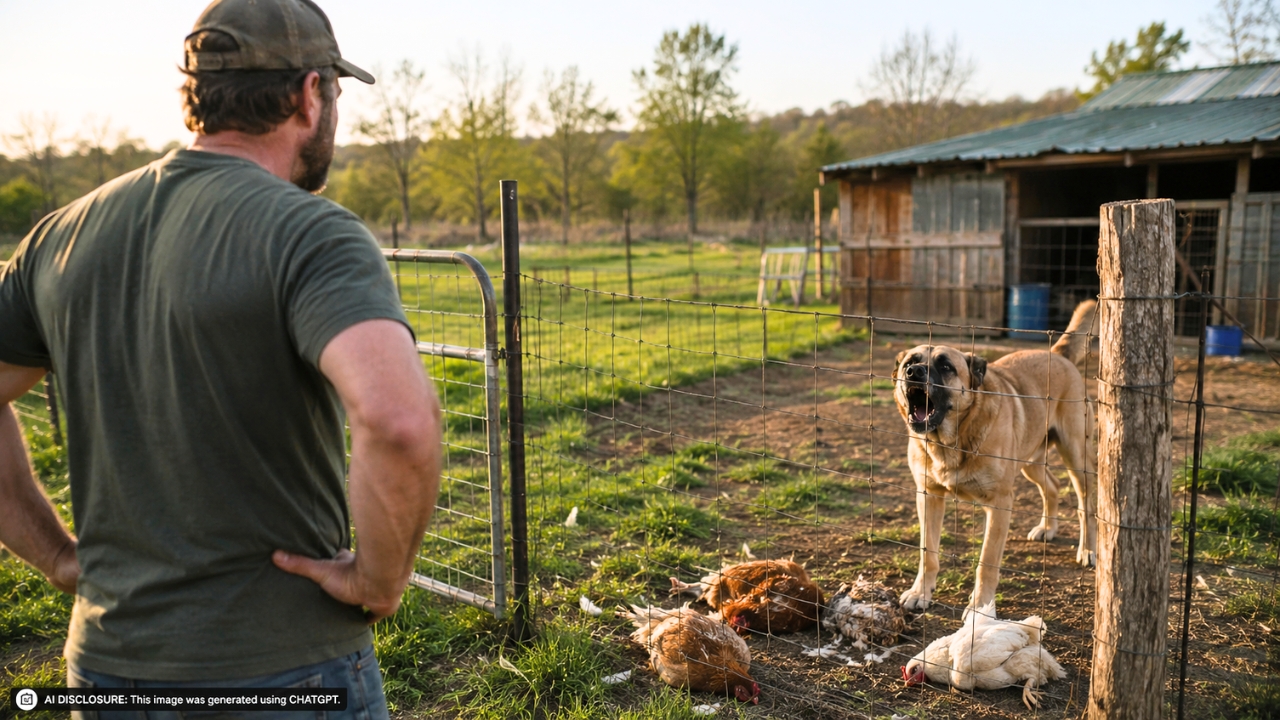
That’s exactly where one homesteader says they’re at after a neighbor’s dog killed more than $700 worth of livestock. In the original post, the owner didn’t sound eager to escalate, but they were blunt about where their head is: they don’t want bad blood, yet they’re not sure what to do besides shooting the dog on sight.
When a “dog problem” becomes a livestock problem
There’s a big difference between a dog that wanders and a dog that kills. Once you’ve got dead animals, it’s not about nuisance anymore—it’s about loss, time, and the fact that most livestock don’t die quick or clean when they’re chased and mauled.
The dollar figure matters, too. “Over $700” might sound like a simple bill to someone who’s never kept animals, but most folks who’ve raised livestock know that number can represent months of feed, breeding plans, egg production, meat for the freezer, or the kind of small-margin operation where every loss hurts.
The neighbor part is what makes it messy
If a stray dog comes in off the road, you handle it one way. When it’s tied to the guy you wave at while checking the mailbox, you’re suddenly balancing two things at once: protecting what’s yours and not turning your property line into a cold war.
The homesteader’s post is short, but you can hear the tension between those two realities. They’re not pitching it like they want to be the tough guy. They’re pitching it like someone who’s fed up, tired of seeing damage, and staring down the possibility that the next attack is going to happen again—maybe tonight.
Why “shoot on sight” enters the conversation so fast
People who don’t live around livestock sometimes act like shooting a dog is an outrageous thought that comes out of nowhere. In reality, it often shows up at the end of a long rope: repeated problems, animals getting killed, and a sense that the situation is sliding out of your control.
There’s also a safety angle that’s hard to ignore. A dog that will push into pens and kill animals isn’t operating on “oops, I got loose” rules. It’s in predatory mode. That can mean the dog is hard to call off, hard to catch, and more likely to come back once it learns your place is easy pickings.
None of that automatically makes shooting the right move. But it explains why a livestock owner can get there mentally—especially after the losses aren’t hypothetical anymore.
Practical steps that usually matter before it turns into a shooting situation
The post didn’t lay out what’s already been tried, but most experienced rural folks will tell you the same thing: you want to handle this like a grown-up first, and you want your ducks in a row if it gets ugly.
That starts with direct communication. Not a vague hint at the fence line—an actual conversation: “Your dog killed my livestock. This is the damage. It has to stop now.” Sometimes the neighbor honestly doesn’t know what the dog is doing when it’s out of sight. Other times they know and they’ve been hoping you won’t make it their problem.
After that, physical prevention is the next layer. Tighten up fencing where you can, fix holes, and think about how a dog is getting in—under, through, or over. If you can pen vulnerable animals closer to the house or into a more secure enclosure at night, that can buy time while you sort the neighbor side out.
And if you’ve never dealt with a killing dog before, here’s a hard truth: once a dog has done it and gotten away with it, it’s more likely to do it again. Hoping it “learns” without consequences is a gamble—paid for with your animals.
Documentation protects you, not your pride
When folks talk about “not wanting bad blood,” what they often mean is they don’t want a shouting match, a deputy at the driveway, or a long-term feud. The fastest way to stumble into all three is to act without documentation and let the story become a he-said/she-said.
Even simple notes matter: dates, what was killed, approximate value, where it happened, and any contact you’ve had with the neighbor. Photos of damage and carcasses can be unpleasant, but they’re also reality. If you’ve got cameras already, this is the moment to make sure they’re actually covering the right gates and pens.
This isn’t about “building a case” to be dramatic. It’s about having something solid if you end up needing to involve animal control, a sheriff’s office, or another local authority that handles roaming dog complaints and livestock losses. It also keeps you honest about the timeline and the total damages.
The hard part: protecting livestock without creating a bigger problem
Most rural people understand that you can’t let a predator—wild or domestic—keep killing on your property. But they also understand that a bullet isn’t a rewind button. If you shoot a neighbor’s dog, you’d better be prepared for the personal fallout, and you’d better be square with the law where you live.
That’s why the smart play is usually to slow down just enough to think through consequences. Know your local rules. Some places treat livestock protection very differently than others, and the details matter—where the dog is, what it’s doing at the moment, and whether there’s an immediate threat.
At the same time, “do nothing” isn’t neutral. Doing nothing means accepting more dead animals, more money lost, and more stress every time you step outside and hear commotion in the pen. That’s not fair to the livestock owner, and it’s not good stewardship.
The homesteader asked for suggestions, and that’s the right move. The best outcomes in these situations usually come from a firm conversation, tighter containment (on both properties), and a clear paper trail. But if none of that happens and the dog keeps killing, the situation tends to force a decision—whether anyone wants it to or not.
In the country, peace is earned with respect and responsibility. If a dog owner won’t control their animal, they’re not just being careless—they’re pushing their neighbor toward a breaking point where every option feels bad, and some of them can change a neighborhood forever.